
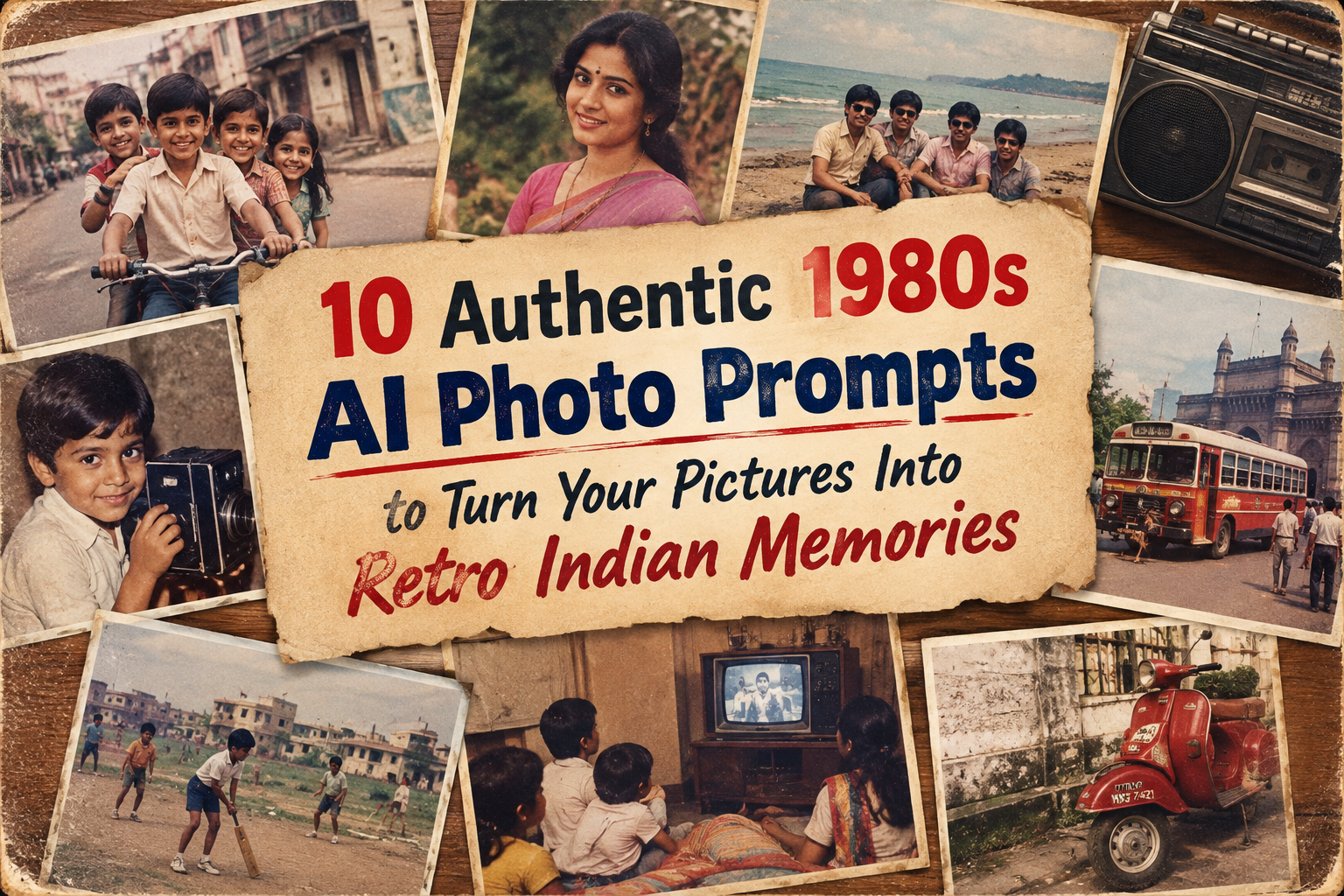
The 1980s are having a major comeback in AI image generation. People are taking ordinary modern photographs and transforming them into images that look as though they were captured decades ago, complete with vintage clothing, period hairstyles, analogue film grain, old cars, dramatic lighting and nostalgic Indian settings.
The trend is especially interesting because it goes beyond simply applying a vintage filter. A good 1980s AI photo prompt can change the clothing, hairstyle, surroundings, camera treatment and atmosphere while keeping the person recognizable.
Recent coverage of the trend shows that users are particularly interested in retro Bollywood portraits, Indian street scenes, family photographs, wedding-style portraits and cinematic 1980s looks. Detailed prompts tend to produce more convincing results because they tell the image model exactly what should change and what should remain recognizable.
If you want to recreate this aesthetic yourself, the following prompts give you different directions to try.
What Makes an AI Generated 1980s Photo Look Real?
A convincing retro image needs more than 1980s clothing.
The photographic treatment matters just as much. Modern digital images tend to look extremely clean, sharp and evenly exposed. Older film photographs often have softer details, visible grain, slightly faded colors, imperfect exposure and a distinctive analogue character.
That is why useful prompts often mention details such as 35mm film, subtle grain, soft flash, warm colors, faded texture, natural skin texture and realistic shadows.
The environment matters too. A vintage car, old building, period storefront, traditional Indian clothing or an old street can immediately establish the decade.
Most importantly, if you are transforming your own photograph, tell the AI to preserve your identity. Recent guides on the trend similarly recommend specifying the face, skin tone, facial structure and recognizable features rather than simply asking for a generic retro transformation.
Prompt 1: Three-Frame 1980s Bombay Street Style
This concept is ideal if you want a fashion-focused image with the atmosphere of old Bombay.
The combination of vintage cars, bold collars, cinematic shadows and period styling can create something that feels more like a still from an old Indian film than a modern portrait.
Prompt:
Three frames, one timeless attitude—straight from the golden streets of 80s Bombay. Bold collars, vintage cars, cinematic shadows, and effortless confidence bring an unforgettable era back to life. When fashion had character and every street felt like a movie, style wasn’t following trends—it was creating them.
This prompt works particularly well for a multi-frame editorial concept. Each frame can show a slightly different pose or composition while maintaining the same period atmosphere.
For a stronger result, use a clear reference photograph and let the image model preserve the person’s recognizable appearance while changing the surroundings and styling.
Prompt 2: Classic 1980s Indian Men’s Fashion
The second concept focuses heavily on clothing, grooming and posture.
It is useful when you want the photograph to communicate the fashion of the decade rather than simply adding a retro color filter.
Prompt:
Visual Elements Breakdown: The Subject: A man with a thick mustache, beard, and a voluminous, styled mullet haircut. He is looking downward and slightly away from the camera. The Outfit: He is dressed in iconic ’80s fashion, featuring a colorful, geometrically patterned button-up shirt with rolled-up sleeves, tucked into high-waisted, light-wash acid-washed jeans.
The details in this prompt are important because they define both the silhouette and the attitude of the final photograph.
The patterned shirt, rolled sleeves, high-waisted jeans, facial hair and voluminous hair all contribute to the period-specific appearance.
If the result looks too modern, add analogue photography instructions such as soft focus, faded film colors and subtle 35mm grain.
Prompt 3: Turn Your Own Photo Into an Authentic 1980s Indian Photograph
This is one of the most useful approaches when the goal is to make yourself look as though you were genuinely photographed during the decade.
Instead of creating an entirely different person, the prompt specifically asks the model to retain recognizable characteristics.
Prompt:
Use the uploaded photo as the identity reference and transform it into a genuine 1980s photograph, while keeping the person’s face highly recognizable and preserving their exact facial features, proportions, skin tone, age, and natural expression. Give them authentic 1980s hair, grooming, clothing, accessories, and styling appropriate to their appearance, with a believable period setting such as an Indian everyday environment.
The phrase about preserving identity is particularly useful when editing an existing photograph.
The goal is not to make the person look like a generic 1980s character. Instead, the surrounding visual language should change while the person remains recognizable.
You can also specify a location such as an old Indian market, railway platform, neighborhood street, school, home or cinema entrance.
Prompt 4: 1990s Indian Cinematic Portrait
Not every retro transformation has to stay strictly inside the 1980s.
If you want a slightly later Indian cinema aesthetic, this prompt moves into the 1990s while maintaining a strong period-photography feel.
Prompt:
Create a realistic 1990s Indian cinematic portrait inspired by this reference: a stylish young woman wearing a purple sleeveless vest over a white blouse with bold purple polka dots, matching scarf headband, statement earrings, voluminous updo, dramatic kajal, defined brows, and glossy pink lipstick. Use warm studio lighting, authentic 90s colors, subtle analog film grain, faded texture, and classic Bollywood photography aesthetic.
This prompt is useful for readers who want to experiment with both decades.
The clothing, makeup, hairstyle and lighting create a recognizable 1990s visual language, while the analogue grain prevents the image from looking like a modern digital fashion photograph.
Prompt 5: 1980s Indian Travel Couple Photograph
Travel photography is another excellent way to recreate the feeling of an old family album.
This prompt is designed around a couple standing together at a scenic mountain location.
Prompt:
1980s prompt
1/9 — 9:16 — Ultra-realistic authentic late-1980s Indian travel photograph of an adult Indian couple standing close together at a scenic mountain viewpoint. Woman: height 5’6”, bust 34”, waist 26”, hips 38”; natural proportional figure. She has voluminous, thick, shoulder-length dark-brown wavy hair, naturally windblown, with soft curls framing her face. She wears vintage gold aviator-style sunglasses, round gold earrings, colorful stacked bangles, and
The travel-photograph concept works particularly well with environmental details.
A mountain road, old hotel, roadside viewpoint, vintage vehicle or distant landscape can make the photograph feel like an actual holiday snapshot from the period.
For the most natural result, prioritize realistic proportions and natural poses instead of making the image look like a fashion advertisement.
Prompt 6: Vintage Kerala Cinema Street Portrait
This prompt combines fashion, a vintage vehicle and a distinctly Indian location.
Prompt:
A stylish young man with curly hair, a thick moustache and light beard, wearing black sunglasses, standing casually and leaning against the front of a vintage cream-colored classic car. He is looking directly toward the camera with a confident, calm expression. One hand rests casually on the car while the other is tucked into his trouser pocket, with one leg crossed over the other in a relaxed pose.
He is wearing a slightly oversized off-white/cream button-down shirt with the top buttons open and sleeves rolled up to the elbows, paired with high-waisted brown vintage trousers, a dark brown leather belt, and polished black formal shoes. A classic wristwatch is visible on his wrist.
The setting is an old-fashioned street to the building entrance in Kerala, India, with Malayalam signage, vintage movie posters on the walls, a parked bicycle, and the classic car in the foreground. The environment has an authentic 1980s/1990s Indian cinema aesthetic.
Warm natural sunlight, muted earthy tones, vintage faded color palette, authentic film grain, subtle dust and scratches, aged photograph texture, nostalgic retro atmosphere, cinematic lighting, realistic shadows, shallow depth of field, slightly low camera angle, full-body composition, highly detailed, ultra-realistic, photorealistic, vintage Indian cinema photography, 35mm film look, editorial portrait photography, natural skin texture, realistic proportions, authentic retro styling.
This is one of the more detailed prompts in the collection because it controls several parts of the scene at once.
The Malayalam signage, vintage posters, bicycle and classic car establish a specific environment rather than leaving the AI to create a generic “old India.”
The camera angle and shallow depth of field then help turn the scene into a cinematic portrait.
Prompt 7: Authentic 1980s Version of Yourself
Sometimes a simple prompt is better when you want the model to make most of the creative decisions.
This version focuses on identity preservation while requesting period styling.
Prompt:
Transform my appearance into an authentic 1980s version of myself while keeping my facial features and identity recognizable. Give me an iconic 80s scarf, vintage clothing, retro accessories, and an authentic 1980s atmosphere. Make it look like a real photograph taken in the 1980s, with vintage film grain, natural lighting, realistic skin texture, and period-accurate colors. Do not change my face or make me look like a different person.
This is a good starting point for beginners.
If the first result is too generic, you can follow it with additional instructions specifying a location, hairstyle, clothing color, camera angle or type of photograph.
For example, you could ask for a school portrait, family album image, street photograph or studio portrait while retaining the same identity.
Prompt 8: Repeatable 1980s Identity Transformation
The eighth prompt uses the same core transformation concept but can be treated as a reusable base prompt.
Prompt:
Transform my appearance into an authentic 1980s version of myself while keeping my facial features and identity recognizable. Give me an iconic 80s scarf, vintage clothing, retro accessories, and an authentic 1980s atmosphere. Make it look like a real photograph taken in the 1980s, with vintage film grain, natural lighting, realistic skin texture, and period-accurate colors. Do not change my face or make me look like a different person.
The advantage of a reusable base prompt is that you can change only one variable at a time.
For example, after generating the first image, you can request a different outfit without changing the person’s face. You can also move the person from an indoor setting to an outdoor Indian street or change the lighting from daylight to evening.
This staged approach can give you more control than trying to describe every possible detail in one enormous prompt. Recent coverage of the trend also recommends building the image in stages when individual elements need tighter control.
Prompt 9: Vintage 1980s Studio Portrait
A studio portrait gives you a completely different interpretation of the decade.
Instead of a busy street or cinematic setting, the focus remains on the person, clothing and analogue photography.
Prompt:
Using the uploaded photo as the identity reference, recreate the person as they might have looked in the 1980s. Keep the facial identity recognizable while giving them an authentic 1980s hairstyle, era-appropriate fashion and styling. Photograph them like a genuine vintage studio portrait with warm analog colors, soft flash lighting, subtle film grain and slightly faded photographic texture. The result should look like a real portrait taken in the 1980s rather than a modern image with a retro filter.
This prompt is especially useful for profile-style portraits.
The instruction to avoid a modern image with a retro filter is important because it pushes the model toward changing the entire photographic treatment rather than simply adding grain and faded colors.
A simple studio backdrop, period clothing and soft flash can make the result resemble an old family or professional portrait.
Prompt 10: Couple’s 1980s Photograph
The final prompt is designed for couples.
Instead of transforming one person, it asks the model to maintain the recognizable appearance of both people while recreating the decade around them.
Prompt:
Using our photo as reference, create a realistic portrait of what we would have looked like in the 1980s. Keep our faces recognizable, but give us authentic 80s hair, outfits and styling. Make it look like a genuine old photograph from that era.
This prompt can be expanded according to the type of image you want.
You could add a vintage Indian wedding setting, mountain holiday, old family home, cinema-style portrait, roadside photograph or classic car scene.
The basic instruction provides the identity foundation, while the additional details determine the story of the photograph.
How to Use 1980s AI Photo Prompts
Using these prompts is relatively straightforward.
Start with a clear photograph where the person’s face is visible. A high-quality reference generally gives the image model more useful information about facial structure and appearance.
Upload the image to your preferred AI image generator.
Then paste one of the prompts and specify whether you want the result to be a portrait, full-body photograph, couple image or wider environmental scene.
The current 1980s AI trend is largely built around this upload-and-prompt workflow, with users using ChatGPT and other image-generation tools to transform ordinary photographs into period-specific images.
After the first generation, do not be afraid to refine it.
You can say:
“Keep the face unchanged but make the hair more authentic to the late 1980s.”
Or:
“Keep the same person and outfit, but change the background to an old Indian street.”
Small follow-up instructions can be easier to control than rewriting the entire prompt.
Why Detailed 1980s Prompts Give Better Results
A basic instruction such as “make my photo look 80s” leaves many decisions to the AI.
It does not specify whether the image should resemble a family photograph, Bollywood publicity portrait, street snapshot or travel picture.
A detailed prompt establishes four important things.
Identity: Who should remain recognizable?
Era: What period should the styling represent?
Scene: Where should the photograph appear to have been taken?
Photography: What should the camera and film treatment look like?
That structure gives the model a clearer visual target.
Recent guides covering the trend make the same distinction: detailed instructions about clothing, hair, lighting, location and photographic characteristics tend to produce a more specific result than a generic retro instruction.
How to Make an AI 1980s Photo Look More Authentic
The difference between a convincing vintage photograph and a modern AI image with a filter often comes down to small details.
Use Period Appropriate Clothing
High-waisted trousers, oversized shirts, patterned clothing, vintage sunglasses, scarves, traditional Indian outfits and statement accessories can establish the decade quickly.
Add the Right Hair and Grooming
Hair volume, moustaches, mullets, side parts and period-specific makeup can dramatically change the perceived era.
Describe the Environment
An old car alone may not be enough.
Add period architecture, signage, bicycles, storefronts, furniture, posters or roads that support the setting.
Mention Analogue Photography
Terms such as subtle 35mm grain, soft flash, faded colors, natural skin texture and slight photographic imperfections can help avoid an overly polished digital appearance.
Avoid Excessive Vintage Effects
Too much grain, scratches or sepia can make the photograph look artificially aged.
The goal is to make it look like a real photograph that happened to be taken decades ago.
1980s Bollywood vs Everyday Indian Retro Photos
There are two major directions you can take with this trend.
A Bollywood-inspired image can use dramatic lighting, expressive poses, glamorous styling, cinematic backgrounds and theatrical compositions.
An everyday Indian retro photograph should feel more natural.
Think about family albums, school photographs, neighborhood streets, travel pictures, ordinary homes and casual clothing.
Both styles can work, but mixing them without purpose can make the result feel less authentic.
If you want a cinematic result, tell the AI to create a cinematic photograph.
If you want a family-album effect, ask for natural posing, consumer-camera characteristics and a less polished composition.
How to Keep Your Face Recognizable
Identity preservation is one of the most important parts of a photo transformation.
Use a clear reference image and explicitly state that the face, facial structure, skin tone and recognizable characteristics should remain consistent.
You can then change the surrounding elements such as:
- Hair
- Clothing
- Accessories
- Background
- Lighting
- Camera style
- Color treatment
The idea is to transform the context and styling, not replace the person.
However, AI image generation can still introduce small changes. If the face changes too much, try a clearer reference photograph and simplify the prompt before adding more stylistic details.
Can These Prompts Work for Couples?
Yes.
Couple transformations can be particularly effective because the scene itself provides a natural story.
A mountain trip can look like a late-1980s holiday photograph. A classic car can create a cinematic portrait. A wedding setting can resemble an old family album.
When working with two people, explicitly ask the model to preserve both identities rather than focusing on only one person.
The couple prompt above is a good starting point because it establishes recognizable faces first and asks the model to change the period styling around them.
Final Thoughts
The current 1980s AI photo trend shows how much a detailed prompt can change the character of an ordinary photograph. Instead of simply adding a vintage filter, users can rebuild the clothing, hair, environment, lighting and photographic texture to create something that feels like another decade.
The strongest results usually come from combining identity preservation, period-appropriate styling, believable surroundings and analogue photography details.
Whether you want a Bombay street-style portrait, a Kerala cinema scene, an 80s travel photograph, a studio portrait, a Bollywood-inspired image or a couple’s vintage photograph, the prompts above give you different starting points.
The most useful approach is to begin with one clear prompt, generate the image, and then refine individual elements. Change the clothing if necessary. Adjust the background if it feels too modern. Ask for softer lighting or more natural film grain if the image looks overly digital. Also read this DreamMeaniing.com USA: What Your Dreams Really Mean.
That process gives you much more control while keeping the original person recognizable and the final image closer to a believable 1980s photograph.