
If someone tells you, “I have an important interview tomorrow, fingers crossed,” they are not talking about their fingers for no reason. They are expressing hope that something will turn out well.
The phrase fingers crossed is a common English idiom used when someone strongly hopes for a positive result or wants good luck. It can be spoken as part of a sentence, used on its own, or represented by a crossed-fingers hand gesture.
For example:
I submitted my application today. Fingers crossed!
Here, the speaker hopes the application will have a good outcome.
The expression is simple, but its meaning can change slightly depending on the situation. It can communicate hope, optimism, uncertainty, encouragement, or a wish for good luck. There is also a less common historical use connected with making a promise and crossing your fingers behind your back.
So, what exactly does fingers crossed mean? Is it always positive? Where did the expression come from? Can you use it in professional conversations? And what does the crossed-fingers emoji mean?
This guide explains everything you need to know about the fingers crossed meaning, with clear examples and everyday situations.
What Does Fingers Crossed Mean?
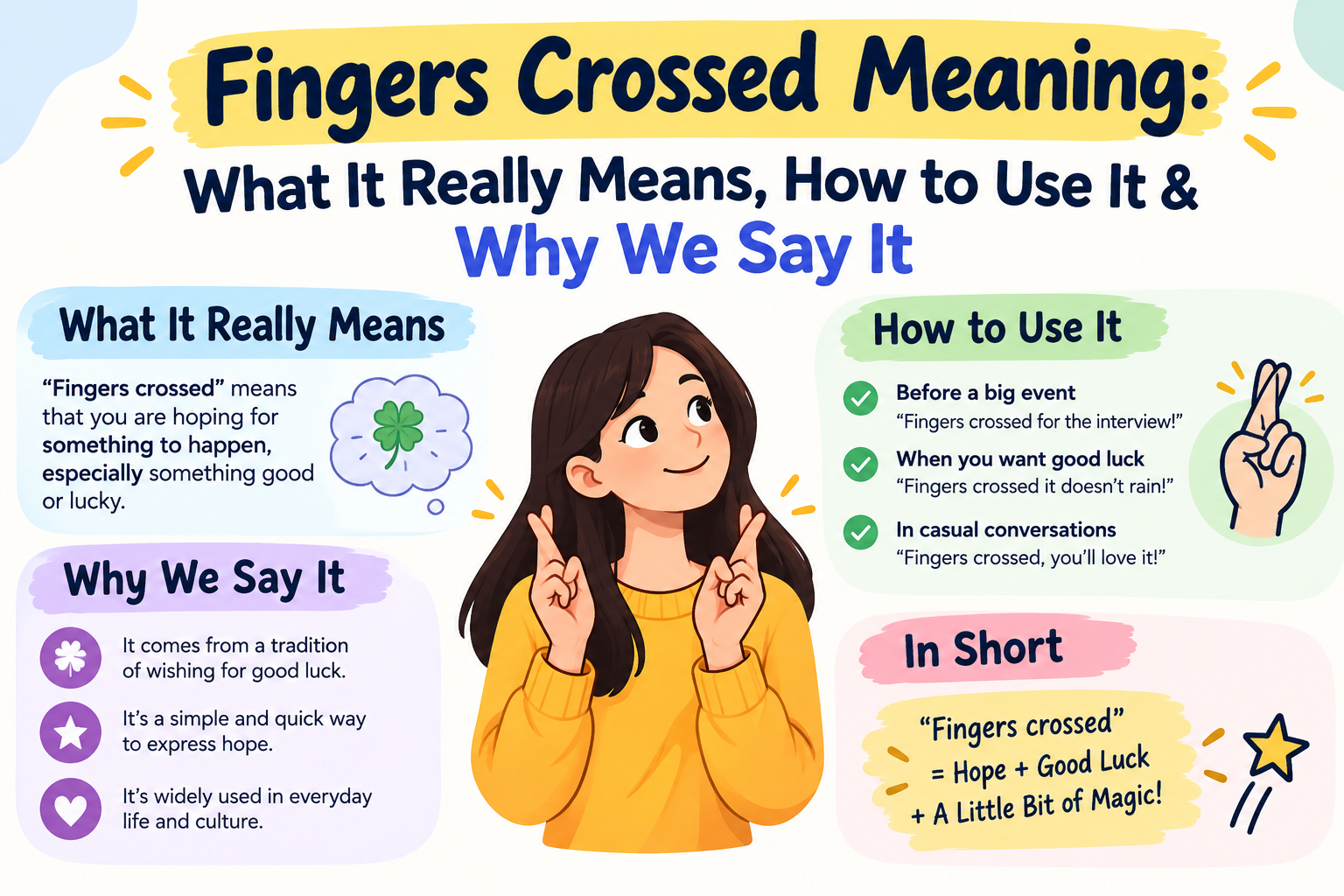
Fingers crossed is an informal expression used to show that you are hoping something happens the way you want.
In simple English:
Fingers crossed means “I hope it works out” or “I hope something good happens.”
For example:
I hope I get the job. Fingers crossed.
The speaker does not know the result yet, but they are optimistic and hoping for success.
The expression can also be used when you are wishing someone else good luck:
Your exam is tomorrow? Fingers crossed for you!
In this case, the speaker is expressing a positive wish for the other person.
Dictionaries describe the expression as a way of strongly hoping that something will happen as desired.
Fingers Crossed Meaning in Simple Words
If you want to remember the meaning quickly, think of these phrases:
Fingers crossed = I hope so.
Fingers crossed = Hopefully it goes well.
Fingers crossed = Good luck.
Fingers crossed = I am hoping for a positive result.
The exact wording changes according to the situation, but the central idea is hope.
For example:
I’m waiting to hear whether I got accepted. Fingers crossed.
This means:
I hope I get accepted.
Another example:
Fingers crossed, the weather stays clear tomorrow.
This means:
I hope the weather stays clear tomorrow.
What Is the Fingers Crossed Gesture?
The expression is closely connected to a physical hand gesture.
To make the traditional crossed-fingers gesture, a person crosses their index finger over or against their middle finger.
The gesture is commonly associated with wishing for luck or hoping for a favorable outcome.
Someone might physically cross their fingers while saying:
Fingers crossed!
Or they may simply make the gesture without saying anything.
The gesture communicates the same general idea of hope or good luck.
Is Fingers Crossed Positive or Negative?
In normal modern English usage, fingers crossed is positive or hopeful, not negative.
When someone says:
Fingers crossed!
they generally want something good to happen.
However, the phrase often appears when the result is uncertain.
For example:
We should hear back from the university tomorrow. Fingers crossed.
The speaker is hopeful, but they do not know what will happen.
So the expression is positive in attitude, even when the situation itself may be uncertain or stressful.
What Is the Meaning of the Idiom “Fingers Crossed”?
As an idiom, fingers crossed means that a person is hoping for good luck or a desired outcome.
An idiom is an expression whose overall meaning is not necessarily identical to the literal meaning of each individual word.
If someone says:
Fingers crossed I pass the test.
They are not merely describing the position of their fingers. They are expressing the hope that they will pass.
The phrase can therefore function as a compact way of communicating optimism about an uncertain result.
Keep Your Fingers Crossed Meaning
You may also hear the longer expression:
Keep your fingers crossed.
This means:
Continue hoping that something will turn out well.
For example:
Keep your fingers crossed that I get the job.
The speaker is asking the listener to join them in hoping for a positive result.
Another example is:
Keep your fingers crossed for tomorrow’s game.
This expresses a wish that the desired outcome will happen.
The expression keep your fingers crossed is also recognized as an idiomatic way to express strong hope.
Cross Your Fingers Meaning
Another closely related phrase is:
Cross your fingers.
It can mean:
Hope that something good happens.
For example:
Cross your fingers that everything goes smoothly.
This is essentially another way to express hope for a favorable result.
There is a small difference in how these forms are used:
Fingers crossed can be a standalone expression.
The interview is tomorrow. Fingers crossed.
Cross your fingers can sound more like an instruction or request.
Cross your fingers for me.
Keep your fingers crossed emphasizes continuing to hope.
Keep your fingers crossed that I get the apartment.
All three are closely related.
Fingers Crossed Examples in Everyday English
Here are some natural examples of the phrase.
Before an exam
My final exam is tomorrow. Fingers crossed!
The student hopes they perform well.
Before a job interview
I have an interview at my dream company tomorrow. Fingers crossed.
The speaker hopes to get the position.
Waiting for good news
The doctor said we should get the results tomorrow. Fingers crossed.
The speaker is expressing hope for a positive outcome.
Waiting for a decision
We submitted the proposal last week. Fingers crossed they approve it.
The speaker hopes the proposal will be accepted.
Before traveling
Hopefully the flight isn’t delayed. Fingers crossed.
The speaker hopes the journey goes smoothly.
During a competition
Our team is in the final. Fingers crossed we win.
The speaker hopes for victory.
For another person
You have your driving test tomorrow? Fingers crossed for you!
Here, the speaker is wishing the other person good luck.
How to Use “Fingers Crossed” in a Sentence
There are several natural ways to use the expression.
At the end of a sentence
I hope everything works out. Fingers crossed.
This is one of the most common casual uses.
At the beginning of a sentence
Fingers crossed, we get there before it starts raining.
Here, the phrase introduces the speaker’s hope.
With “that”
Fingers crossed that we get good news tomorrow.
This makes the desired outcome explicit.
With “for”
Fingers crossed for a successful launch.
This is useful when wishing for a particular outcome.
As a response
Person A:
I’m waiting for my test results.
Person B:
Fingers crossed!
Here, the phrase works as a short expression of encouragement.
Fingers Crossed Meaning in Texting
In text messages and online conversations, fingers crossed is extremely easy to use.
Someone might write:
I really hope they accept my application. Fingers crossed.
Or:
Hopefully the weather improves tomorrow, fingers crossed.
It can also appear as a short reply:
“I think I might get the job.”
“Fingers crossed!”
The informal nature of the expression makes it especially suitable for conversations with friends, family members, coworkers you know well, and people in casual online settings.
What Does the Fingers Crossed Emoji Mean?
The crossed-fingers emoji is commonly used to represent the same basic idea as the phrase.
It can communicate:
- Hope
- Good luck
- Optimism
- Wishing for a positive outcome
- Anticipation
- Uncertainty about an outcome
For example:
I hope I get the apartment 🤞
The emoji reinforces the idea that the person is hoping for good news.
The emoji can also make a written message feel more casual and expressive.
However, the meaning still depends on context. A person might use it sincerely, jokingly, or simply as a friendly way of wishing someone luck.
Is It Okay to Say “Fingers Crossed”?
Yes. Fingers crossed is a normal and widely understood informal English expression.
It is appropriate in everyday conversation and many casual written situations.
For example:
I’m hoping everything goes well. Fingers crossed.
You can also say:
Keep your fingers crossed for me.
However, in highly formal writing, you may prefer a more direct expression such as:
I hope the outcome is favorable.
or:
We hope the project is successful.
The choice depends on your audience and the tone of the communication.
Can You Say “Fingers Crossed” at Work?
Yes, especially in informal workplace communication.
For example:
We’re waiting for the client’s approval. Fingers crossed.
This sounds natural in a casual email, team chat, or conversation with colleagues.
For a formal business document, however, a phrase such as “we hope for a positive outcome” may sound more professional.
The expression itself is not inappropriate. It is simply more conversational than formal.
Fingers Crossed Meaning in a Romantic Context
The phrase can also appear in romantic conversations.
For example:
I hope we can finally meet this weekend. Fingers crossed.
Here, the speaker is expressing hope that the planned meeting will happen.
It can also be used when someone is hoping a relationship develops positively:
We’ve been talking for a while, so fingers crossed it works out.
The expression does not have a specifically romantic meaning. The surrounding conversation determines the context.
Fingers Crossed Meaning When Waiting for Results
The phrase is especially common when someone is waiting for something they cannot completely control.
Examples include:
- Exam results
- Job applications
- University admissions
- Medical test results
- Competition results
- Business decisions
- Travel plans
- Event arrangements
- Weather conditions
The common factor is uncertainty.
You hope for a particular result, but you do not yet know whether it will happen.
That is exactly where fingers crossed fits naturally.
Why Do People Cross Their Fingers for Good Luck?
The exact historical development of the expression is complicated, and several explanations have been associated with the gesture.
One commonly discussed explanation connects the crossed shape with Christian symbolism. Historical accounts and popular explanations also describe the gesture as a way of invoking protection or expressing hope.
However, it is important not to treat every popular story about the origin as a proven single explanation.
What is clear in modern usage is that crossing the fingers has become strongly associated with luck and hope.
The gesture eventually became part of everyday English expression, giving us phrases such as fingers crossed, cross your fingers, and keep your fingers crossed.
Fingers Crossed and the Idea of Luck
There is a subtle difference between wishing for something and believing that you can control its outcome.
When someone says:
Fingers crossed I win.
they are usually acknowledging that the result is not completely under their control.
They are hoping for luck or a favorable outcome.
This makes the expression useful in situations where effort has already been made but the final decision belongs to someone or something else.
For example:
I’ve prepared everything for the interview. Fingers crossed.
The speaker has done what they can and is now hoping things go well.
Fingers Crossed Meaning When Lying
There is another, less common meaning associated with the physical gesture.
Historically and informally, some people, especially children, have crossed their fingers behind their backs while making a promise or saying something untrue.
The idea was that crossing the fingers could somehow cancel or invalidate the promise.
For example, a child might say:
I didn’t eat the cookies.
while secretly crossing their fingers behind their back.
This usage is different from the normal modern meaning of fingers crossed as an expression of hope.
Dictionary sources also record this informal association with telling a minor lie or making a promise that the person considers not binding.
Does Fingers Crossed Always Mean Good Luck?
Not necessarily in the strict sense of “luck,” but it almost always expresses hope for a desirable outcome.
For example:
Fingers crossed the meeting goes smoothly.
The speaker may not literally believe in luck. They are simply saying that they hope things go well.
Therefore, fingers crossed can be understood more broadly as an expression of hope rather than only a request for supernatural good fortune.
Fingers Crossed vs. Good Luck
These expressions are similar but not identical.
Good luck directly wishes someone success.
Good luck on your exam!
Fingers crossed expresses hope for a favorable result.
Fingers crossed you pass your exam!
You can also combine them:
Good luck with your interview. Fingers crossed!
This sounds natural because the two expressions complement each other.
Fingers Crossed vs. Hopefully
Hopefully and fingers crossed can both communicate hope, but their style is different.
Compare:
Hopefully, everything goes well.
and:
Fingers crossed, everything goes well.
The first is neutral.
The second is more conversational and expressive.
The phrase can therefore add a friendly, informal tone to a message.
Common Mistakes With Fingers Crossed
Although the phrase is simple, learners sometimes use it in unnatural ways.
Mistake 1: Treating it as completely literal
If someone says:
Fingers crossed!
they are usually expressing hope, not simply describing their hands.
Mistake 2: Using it for something certain
The expression works best when the outcome is uncertain.
For example:
The sun rises tomorrow. Fingers crossed.
This sounds strange because the event is normally expected and predictable.
A better example would be:
Fingers crossed the rain stops before our outdoor event.
Mistake 3: Using it in every formal situation
The phrase is informal.
It works well in conversation and casual messages, but formal documents may require more neutral wording.
Mistake 4: Confusing “fingers crossed” with “cross your fingers”
They are related but have different grammatical structures.
Fingers crossed!
is an expression.
Cross your fingers!
is an instruction.
Keep your fingers crossed!
is a request to continue hoping.
Synonyms and Similar Expressions
There is no single perfect synonym for fingers crossed, but several expressions communicate a similar idea.
Hopefully
Hopefully, everything works out.
Good luck
Good luck with your interview.
Best of luck
Best of luck with your exam.
I hope so
I hope so. I’m really looking forward to it.
Let’s hope
Let’s hope they approve the proposal.
Wish me luck
Wish me luck for tomorrow’s interview.
Here’s hoping
Here’s hoping everything goes according to plan.
These expressions differ in tone, but they all communicate some form of hope or positive expectation.
Grammar: Is “Fingers Crossed” a Complete Sentence?
In informal English, fingers crossed can stand alone as an independent expression.
For example:
“Do you think we’ll get the tickets?”
“Fingers crossed!”
It does not need a conventional subject and verb to communicate its meaning in conversation.
This is common with idiomatic expressions. The context supplies the missing information.
You can also place it inside a fuller sentence:
Fingers crossed that we hear good news tomorrow.
or:
I’m keeping my fingers crossed that everything works out.
Fingers Crossed in American and British English
The expression is widely understood in both American and British English.
You may hear:
Fingers crossed.
Keep your fingers crossed.
Cross your fingers.
The wording and frequency may vary slightly between speakers, but the basic meaning remains the same.
It is not an expression restricted to one particular variety of English.
Quick Comparison of Related Phrases
| Expression | Main meaning | Typical tone |
| Fingers crossed | I hope it works out | Informal |
| Keep your fingers crossed | Continue hoping | Informal |
| Cross your fingers | Hope for a good result | Informal |
| Good luck | I wish you success | Neutral to informal |
| Best of luck | I wish you success | Friendly |
| Hopefully | I hope something happens | Neutral |
| Wish me luck | Please hope I succeed | Informal |
Frequently Asked Questions About Fingers Crossed Meaning
What is the meaning of crossed fingers?
Crossed fingers commonly express hope for good luck or a positive outcome. The gesture is made by crossing the index and middle fingers, and it is closely associated with wishing for something to go well.
Is fingers crossed positive or negative?
Fingers crossed is generally positive. It expresses hope, optimism, or a wish for a favorable result. It is often used when the outcome is uncertain.
What is the meaning of the idiom “fingers crossed”?
The idiom fingers crossed means that someone is strongly hoping something will happen in the way they want. It is commonly used when waiting for an uncertain result.
Is it okay to say “fingers crossed”?
Yes. It is a common and natural informal English expression. You can use it in conversations, casual messages, and informal workplace communication. More formal writing may call for a more neutral phrase.
What does “keep your fingers crossed” mean?
“Keep your fingers crossed” means to continue hoping that something will have a positive outcome. It can also be used to wish someone good luck.
What does “cross your fingers” mean?
“Cross your fingers” means to hope that something good happens or that an uncertain situation has a favorable outcome.
What does fingers crossed mean in texting?
In texting, fingers crossed usually means “I hope so,” “I hope it works out,” or “good luck.” It is a casual way to express optimism about an uncertain situation.
What does the fingers crossed emoji mean?
The crossed-fingers emoji is generally used to express hope, luck, optimism, or a wish for a positive result. Its meaning is usually similar to saying “fingers crossed.”
Does fingers crossed mean good luck?
It can function as a way of wishing someone good luck, but its broader meaning is expressing hope for a positive outcome.
What does fingers crossed mean when someone is lying?
In an older or informal usage, crossing fingers behind the back while making a promise could imply that the person believed the promise did not count. This association is especially linked with children’s behavior and is different from the common modern meaning of hoping for good luck.
Can I say “fingers crossed” for someone else?
Yes. You can say:
Fingers crossed for you!
This means you are hoping that the other person’s situation turns out well.
Is “fingers crossed” an idiom?
Yes. It is an idiomatic expression used to communicate hope for a favorable outcome.
What is another way to say fingers crossed?
Depending on the context, you can say “hopefully,” “good luck,” “best of luck,” “I hope so,” “let’s hope,” “wish me luck,” or “here’s hoping.”
Final Thoughts
The fingers crossed meaning is simple once you understand the idea behind the expression.
It is a common informal phrase used to express hope for a good result, good luck, or a favorable outcome. It is especially useful when you have done what you can but still have to wait for the final result.
You might say it before an exam, while waiting for a job offer, before a trip, after submitting an application, or when wishing someone else success.
The related expressions cross your fingers and keep your fingers crossed carry essentially the same hopeful idea, while the crossed-fingers gesture and emoji provide a visual way to communicate it. Also read this Synchronize: Meaning, Examples, Uses, Synonyms & How It Works.
Although the expression has historical associations beyond its modern meaning, everyday English uses fingers crossed primarily as a friendly and optimistic way of saying:
I really hope things go well.