
Recurring vs. reoccurring is one of those English word comparisons that can leave even experienced writers second-guessing themselves. The two words look almost identical, both are connected with the idea of something happening again, and in many everyday sentences they can appear interchangeable.
So, is there actually a difference between recurring and reoccurring?
The short answer is: sometimes, but the distinction is not as strict as many grammar guides suggest.
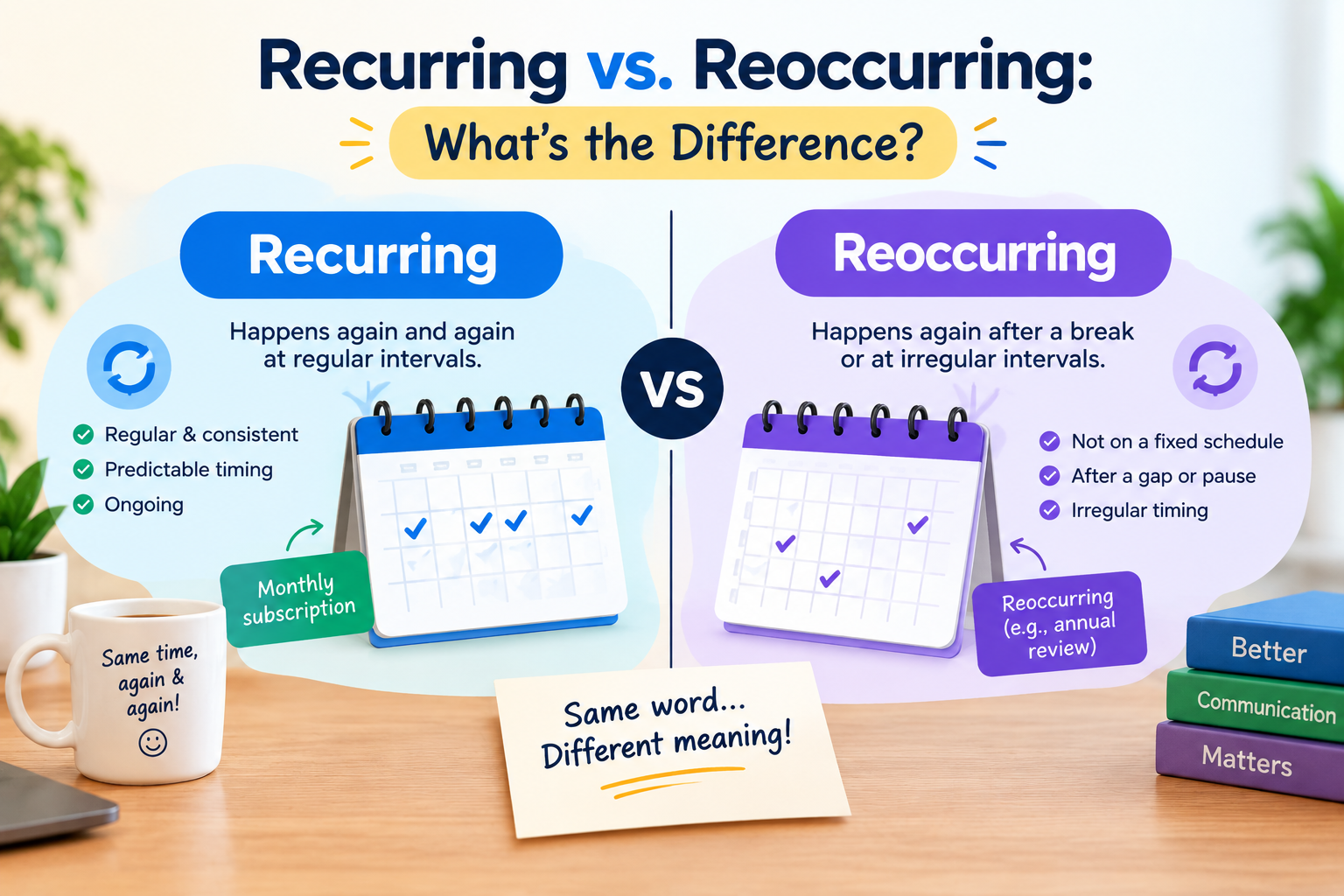
Recurring is the more common choice when something happens repeatedly, especially when the repetition is frequent, ongoing, or part of an established pattern. Reoccurring means happening again and is a valid word, but it is generally less common and does not necessarily imply a regular schedule.
For example:
“I have recurring meetings every Monday.”
Here, the repetition is clearly scheduled.
But:
“The same problem reoccurred after the update.”
This simply tells us that the problem happened again.
Understanding this small difference can help you choose the word that sounds most natural and accurately communicates what you mean.
Recurring vs. Reoccurring: Quick Answer
If you need a quick rule, remember this:
| Word | General Meaning | Typical Use |
| Recurring | Happening repeatedly or returning again | Repeated, ongoing, frequent, or patterned events |
| Reoccurring | Happening again | An event or problem that happens another time |
| Recur | To happen or appear again | Verb form of recurring |
| Reoccur | To happen again | Verb form of reoccurring |
The important point is that recurring does not require a perfectly predictable schedule, and reoccurring does not necessarily mean something random.
Major dictionaries support this broader overlap. Merriam-Webster defines recur as “to occur or appear again,” while its entry for reoccur also means “to occur again” or “to happen another time.”
That means context matters more than a rigid rule.
What Does “Recurring” Mean?
Recurring is the adjective formed from the verb recur.
It describes something that happens again, appears repeatedly, or returns over time.
For example:
“She has recurring nightmares.”
“The company has recurring monthly expenses.”
“A recurring theme appears throughout the novel.”
“We have a recurring meeting every Friday.”
The word is especially natural when the repetition is something you expect, notice repeatedly, or experience as an ongoing pattern.
Cambridge defines recurring as something “happening many times, or happening again.” In business English, it also uses the word for things such as recurring revenue, costs, and expenses that happen or are paid regularly.
Examples of Recurring
A few common examples include:
Recurring payment: A payment that is charged repeatedly, such as a monthly subscription.
Recurring meeting: A meeting that takes place repeatedly, such as a weekly team meeting.
Recurring dream: A dream that returns repeatedly.
Recurring problem: An issue that keeps appearing.
Recurring theme: An idea or subject that appears repeatedly in a story, discussion, or piece of writing.
Recurring expense: A cost that occurs repeatedly as part of normal operations.
In everyday English, recurring is often the most natural word when you want to emphasize repetition.
What Does “Reoccurring” Mean?
Reoccurring comes from the verb reoccur.
Its basic meaning is happening again.
For example:
“The error reoccurred after the software update.”
“If the symptoms reoccur, contact your doctor.”
“The issue may reoccur in the future.”
Unlike the common simplified rule that says reoccurring must describe an unpredictable event, dictionaries generally give it a broader meaning.
Merriam-Webster defines reoccur as “to occur again” or “to happen another time,” and Oxford similarly defines it as “to happen again or a number of times.”
So reoccurring is not incorrect.
It is a legitimate English word.
However, in many situations, recurring will sound more natural.
Recurring vs. Reoccurring: The Main Difference
The easiest way to understand the distinction is to think about emphasis.
Recurring often emphasizes a repeated pattern or something that keeps returning.
Reoccurring emphasizes the fact that something has happened again.
Consider these sentences:
“We have a recurring problem with late payments.”
This suggests that late payments keep happening and have become an ongoing issue.
“The problem reoccurred after we thought it had been fixed.”
This emphasizes that the problem happened again.
Both words relate to repetition, but the writer may choose one based on what aspect of the event is most important.
Does “Recurring” Always Mean Regular?
Not necessarily.
This is one of the most important points to understand about recurring vs. reoccurring.
A recurring event can be regular:
“Our recurring meeting takes place every Tuesday.”
But something can also be recurring without following an exact schedule:
“He experienced recurring headaches throughout the year.”
The headaches happen repeatedly, but we are not necessarily told that they occur every Monday, every two weeks, or according to any fixed timetable.
Cambridge defines recurring broadly as “happening many times, or happening again,” which supports this wider usage.
Therefore, it is better to remember:
Recurring = repeated or returning, often with an established or noticeable pattern.
rather than:
Recurring = only something that happens on a fixed schedule.
Does “Reoccurring” Mean Random?
Again, not necessarily.
A reoccurring event can be irregular, but the word itself does not require randomness.
For example:
“The software error reoccurred three times this year.”
There may not be a predictable schedule, but we know the error happened again.
At the same time, reoccur can also be used for something that happens at regular intervals. Merriam-Webster’s examples include an event expected to reoccur every five to seven years, showing that reoccur is not limited to random repetition.
This is why the simple “regular versus random” rule can sometimes create more confusion than it solves.
Recurring vs. Reoccurring Examples
Seeing the words in context makes the difference easier to understand.
Examples With Recurring
The company charges a recurring monthly subscription fee.
She has a recurring dream about being lost in a city.
The team holds a recurring meeting every Friday.
The author uses a recurring image throughout the novel.
We need to address this recurring customer complaint.
The business has several recurring operating expenses.
In each example, the focus is on repetition, continuation, or an established pattern.
Examples With Reoccurring
The same error reoccurred after the application was restarted.
The issue may reoccur if the settings are changed incorrectly.
The symptoms reoccurred several months later.
The problem has reoccurred despite several attempts to fix it.
If the problem reoccurs, contact technical support.
Here, the writer is often emphasizing that something happened again.
Recurring vs. Reoccurring in Business English
Business writing provides some of the clearest examples of why recurring is generally preferred in certain contexts.
You will frequently see expressions such as:
Recurring revenue
Recurring expenses
Recurring costs
Recurring payments
Recurring customers
Recurring meetings
For example:
“The company is trying to increase its recurring revenue.”
This means revenue that continues to come from repeat or subscription-based activity.
Cambridge specifically uses recurring in business and finance contexts for things that happen or are paid regularly, including recurring revenue, costs, and expenses.
Using reoccurring revenue would sound unusual in this context.
That does not necessarily make reoccurring grammatically impossible. It simply makes recurring the much more natural business term.
Recurring vs. Reoccurring in Technical Writing
Technical writing can use both words.
Consider a software application.
You might write:
“This is a recurring error that appears during every scheduled backup.”
That makes sense because the problem has an identifiable pattern.
You might also write:
“The error reoccurred after the latest software update.”
Here, the emphasis is on the error happening again.
The choice depends on what you want the sentence to communicate.
If you are describing an ongoing category of problem, recurring is often better.
If you are reporting that something happened again after previously being resolved or observed, reoccurred can work naturally.
Recurring vs. Reoccurring in Academic Writing
Academic writing generally benefits from precision.
If you are discussing a phenomenon that appears repeatedly in research, recurring is often the stronger choice.
For example:
“A recurring pattern was observed across the three studies.”
“The researchers identified a recurring theme in the interviews.”
If you simply need to state that an event happened again, reoccurred may be appropriate:
“The same result reoccurred during the second experiment.”
When writing for an academic audience, always consider the exact meaning you want to communicate rather than choosing a word simply because it sounds more formal.
Is “Reoccurring” a Correct Word?
Yes.
Reoccurring is a real and accepted English word.
You should not assume that it is a spelling mistake or an incorrect version of recurring.
Oxford lists reoccur as a verb meaning to happen again or a number of times, with reoccurring as its -ing form.
Merriam-Webster also has a dedicated entry for reoccur and gives examples of current usage.
The reason writers sometimes avoid it is not because the word is invalid.
It is because recurring is usually more common and more natural in many contexts involving repeated events.
When Should You Use “Recurring”?
Choose recurring when you are describing something that:
Keeps happening
Appears repeatedly
Returns over time
Forms a noticeable pattern
Is part of a regular business process
Is an ongoing issue
For example:
“The company is reviewing its recurring expenses.”
“I keep having recurring dreams about the same place.”
“This recurring problem needs a permanent solution.”
“The story contains several recurring themes.”
When Should You Use “Reoccurring”?
Choose reoccurring when your main point is that something has happened again.
For example:
“The error reoccurred after the update.”
“The problem could reoccur if the system is not repaired.”
“The symptoms reoccurred several months later.”
It can be particularly useful when describing the return of something that had previously stopped.
Still, in many of these sentences, recurring may also work depending on the intended meaning.
Recurring vs. Reoccurring: A Simple Memory Trick
Instead of memorizing an absolute grammar rule, use this practical reminder:
Recurring → think “keeps coming back.”
Reoccurring → think “happens again.”
For example:
Recurring:
“The company has a recurring billing issue.”
The issue keeps returning and has become an ongoing pattern.
Reoccurring:
“The billing issue reoccurred after the update.”
The issue happened again.
This distinction will help you choose naturally without treating the two words as completely separate categories.
Common Mistakes With Recurring and Reoccurring
Mistake 1: Thinking “Reoccurring” Is Always Wrong
It isn’t.
Reoccurring is a legitimate word and is listed by major dictionaries.
Mistake 2: Assuming Recurring Must Follow a Fixed Schedule
A recurring event can happen repeatedly without following an exact calendar.
A recurring problem or recurring dream may have no precise timetable.
Mistake 3: Treating Reoccurring as Synonymous With Random
Reoccurring means happening again. It does not inherently mean unpredictable.
Mistake 4: Using Reoccurring When Recurring Is the Established Term
Some expressions strongly favor recurring.
For example:
Recurring revenue
Recurring payment
Recurring expense
Recurring meeting
In these contexts, recurring is the natural choice.
Mistake 5: Choosing the Longer Word to Sound More Formal
“Reoccurring” is not automatically more sophisticated than “recurring.”
In fact, recurring is often the cleaner and more conventional choice.
Recurring vs. Reoccurring: Quick Comparison
| Feature | Recurring | Reoccurring |
| Basic idea | Happening repeatedly or returning | Happening again |
| Valid English words? | Yes | Yes |
| Common usage | Very common | Less common |
| Can you describe repeated events? | Yes | Yes |
| Requires a fixed schedule? | No | No |
| Can you describe an irregular event? | Yes | Yes |
| Common in business terminology? | Very common | Less common |
| Example | Recurring payment | Error reoccurring after an update |
The biggest takeaway is that these words overlap in meaning.
They should not be treated as two completely separate categories.
Recurring vs. Reoccurring: Which One Should You Use?
If you are unsure, recurring will often be the safer and more natural choice when you are describing something that repeatedly happens or continues to return.
Use reoccurring when you specifically want to emphasize that something has happened again.
For example:
“We are experiencing a recurring problem.”
This sounds natural when the problem keeps happening.
“The problem reoccurred after the repair.”
This works well when you are describing one additional occurrence.
The best word depends on the sentence and the meaning you want to emphasize.
Frequently Asked Questions
What is the difference between recurring and reoccurring?
Both words relate to something happening again. Recurring is commonly used for repeated or continuing events and patterns, while reoccurring emphasizes another occurrence. The meanings overlap, so the difference is not always absolute.
Is reoccurring grammatically correct?
Yes. Reoccurring is the -ing form of the verb reoccur, and major dictionaries recognize the word.
Is recurring or reoccurring more common?
Recurring is generally the more common choice, particularly in phrases such as recurring payments, recurring expenses, recurring revenue, recurring meetings, and recurring problems.
Does recurring mean regular?
It can imply a repeated or established pattern, but it does not require an exact schedule. Something can be recurring simply because it keeps happening or returning.
Does reoccurring mean random?
No. Reoccurring means happening again. The event may be regular or irregular depending on the context.
Is “recurring problem” correct?
Yes. “Recurring problem” is a very natural English phrase when an issue keeps happening.
Is “reoccurring problem” correct?
Yes. It is grammatically possible, although “recurring problem” is often the more natural choice when describing an ongoing or repeated issue.
Which is better for formal writing?
In many formal contexts, recurring is the more conventional choice. However, reoccurring is not grammatically wrong. Choose the word that best matches the meaning you want to express.
Final Thoughts on Recurring vs. Reoccurring
The difference between recurring vs. reoccurring is subtle because both words describe something happening again.
The most useful distinction is not a rigid rule that says one word must always describe predictable events while the other must describe random events.
Instead, think about emphasis.
Recurring is especially natural when something repeatedly happens, continues to return, or forms a recognizable pattern.
Reoccurring means that something happens again and can be useful when you want to emphasize another occurrence.
When in doubt, look at the sentence as a whole.Also read this Online Tutoring and Teaching: A Complete Guide for 2026.
If you are talking about recurring revenue, recurring payments, recurring meetings, recurring expenses, recurring dreams, or a recurring problem, the shorter form will usually be the natural choice.
If you are describing something that happened again after it had already happened, reoccurring may communicate that idea neatly.
The key is not simply memorizing which word is “right.” It is understanding what you want the reader to notice: the repeated pattern or the return of the event.