

Quick Summary
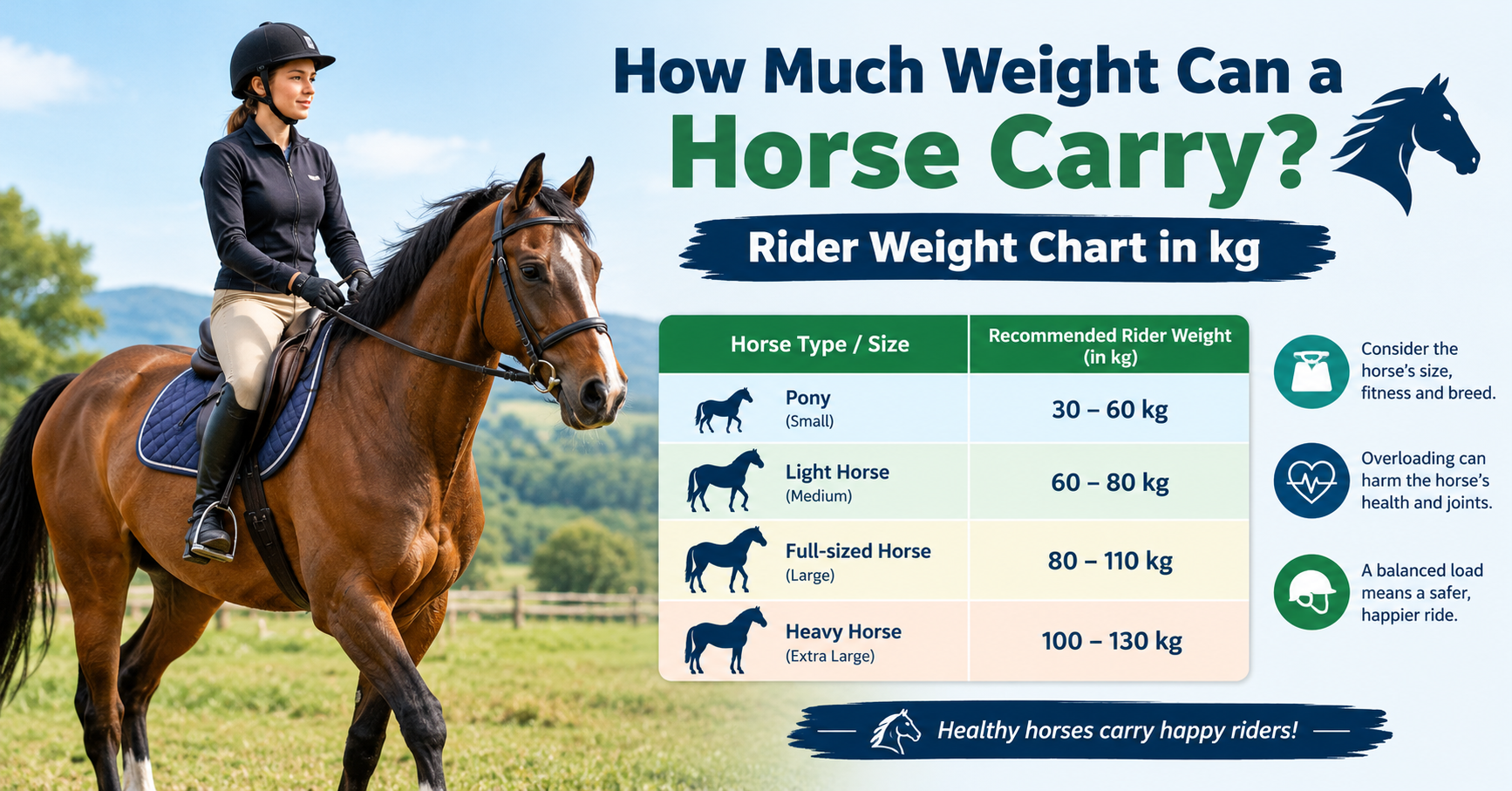
A fit, healthy horse should carry about 15% to 20% of its body weight, and that includes the rider and every bit of gear. Clydesdales and Percherons can handle roughly 150 to 200 kg in total, a Quarter Horse about 90 to 110 kg, and a pony about 40 to 80 kg. Use your horse’s real weight and your saddle’s real weight, and when you’re unsure, go with the lighter load.
How Much Weight Can a Horse Carry? Most healthy, fit horses can carry around 15% to 20% of their own body weight. Here’s the part people miss: that number covers everything on the horse’s back, not only the rider. Saddle, pad, bridle, saddlebags, all of it. A 500 kg horse, for example, has a total allowance of 75 to 100 kg, and a heavy Western saddle can swallow 15 kg of that before anyone even climbs on.
So there’s no single answer to this question. The real limit moves with the horse’s size, bone, back shape, fitness and age. It also depends on the rider. Someone who sits balanced and moves with the horse is easier to carry than a lighter person who bounces. Below you’ll find a simple kg chart, numbers for Clydesdales, Percherons, Quarter Horses and ponies, and quick answers to the questions people ask most, so you won’t need to go hunting anywhere else.
The 20% Rule Explained in Simple Words
The rule is easy. The total weight on a horse’s back should stay at or under 20% of the horse’s ideal body weight. A lot of vets like to stay lower, closer to 15%, especially for lighter boned horses or horses that work hard.
To work it out for your own horse:
- Get your horse’s weight in kg. A weight tape works, a livestock scale is better.
- Multiply by 0.15 for the comfortable limit and by 0.20 for the upper limit.
- Take away the weight of your saddle, pad and other gear.
- Whatever is left is the most your rider should weigh.
Worked Example at 20%
Your horse weighs 500 kg. Twenty percent is 100 kg. Your Western saddle and pad weigh 14 kg together. That leaves 86 kg for the rider.
Same Horse at the Safer 15%
Fifteen percent of 500 kg is 75 kg. Take off the same 14 kg of gear and you’re left with 61 kg. If you’re heavier than that, the horse can still do it, but you’re asking more of it.
Horse Weight Carrying Chart in kg
This table shows the total load, which means the rider and all the tack added together.
| Horse Weight | Safe Load at 15% | Upper Limit at 20% |
| 400 kg | 60 kg | 80 kg |
| 450 kg | 68 kg | 90 kg |
| 500 kg | 75 kg | 100 kg |
| 550 kg | 83 kg | 110 kg |
| 600 kg | 90 kg | 120 kg |
| 700 kg | 105 kg | 140 kg |
| 800 kg | 120 kg | 160 kg |
| 900 kg | 135 kg | 180 kg |
| 1000 kg | 150 kg | 200 kg |
Always take off the saddle and gear weight before you compare the figure with your own weight.
Don’t Forget the Saddle, It Counts Too
Most riders only think about their own weight. The horse feels everything. A light English saddle runs 3 to 5 kg, while a Western saddle is often 10 to 15 kg. Add a thick pad, stirrups, a girth and a pair of saddlebags and the horse may already be carrying 15 to 20 kg with nobody on top.
If your horse is close to its limit, a lighter saddle is the easiest fix. It costs less than buying a bigger horse and the horse notices the difference straight away.
What Decides How Much a Horse Can Carry
Body weight is the starting point, not the whole story. These things change the real limit:
- Bone and build. A short, wide, strong back with thick bone below the knee can handle closer to 20%. Finer boned horses, like many Thoroughbreds, do better nearer 15%.
- Fitness. A horse that’s ridden regularly and has strong back muscles carries weight far better than an unfit horse of the same size.
- Age. Young horses with growing bones and older horses with stiff joints should carry less.
- Rider balance. A balanced rider who moves with the horse puts less strain on its back than a beginner who slumps or bounces.
- Type of work. An easy hour at a walk is nothing like a long day of trotting, cantering or jumping. The harder the work, the lower the load should be.
- Terrain. Steep hills, deep sand and long trail days make the same weight feel a lot heavier.
How Much Weight Can Different Horses Carry?
How Much Weight Can a Clydesdale Carry?
A Clydesdale usually weighs 770 to 1,000 kg. At 20%, that gives a total load of roughly 150 to 200 kg. Take off a saddle and you’re looking at a rider of about 140 to 185 kg in the best case. They’re heavy boned and strong, which is why they’re a popular pick for bigger riders. One thing to keep in mind, though: they’re bred for pulling, not riding, so a saddle that really fits matters a lot.
How Much Weight Can a Percheron Carry?
Percherons weigh about 800 to 1,000 kg, so the numbers sit close to the Clydesdale. Plan on a total load of 160 to 200 kg. They have a broad back and a calm nature, so they’re a common choice for heavier riders.
How Much Weight Can a Quarter Horse Carry?
The average Quarter Horse weighs 450 to 550 kg, which gives a total load of about 90 to 110 kg at the upper limit. They’re compact and tough, but a Western saddle can use up a big slice of that allowance, so do the math before you ride.
How Much Weight Can a Pony Carry?
Ponies are strong for their size, but their backs are short. A pony of 200 to 400 kg can carry about 40 to 80 kg in total at the upper limit. That’s why ponies suit children and most adults should look at a horse instead. A pony may look tough, but looks don’t change the numbers.
How Much Weight Can a Pack Horse Carry?
A pack horse follows the same rule, about 20% of body weight including the pack saddle. A 500 kg pack horse tops out around 100 kg. Keep the load even on both sides and close to the body. Mules can sometimes handle a bit more, but for horses on long trips it’s smarter to stay under 20%.
Common Questions About Rider Weight
Can a Horse Carry a 200 kg Person?
Not safely, no. A 200 kg rider plus around 15 kg of tack makes a 215 kg load. To keep that at 20%, the horse would have to weigh over 1,075 kg, which is bigger than almost any horse alive. If you’re at this weight, the honest answer is that riding would put your horse at real risk of back pain and injury. Some people choose a cart ride with a trained driver, or spend time with horses from the ground instead.
Can a 70 kg Person Ride a Horse?
Yes, with no trouble. A 70 kg rider with a 10 kg saddle is an 80 kg load. That’s fine for a horse of about 400 kg at the 20% limit, and for one of about 530 kg at the gentler 15% limit. Any medium horse of 450 to 550 kg, like a Quarter Horse or an Arabian, can carry that rider easily.
How Heavy Can a Horse Carry in kg?
An average 500 kg riding horse tops out near 100 kg in total. A big draft horse of 900 to 1,000 kg can reach 180 to 200 kg. Treat those as ceilings, not targets. Staying nearer 15% is kinder to the horse.
Can a Horse Carry More Than It Can Pull?
It’s the other way round. A horse can pull far more than it can carry. On a smooth road the wheels do most of the work, so a horse can move a cart several times its own weight. When a horse carries weight, all of it presses down on the spine. That’s why pulling and carrying numbers can’t be compared.
Signs Your Horse Is Carrying Too Much
Your horse can’t tell you its back hurts, but it will show you. Look out for:
- Pinned ears or a swishing tail when you saddle up or get on
- Flinching or dropping the back when you touch it
- Short, choppy strides or not wanting to go forward
- Bucking, rearing or refusing to move
- Uneven sweat patches, white hairs or sores under the saddle
- Stiffness or a sour mood after rides
- Tiring much faster than usual
If you notice any of these, stop riding and get a vet or an equine back specialist to take a look.
How to Reduce the Load on Your Horse
If you’re close to the limit, small changes add up:
- Switch to a lighter saddle
- Drop extra gear and heavy saddlebags
- Choose a bigger, sturdier horse
- Keep rides shorter and skip hard work like long canters or jumping
- Take lessons to improve your balance
- Keep your horse fit and at a healthy weight
As a trusted hub for latest trends, practical tips, and global news, Weekly Magazine delivers high-quality reading material on a wide range of topics. Visit our home page regularly to never miss out on key updates and fresh perspectives.
Frequently Asked Questions
Can a horse carry a 200 kg person?
Not safely. A 200 kg rider plus tack needs a horse of about 1,075 kg or more at the 20% rule, which is bigger than almost any horse.
How much weight can a horse handle on their back?
Most riding horses can handle 15% to 20% of their body weight in total. For a 500 kg horse that’s 75 to 100 kg, saddle included.
Can a 70 kg person ride a horse?
Yes. A medium horse of 450 to 550 kg can carry a 70 kg rider and a normal saddle without any problem.
How heavy can a horse carry in kg?
An average riding horse can carry up to about 100 kg in total. Large draft horses can carry 160 to 200 kg.
How much can a Clydesdale carry?
Usually about 150 to 200 kg in total, counting the rider and the saddle.
How much weight can a Percheron carry?
About 160 to 200 kg in total, depending on the horse’s size and fitness.
How much weight can a pack horse carry?
No more than about 20% of its body weight. That’s around 100 kg for a 500 kg horse.
How much weight can a Quarter Horse carry?
A typical Quarter Horse can carry about 90 to 110 kg in total, so the rider’s share is smaller once you take off the saddle.
How much weight can a pony carry?
Most ponies manage about 40 to 80 kg in total, depending on size. That suits children and small riders.
How much can a horse lift?
Horses don’t lift weight the way people do. They carry it on the back or pull it on wheels, and the safe carrying limit is about 15% to 20% of body weight.
Is there a weight limit for horseback riding?
Yes. Many riding stables set a rider limit of around 90 to 110 kg, because their horses are usually average sized.
Can a horse carry 3 people?
No. Three riders is far over the safe limit for any horse and risks serious back injury.
Am I too heavy to ride a horse?
Check the math. Add your weight to your saddle weight, then divide by your horse’s weight. If the answer is above 20%, your horse is carrying too much.
Does a bigger horse always carry more?
Usually, but not always. Bone strength, back shape and fitness matter too. A fit horse with a strong back beats a big horse with a weak one.