
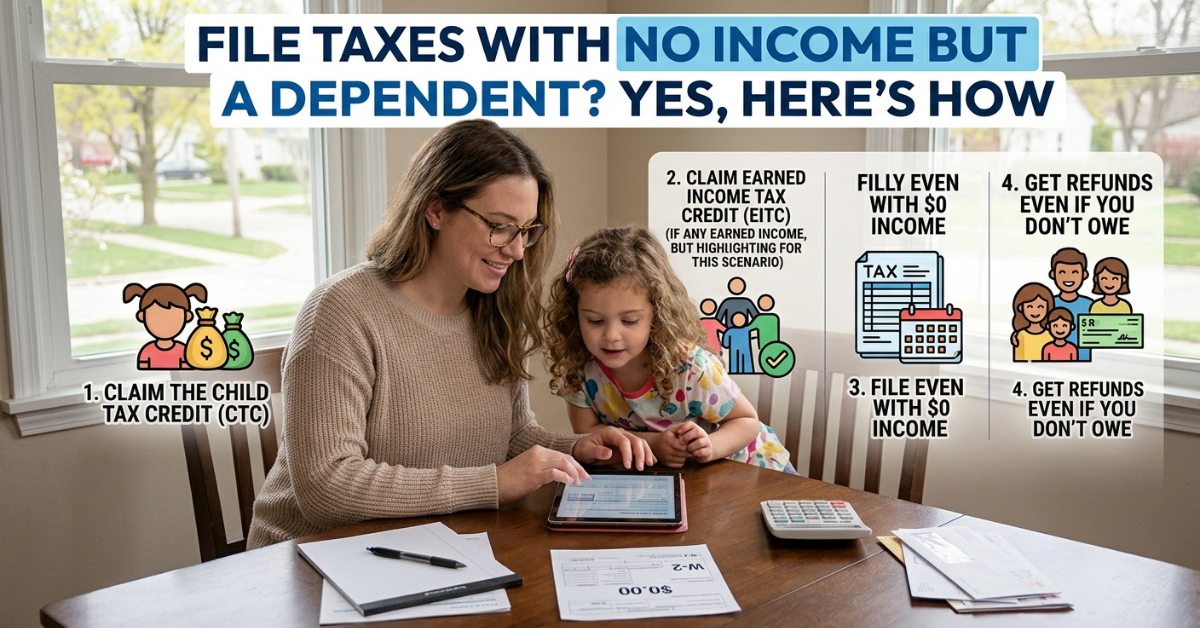
Yes, you can file a tax return with no income and a dependent, and the IRS will accept it. Most of the time you do not have to, though. The bigger question is whether filing gets you any money, and that depends on earned income. The numbers below cover tax year 2025, which most people filed in 2026. The IRS updates them every year.
Quick Answer to Common Tax Questions About Zero Income and a Dependent
Yes, You Can File Taxes With No Income
Anyone can file a federal return with zero income. A dependent does not change that. Dependent status depends on relationship, age, where the child lived and who paid for support. It does not depend on how much you earned.
Why Filing Does Not Always Mean a Refund
A refund comes from tax that was withheld or from refundable credits. With no wages there is no withholding. The main refundable credits also need earned income, so a return with zero income usually ends at $0.
Filing Requirement Basics: Do You Need to File Taxes With No Income?
How the IRS Sets the Filing Requirement
The IRS compares your gross income to the standard deduction for your filing status and age. For 2025 the amounts are $15,750 for single filers, $23,625 for head of household and $31,500 for married filing jointly. If you earn less than your amount, you usually do not have to file.
When You Do Not Need to File
Zero income sits below every one of those lines. Child support and most public benefits are not taxable, so they do not push a parent over the limit. Unemployment pay is different because it counts as taxable income.
When You Need to File Even With Low Income
A few situations trigger a return at any income level. Net self-employment earnings of $400 or more is the most common. Owing household employment tax is another. A parent with small gig income should check this rule first.
Who Counts as a Dependent for the IRS?
Qualifying Child Tests
A qualifying child must be your son, daughter, sibling or a descendant of one of them. The child must be under 19, or under 24 as a full time student. The child must live with you more than half the year and cannot pay more than half of their own support.
Qualifying Relative Tests
A qualifying relative cannot be anyone’s qualifying child. The person must be a listed relative or live in your home all year. Their gross income must stay under $5,200 for 2025, and you must provide more than half of their support.
Who Can Claim the Child When Two People Qualify
Only one person can claim a child. Under the IRS tie-breaker rules a parent wins over a non-parent. If both are parents filing separately, the parent the child lived with longer wins. If the time is equal, the parent with the higher AGI wins.
Reason to File Taxes With No Income and a Dependent
Get Back Tax That Was Withheld
If an employer withheld income tax from even a short job, only a return gets that money back. Say a parent worked two months and had $400 withheld. That parent has no filing requirement but loses the $400 by staying silent.
Claim Credits You May Qualify For
The IRS estimates about one in five EITC-eligible taxpayers do not claim the credit. IRS Chief Executive Officer Frank J. Bisignano called it “vital to supporting working American families” when the agency launched its 2026 awareness campaign. About 23.5 million workers and families received roughly $68.5 billion in EITC for tax year 2024.
Start the IRS Refund and Audit Clock
Filing also starts the time limits. Taxpayers usually have three years to claim a refund, and the IRS generally has three years to review a return. In March 2026 the IRS said 1.3 million people had unclaimed 2022 refunds worth about $1.2 billion.
Tax Credits You May Qualify For With a Dependent and Low Income
Earned Income Tax Credit
The earned income credit is worth up to $4,328 with one child for 2025. You need earned income, an AGI under $50,434 and investment income of $11,950 or less. With no earned income the credit is $0.
Child Tax Credit and Additional Child Tax Credit
The Child Tax Credit is worth up to $2,200 per child under 17. Up to $1,700 is refundable as the Additional Child Tax Credit. H&R Block explains that it needs earned income above $2,500 and equals 15% of the amount over that. Zero earned income means no refundable credit.
Credit for Other Dependents
This credit is worth up to $500 for dependents who do not qualify for the child credit, such as an older child or a relative. It is nonrefundable, so it only reduces tax you owe. With no income you owe nothing to reduce.
Child and Dependent Care Credit
This credit has an earned income test, and the care must let you work or look for work. A parent with no job and no job search cannot claim it, according to IRS Publication 503. The child must also be under 13.
What Counts as Earned Income and What Does Not
Income That Counts
Wages, salaries, tips and net self-employment earnings count as earned income. Gig work and cash side jobs count too when you report them.
Money That Does Not Count
The IRS says child support is not earned income. The same goes for alimony, welfare benefits, unemployment pay, Social Security, pensions and interest. These payments may still matter for other reasons, but they do not unlock refundable credits.
Why Zero Earned Income Changes the Result
Refundable credits grow as earnings rise. A parent with one child and $5,000 of wages can get roughly $1,700 in EITC (34 cents per dollar) plus $375 in ACTC (15% of the amount over $2,500). That is about $2,075. At $0 of earnings both credits are $0.
Can You Use Head of Household Status With No Income?
Head of Household Requirements
You must be unmarried or considered unmarried on the last day of the year. A qualifying person must have lived with you more than half the year. You must also pay more than half the cost of keeping up the home. Our head of household guide covers the details.
Paying More Than Half the Household Costs
Costs include rent, mortgage interest, utilities, repairs and food eaten at home. Public assistance payments are generally treated as paid by the agency, not by you. A parent whose relatives cover the bills usually cannot meet this test.
Head of Household vs Single Filing Status
The 2025 standard deduction is $23,625 for head of household and $15,750 for single. With zero income neither status changes your tax. Head of household still sets a higher filing threshold if your income grows.
Real Examples of Filing With a Dependent and Little or No Income
Parent With No Job and One Child
A parent has no income and no withholding all year. There is no filing requirement, and a return would produce no refund and no credits. Skipping it is fine this year. The parent should file in any year that includes earnings.
Parent Living With Relatives Who Can Claim the Child
A parent with no income lives with the child in a grandparent’s home. The grandparent can claim the child only if the parent does not and the grandparent’s AGI is higher than the parent’s. Otherwise the parent keeps the claim.
Low Income Parent With Small Side Earnings
A parent earns $5,000 at a part time job. Filing is optional, but the credits above add up to roughly $2,075 plus any withheld tax. That is a strong reason to file. Gig income of $400 or more also triggers self-employment tax.
Parent Who Only Receives Benefits or Child Support
Child support and most public benefits are not taxable and are not earned income. The parent has no filing requirement and cannot claim refundable credits. Unemployment pay is taxable but still is not earned income.
When Your Dependent Needs to File Taxes Too
Filing Requirement for a Dependent With Earned Income
A dependent with only wages must file when earned income is above the standard deduction. The cap for 2025 is $15,750. A teen with a withheld paycheck may still file to get that tax back.
Filing Requirement for a Dependent With Unearned Income
A dependent must file when unearned income tops $1,350 for 2025. With both kinds of income the test is gross income above the greater of $1,350 or earned income plus $450. The total cannot exceed the regular standard deduction.
How to File Taxes With No Income and a Dependent Step by Step
Documents You Need Before You Start
Gather Social Security numbers for you and your child, along with W-2s and 1099s. Add last year’s return, bank details for direct deposit and proof the child lived with you, such as school records. The child needs a valid Social Security number to claim the Child Tax Credit and EITC.
Free Ways to File and Check Your Filing Requirement
IRS Free File covers a 2025 AGI of $89,000 or less. Free File Fillable Forms have no income limit. VITA offers free in-person help for incomes generally around $69,000 or less. The IRS Interactive Tax Assistant can check your filing requirement.
Deadlines and How Long You Have to Claim a Refund
The regular deadline is April 15. Form 4868 extends it to October 15, which fell on October 15, 2026 for the 2025 return. There is no late filing penalty when you are owed a refund. You generally have three years to claim one.
Mistakes That Can Delay Your Return or Trigger an IRS Notice
Claiming a Credit Without Earned Income
Claiming the EITC or ACTC with no earned income invites a denial. The IRS can then require extra paperwork on later returns. Check the earned income test before you claim.
Two People Claiming the Same Qualifying Child
When two returns claim the same child, the second one usually gets rejected or flagged. The tie-breaker rules then decide the winner. Settle who claims the child before anyone files.
Wrong Head of Household Status
Choosing head of household without paying more than half the home costs can lead to a denial. Keep rent receipts and bills that show who paid. Single status is the safe choice when you are unsure.
Form 8862 After a Disallowed Credit
After a disallowed credit you may need to attach Form 8862 to claim it again. The IRS can bar the credits for 2 years after reckless or intentional disregard of the rules. A fraud finding means a 10 year ban.
Getting Professional Help With Tax Questions
VITA sites give free help to eligible filers. A CPA or enrolled agent can handle shared custody or messy income. The Taxpayer Advocate Service helps if a notice goes wrong. This article gives general information and is not tax advice.
FAQ
If you have no income can you get a tax refund?
Usually no. A refund comes from withheld tax or refundable credits, and both need income. If your employer withheld tax from even a small paycheck, filing can return that money. The earned income credit and Additional Child Tax Credit need earned income, so $0 in earnings means $0 in credits.
Which parent should claim a child on taxes to get more money?
Often the parent who can actually use the credits, which means the one with earned income. If both parents claim the child, the IRS gives the child to the parent who lived with the child longer. If time is equal, the parent with the higher AGI wins under IRS tie-breaker rules.
Can you claim your spouse as a dependent if they do not work?
No. A spouse cannot be claimed as a dependent on a federal return. A spouse who does not work is covered by filing jointly instead. Joint filers get a 2025 standard deduction of $31,500, which often wipes out the tax.
Who can I claim as a dependent?
You can claim a qualifying child or a qualifying relative. A child must meet the relationship, age, residency and support tests. A relative must have gross income under $5,200 for 2025, and you must provide more than half of their support.
Can I claim my child as a dependent if they are over 18?
Yes, in some cases. A child under 24 who is a full time student can still be a qualifying child. A permanently disabled child qualifies at any age. Other adult children may count as qualifying relatives if their income stays under $5,200 and you pay most of their support.
Can I claim my 18 year old as a dependent if they work?
Yes. An 18 year old who lived with you more than half the year and paid for less than half of their own support can still be your qualifying child. Their paycheck alone does not disqualify them. They may need to file their own return if their earnings pass the IRS dependent thresholds.
Can a 16 year old file taxes independently?
Yes. There is no minimum age for filing a tax return. A 16 year old must file if earned income is above the standard deduction (up to $15,750 for 2025) or unearned income is above $1,350. They should mark that a parent can claim them as a dependent.
Is a spouse a dependent for insurance?
For health insurance a spouse is often called a dependent, but that label is separate from tax rules. Insurance plans define dependents for coverage. The IRS does not let you claim a spouse as a tax dependent.