
It is 6 pm. The shift is over, the bag hits the floor, and the fridge looks like a puzzle with no clear answer. Takeout sits one tap away on the phone. That is how the habit starts, and the numbers show how common it is. In 2024, Americans spent 58.9 percent of their total food budget on food away from home, a record high according to the USDA Economic Research Service.
This guide explains why cooking after work feels so hard, what takeout really costs, and how a busy person can get dinner on the table with a simple plan and a little prep.
Why It Is Hard to Manage to Cook When You Work Full Time
How to Cook When You Work? Most people who work full time do not lack skill. They lack energy and time at the exact hour dinner is due.
Why you feel tired the moment you get home from work
A full workday uses up focus, patience and physical energy. By the time a worker gets home from work, the body wants rest and the brain wants to stop thinking. Cooking asks for both. Someone has to decide what to make, check the fridge, and remember whether the chicken thawed. A tired cook sees that list and takes the easy way out.
How decision fatigue makes takeout the easy choice
Decision fatigue is the idea that making choices all day makes the next one feel harder. By evening, “what should dinner be” is one more task on a long list. Takeout wins because it needs one choice and leaves no dishes behind.
The fix is to decide earlier with a short meal plan written on the weekend.
What Takeout Costs You Every Week
Healthy meal vs takeout meal: what changes in calories and sodium
Sodium is where the gap is easiest to measure. CDC analysis of national survey data from 2007 and 2008 found that store bought food carries about 1,519 mg of sodium per 1,000 calories. Fast food and pizza average 1,848 mg, and sit down restaurants average 2,090 mg (CDC, Preventing Chronic Disease). The Dietary Guidelines suggest staying under 2,300 mg a day, so one restaurant meal can use up most of that limit.
“It’s both possible and life-saving to reduce sodium,” said Tom Frieden, then director of the CDC, when the agency released its restaurant sodium report.
How much a takeout habit adds up to in a month
USDA data shows that per person spending on food away from home hit a record $4,275 in 2024. Spread over twelve months, that is roughly $356 a month. The figure covers all eating out and not only takeout, so a household’s own total may differ.
How to Make Dinner Easier Before You Get Home
Pick three dinners for the week instead of seven
Seven new dinners sounds like a project. Three is a plan a person can keep. Each meal can stretch across two nights with leftovers, which covers the whole weekday stretch. Choose different meals that share ingredients, write one grocery list, and shop once.
Prep ingredients instead of full meals
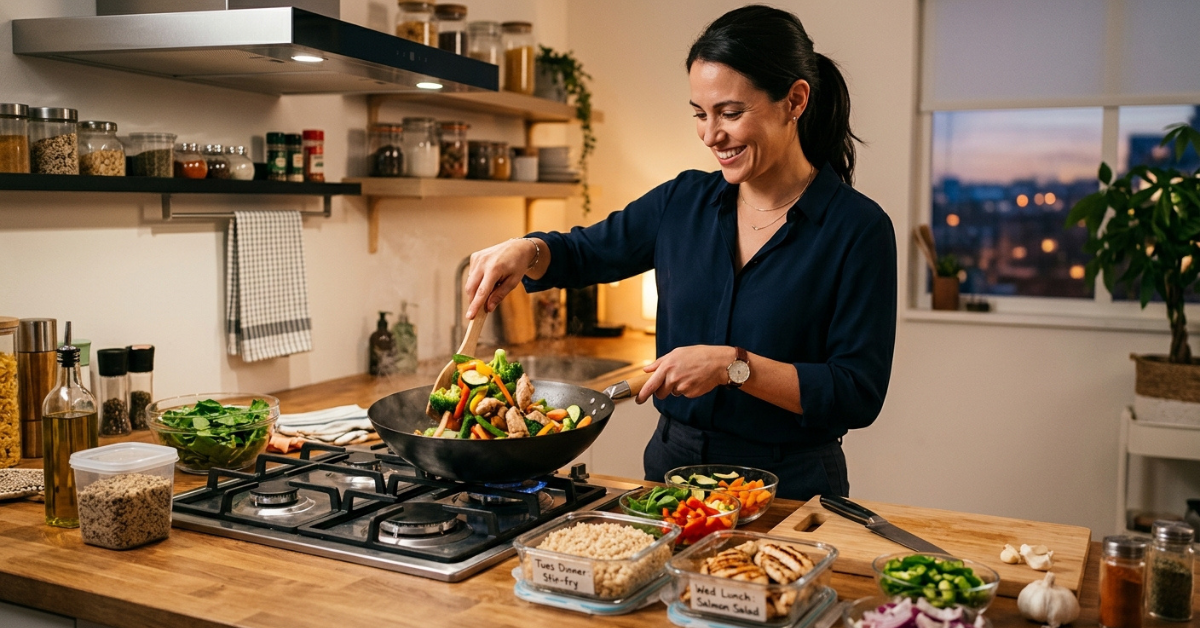
Meal prep does not have to mean cooking every dish on Sunday. Prepping parts is faster and keeps food fresher. Chop veggies, cook a pot of rice or noodle, wash salad greens, and store each in a container in the fridge. During the week, the cook only assembles. The meal prep guide for beginners covers the full Sunday routine.
Use a slow cooker so dinner is ready when you walk in
A slow cooker or crockpot does the work while the cook is at the office. Load it with chicken, beans, tomatoes and spices, switch it on, and a hot dinner waits at the door. A few slow cooker recipes in rotation make find recipes less of a chore.
The Best Way to Cook Fresh Meals on a Weeknight
The best way to cook fresh meals on a weeknight is to use one simple formula and repeat it.
Build every plate with protein, vegetables and a quality carb
A balanced plate holds a protein, a vegetable and a carb with fiber, such as brown rice or whole grain bread. The formula works with almost any food, so it is easy to mix and match.
Cook once and eat twice
When the pan is already hot, a bigger batch costs very little extra time. Cook a big pot of chili or curry, make a double batch, and freeze half. Roast a tray of chicken on Sunday and use it for tacos on Monday and a stir fry on Wednesday. Two meals from one session is the simplest way to make enough food for the week.
Use frozen and canned foods without losing nutrition
Many people believe fresh produce always beats frozen. A two year peer reviewed study tested broccoli, spinach, green beans and berries. Most comparisons showed no significant difference in vitamin content. When differences did appear, frozen produce beat fresh produce stored at home more often than the other way around (Li et al., 2017).
Quick Dinner Ideas When You Are Tired
Ten minute dinners for your lowest energy nights
- Fried eggs over rice with frozen peas and soy sauce
- Instant noodle upgraded with an egg and a handful of frozen veg
- A bean and cheese quesadilla, plus a quick salad
Twenty minute healthy meal ideas
- Stir fry with pre-cut vegetables and chicken strips
- Pasta with sliced meatball and jarred tomato sauce
- A Thai style coconut curry made with ready made paste
One pan and sheet pan dinners with almost no cleanup
Put in the oven what would otherwise fill three pots. Sausage, potatoes and chopped veggies roast together on one sheet pan in about 25 minutes.
A Simple Routine That Saves Time Every Evening
A small routine removes most of the stress and saves time all week.
Stock a pantry and freezer that works for you
Keep rice, pasta, canned beans, canned tomatoes, spices and oil in the pantry. Keep frozen vegetables, chicken, fish and a few frozen meals in the freezer. With those staples on hand, a cook can always find a quick meal that takes only a few minutes to cook.
Set up your kitchen before you leave for work
Five minutes in the morning can change the evening. Move the protein from freezer to fridge, start the slow cooker in the morning, set out the pan and cutting board, and check the plan on the fridge door.
A Sample Weekly Plan for Cooking After Work
Sunday prep schedule
| Day | Meal | Prep time |
| Sunday | Batch prep: cook rice, chop veggies, roast chicken | 60 minutes |
| Monday | Slow cooker chicken curry with rice | 10 minutes |
| Tuesday | Leftover curry over noodles | 5 minutes |
| Wednesday | Sheet pan sausage and vegetables | 10 minutes plus oven time |
| Thursday | Chicken and veg stir fry | 20 minutes |
| Friday | Planned takeout night | 0 minutes |
How to adjust the plan for shift work or late finishes
When a worker has to work late, the plan should lean on the freezer. Keep two frozen meals for emergencies and reheat them without guilt. The goal is a plan that fits the real week and not a perfect one.
How to Cut Back on Takeout Without Feeling Deprived
Plan one takeout night on your busiest day
Pick the hardest night of the week and mark it as takeout. That removes the guilt and the last minute scramble. Choosing to eat at home on the other nights also helps with saving money, since the plan covers most dinners.
How to order a healthier takeout meal when you do
Choose grilled or roasted items over fried ones, ask for sauce on the side, add a vegetable side, and save half the portion for tomorrow’s lunch.
Common Mistakes When You Cook After Work
Prepping too much food at once
The USDA Food Safety and Inspection Service says cooked meals stay safe for three to four days in the fridge and three to four months in the freezer, as reported by Fox 5 DC. A Sunday cook should prep for Monday through Wednesday and freeze the rest.
Choosing recipes that are too complicated for a weeknight
A recipe with twelve steps will take too long on a Tuesday. Save long recipes for weekends when a person can enjoy cooking. Weeknight dinner works best with five ingredients or fewer.
Storing meals the wrong way
“Divide large amounts of food into shallow containers,” advised Argyris Magoulas, a technical information specialist at the USDA Food Safety and Inspection Service, in the same report. Keep the fridge at 40°F or below and label each container with the date.
FAQs
What should someone do when they are too tired to cook after work?
Keep one default quick meal that needs no thinking, such as eggs, rice and frozen vegetables, and use it on every low energy night. The need is real. A reported survey of 2,000 Americans found that 77 percent say some days they are too exhausted to cook after work. A fixed default removes the daily decision, which is often the hardest part of making dinner.
How many nights a week should someone cook at home to eat healthy?
Three nights or more looks like a solid target. A study of 8,668 US adults in Public Health Nutrition found that people in households that cooked dinner at least three times a week had higher diet quality scores than those cooking twice a week or less, as summarized by the Institute of Food Technologists. Lead author Julia Wolfson of the University of Michigan noted that home cooking is “not always feasible for everyone,” so easy meals and planned takeout nights still have a place.
Is it cheaper to eat at home than to order takeout?
The data points that way. In 2024, farms received 18.5 cents of every grocery dollar but only 7.1 cents of every restaurant dollar, because restaurant prices also pay for preparing and serving meals (USDA Economic Research Service). USDA’s February 2026 forecast also projected restaurant prices to rise 3.7 percent in 2026 against 2.5 percent for groceries, as reported by Grocery Dive. Exact savings depend on the meals being compared.
Is it safe to leave a slow cooker on while at work?
Yes, when the cooker works properly and the cook follows a few rules. Clemson Extension, citing USDA guidance, explains that a slow cooker is built to cook slowly enough for unattended use while keeping food out of the 40°F to 140°F danger zone. Thaw meat first, cut it into small pieces, and fill the cooker between half and two thirds. If the power goes out while no one is home, throw the food away.
Can frozen meals be cooked without thawing first?
For most foods, yes. The USDA Food Safety and Inspection Service says cooking from frozen is safe but takes about 50 percent longer. Safe thawing methods are the refrigerator, cold water changed every 30 minutes, and the microwave. Counter thawing is not safe. The slow cooker is the exception, since Clemson Extension advises thawing meat before it goes in.
Which weeknight is the hardest for cooking at home?
Monday, according to the same reported survey, with Wednesday and Friday tied for second. Planning around the weak spots makes the week easier. A slow cooker meal fits Monday, a freezer meal fits Wednesday, and a planned takeout night fits Friday.
Conclusion
Cooking after work comes down to three steps. Plan three dinners, prep the parts on a quiet day, and cook fast with simple methods. Takeout can stay on the menu, but it no longer has to run the week.
One action is enough to start tonight: write down three dinners and add the ingredients to a grocery list.