
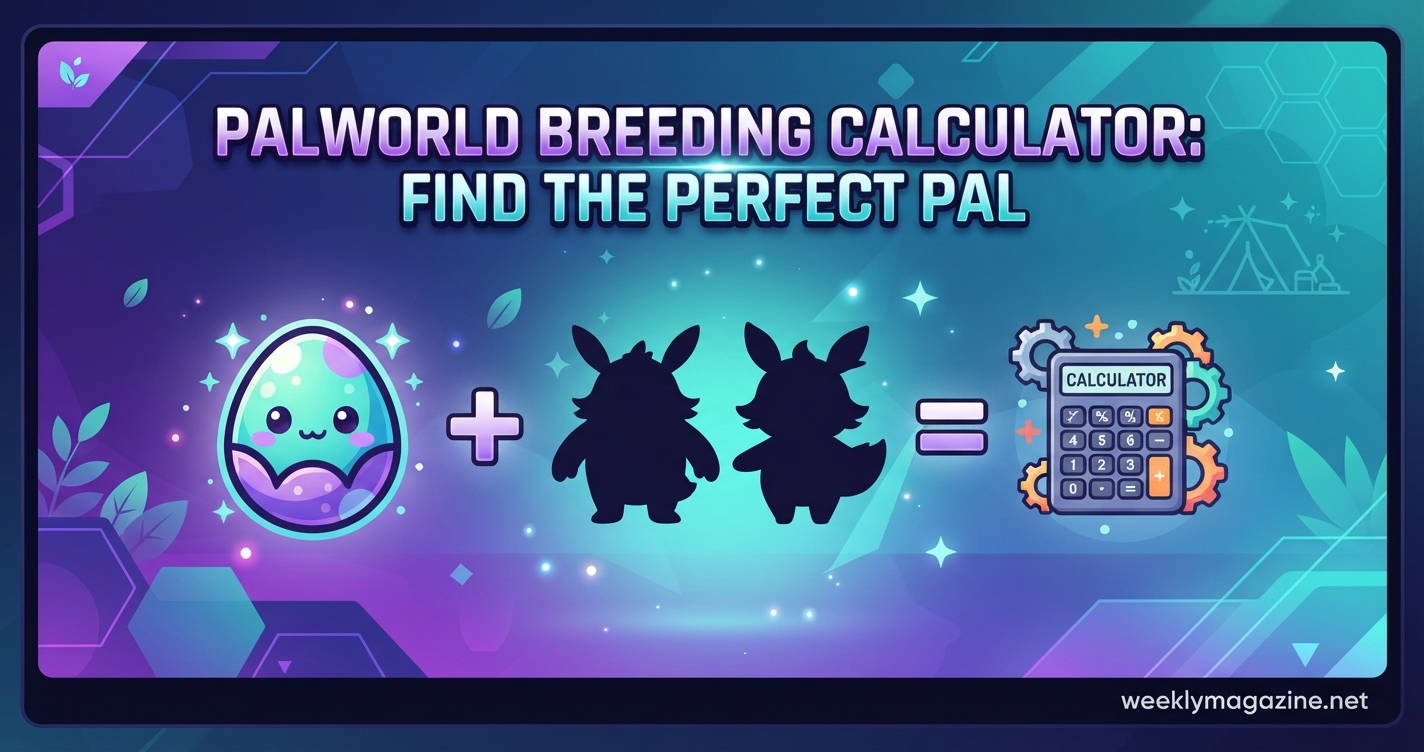
Breeding in Palworld looks simple on the surface, pair two Pals and wait for an egg, but figuring out exactly which Pal will hatch, and what passive skills it will carry, gets complicated fast once you start chasing a specific combination. A Palworld breeding calculator takes the guesswork out of the process, showing you which parent pairing produces the Pal you actually want.
This guide covers everything worth knowing about using a breeding calculator in Palworld, from how the underlying breeding formula works to how passive skills get passed down, so you can plan your ideal Pal lineup without wasting eggs on trial and error.
What Is a Palworld Breeding Calculator?
A Palworld breeding calculator is a free tool, usually web-based, that predicts which Pal will hatch from a given pair of parent Pals. Select your two parents, and the calculator instantly shows the resulting offspring based on the game’s breeding formula.
Since Palworld’s breeding system relies on a specific power-value formula rather than simple type matching, figuring this out manually would mean digging through community-compiled breeding charts. A calculator does that lookup for you instantly.
How Does Palworld Breeding Actually Work?
To breed, you need two compatible Pals of opposite genders placed together at a Breeding Farm, along with enough Cake to feed them. Once conditions are met, the pair produces an egg after some time, which then needs to be incubated to hatch into a new Pal.
Which Pal actually hatches depends on the combined power level of the two parent Pals, matched against the game’s internal breeding chart, rather than simply being a mix of the two parent species as you might expect.
How Does a Breeding Calculator Predict the Offspring?
The calculator works by referencing each Pal’s base power value, adding the two parent values together, and matching that combined total against the specific Pal assigned to that power range in the game’s breeding formula.
In most cases, this produces a straightforward result. However, several specific pairings are hardcoded to override the standard formula, producing an exact result regardless of the combined power calculation, which a good calculator accounts for automatically.
What Information Do You Need to Use the Calculator?
Using a breeding calculator is simple once you know which two Pals you want to try pairing.
- The first parent Pal you plan to use
- The second parent Pal you plan to pair it with
- Optionally, the passive skills currently held by each parent, if you want a passive skill prediction as well
Enter both Pals, and the calculator instantly shows the predicted offspring, along with an estimate of which passive skills might carry over to the resulting egg.
How Are Passive Skills Passed Down During Breeding?
Each parent Pal can pass down a portion of its equipped passive skills to the offspring, up to a combined maximum of four passive skills on the resulting Pal. The exact skills that carry over involve an element of randomness rather than a guaranteed transfer.
Serious breeders often run multiple breeding attempts specifically to stack desirable passive skills onto a single Pal, gradually working toward a build with several strong passives combined on one creature.
Why Do Certain Pal Pairings Give Unexpected Results?
Palworld includes a number of special, hardcoded breeding combinations that ignore the standard power-based formula entirely. These specific pairings were deliberately built into the game to produce certain rare or unique Pals that would otherwise be difficult to obtain through normal formula-based breeding.
A breeding calculator that accounts for these special cases will flag them separately, letting you know when a pairing produces a specific, guaranteed result rather than the standard formula-based prediction.
How Long Does Breeding and Incubation Take?
Once a pair successfully breeds, the resulting egg needs to be placed in an Egg Incubator, or left near a heat source depending on the egg type, to hatch. Incubation time varies depending on the egg’s rarity tier, with rarer eggs generally taking longer to hatch than common ones.
Planning your breeding sessions around incubation time helps you manage a more efficient Pal farm, especially if you are running multiple breeding pairs simultaneously to speed up your overall progress.
Best Pals for Starting a Breeding Farm
New breeders typically start with easily obtainable, common Pals to understand the mechanics before investing time chasing rarer combinations. Pals with useful early-game passive skills make a solid foundation to build toward more specialized breeding goals later.
As you progress, focusing on Pals with strong work suitability passives, such as those boosting mining, farming, or handiwork, tends to offer the most practical long-term value for your base operations.
How to Use a Breeding Calculator to Plan a Passive Skill Build
Planning an ideal passive skill combination usually takes several breeding generations rather than a single lucky egg. A calculator helps map out this process by showing which passive skills are likely to transfer at each breeding step.
Many experienced players work backward from their desired final Pal, using the calculator to plan a sequence of intermediate breeding pairs that gradually stack the passives they want onto their target Pal.
Common Mistakes When Using a Palworld Breeding Calculator
- Selecting the wrong variant of a Pal when multiple versions exist in the game
- Forgetting that passive skill inheritance involves randomness, not a guaranteed outcome
- Overlooking special hardcoded breeding combinations that bypass the standard formula
- Not accounting for gender requirements, since breeding pairs need opposite genders
- Assuming a calculator’s prediction removes all randomness from the actual in-game result
Is Breeding Worth the Time Investment in Palworld?
Breeding takes real time and resources, including Cake and base management, but it remains one of the most reliable ways to obtain specific rare Pals or build a creature with a highly optimized passive skill set that would be difficult to find in the wild.
For players focused on late-game efficiency, whether for combat, base work, or completing the Paldeck, a well-planned breeding strategy, guided by a calculator, tends to save considerably more time than random wild captures alone.
How Breeding Calculators Handle Rare and Legendary Pals
Rare and legendary Pals typically sit at the higher end of the power-value formula, meaning they usually require pairing two already-strong Pals to reach the combined power threshold needed. A calculator makes identifying these high-value pairings far easier than manually cross-referencing power values.
Some legendary Pals cannot be bred at all and must be obtained through other in-game methods, so a reliable calculator will typically indicate when a desired Pal falls outside standard breeding possibilities entirely.
Building an Efficient Breeding Farm Layout
An efficient breeding setup generally includes a Breeding Farm, a steady Cake supply chain, and enough Egg Incubators to hatch multiple eggs simultaneously without bottlenecking your progress. Positioning these structures close together within your base reduces wasted time managing the process.
Automating Cake production early, rather than crafting it manually each time, keeps your breeding operation running continuously instead of stalling out whenever your Cake supply runs low.
Palworld Breeding for Different Playstyles
Combat-Focused Players
Players building a strong combat team typically prioritize breeding for offensive or defensive passive skills, stacking multiple damage-boosting or survivability passives onto a single powerful Pal for late-game battles.
Base Building and Work Efficiency
Players focused on base optimization often breed specifically for work-suitability passives, aiming to create Pals that dramatically speed up tasks like mining, farming, logging, or handiwork around their base.
Paldeck Completionists
Players working toward filling out their entire Paldeck use breeding calculators to identify which rare Pals are obtainable through specific parent combinations, rather than relying purely on chance encounters in the wild.
Casual Explorers
Even players not deeply invested in optimization often use a basic breeding calculator just to experiment safely, checking a pairing’s predicted result before committing Cake and time to an actual breeding attempt.
How Power Values Influence Breeding Outcomes
Every Pal in the game has an assigned power value used specifically in breeding calculations, separate from its combat stats. When two parents breed, their power values are averaged, and the resulting number determines which Pal on the breeding chart matches that combined total.
This system means pairing two very different Pals can sometimes produce an unexpected third species entirely unrelated to either parent, which is exactly the kind of surprising result a calculator helps you anticipate before committing resources.
Tips for Managing Cake Production for Breeding
Cake is a required ingredient for triggering breeding at the Breeding Farm, and running out mid-breeding-session can slow your progress considerably. Setting up a dedicated Cake production line, with a consistent supply of ingredients like flour, eggs, milk, and honey, keeps your breeding operation running smoothly.
Many experienced players assign specific base Pals to Cake-related tasks permanently, treating steady Cake output as a core part of their overall base infrastructure rather than an occasional chore.
How Breeding Fits Into the Broader Palworld Progression
Early in the game, breeding takes a backseat to exploration, base building, and simply capturing new Pals through normal gameplay. As players unlock the Breeding Farm and gather enough resources to sustain it, breeding gradually becomes a more central part of long-term progression.
By the mid to late game, many players shift significant base capacity toward breeding infrastructure, since it becomes one of the most reliable paths toward specific, highly optimized Pals that are difficult or impossible to find through wild encounters alone.
A Quick Glossary of Palworld Breeding Terms
- Power value: a hidden numeric value assigned to each Pal, used specifically in breeding calculations
- Passive skill: a special trait a Pal can carry that provides a bonus effect, inheritable through breeding
- Breeding Farm: the base structure required for two Pals to produce an egg together
- Egg Incubator: the structure used to hatch eggs after they are produced
- Hardcoded pairing: a specific parent combination that overrides the standard power-based breeding formula
Planning a Multi-Generation Breeding Chain
Reaching an ideal Pal, one with both the right species and a stacked set of desirable passive skills, often takes several breeding generations rather than a single attempt. Players typically start by breeding for the correct species first, then focus subsequent breeding rounds on refining the passive skill combination.
Keeping notes, or using a calculator that lets you plan out each generation in advance, helps avoid wasted Cake and time on breeding pairs that will not meaningfully move you closer to your final target Pal.
Breeding Calculator vs Community Breeding Charts
Before dedicated calculators existed, most Palworld players relied on community-compiled spreadsheets and breeding charts, manually cross-referencing power values to guess at outcomes. These charts were useful but often tedious to navigate, especially for players unfamiliar with the underlying formula.
A calculator streamlines this same information into an instant, searchable tool, removing the need to manually scroll through a large spreadsheet every time you want to test a new pairing idea.
How Server Settings Can Affect Breeding
Players on private or custom servers sometimes adjust settings related to breeding speed, egg hatching time, or resource requirements. These custom settings do not typically change which Pal results from a given pairing, but they can significantly affect how quickly you can execute a breeding strategy.
If you are playing on a modified server, it is worth checking whether breeding-related settings have been altered, since this can change your overall planning around Cake production and incubation timing even though the core breeding formula usually remains the same.
Why Some Players Avoid Breeding Entirely
Not every player chooses to engage with the breeding system, since it requires a meaningful time investment in base building, resource gathering, and waiting for eggs to hatch. Some players prefer capturing Pals directly in the wild instead, accepting more randomness in exchange for a simpler overall approach.
Breeding tends to appeal most to players who enjoy optimization and long-term planning, while players focused primarily on exploration or combat may find wild captures sufficiently rewarding without the added breeding infrastructure.
Trading Pals as an Alternative to Breeding
Some multiplayer servers allow trading Pals between players, which can sometimes be a faster route to a specific rare Pal than breeding it yourself. This works especially well within active communities where certain hard-to-breed Pals circulate more freely between players.
Even when trading is an option, understanding the breeding formula remains valuable, since it helps you judge whether a Pal offered in a trade is genuinely rare and difficult to breed, or something you could realistically produce yourself with a bit of planning.
How to Verify a Calculator’s Breeding Data Is Up to Date
Palworld has received updates that occasionally add new Pals or adjust game mechanics, which can affect breeding outcomes over time. A reliable calculator should reflect the current version of the game, so checking for a recent update date or active maintenance is worth doing before trusting its predictions completely.
If a calculator’s results seem inconsistent with your actual in-game outcomes, it may be running on outdated data from a previous game version, in which case switching to a more recently updated tool usually resolves the discrepancy.
Balancing Breeding With Other Base Priorities
A dedicated breeding operation competes for base space, worker Pals, and resources with other priorities like defense, production, and storage. Many experienced players designate a separate section of their base specifically for breeding infrastructure, keeping it organized and distinct from combat or crafting areas.
This kind of intentional layout planning becomes especially important once you are running several breeding pairs simultaneously, since disorganized bases tend to create bottlenecks in Cake supply or incubator availability that slow down your overall breeding progress.
Final Thoughts
A Palworld breeding calculator turns a genuinely confusing hidden formula into a clear, predictable planning tool. Whether you are chasing a specific rare Pal, stacking passive skills for an optimized build, or simply curious what a pairing might produce, having an accurate prediction saves real time and Cake compared to trial and error.
Double-check you have selected the correct Pal variant, account for the randomness in passive skill inheritance, and watch for special hardcoded pairings that override the standard formula. Keeping your calculator’s data up to date with the current game version also helps ensure your predictions stay reliable over time. For more gaming guides and tools like this one, visit WeeklyMagazine.net.
Frequently Asked Questions (FAQs)
1. How do I use a Palworld breeding calculator?
Select the two parent Pals you plan to breed, and the calculator instantly predicts the resulting offspring based on the game’s power-value breeding formula, along with likely passive skill outcomes.
2. Does breeding always produce the same offspring for a given pairing?
The species of the offspring is generally consistent for a given pairing based on the formula, but passive skills carried over involve an element of randomness each time.
3. Why did my breeding result not match the calculator’s prediction?
This usually happens from selecting the wrong Pal variant, or from a special hardcoded pairing overriding the standard formula, which a good calculator should flag separately.
4. How many passive skills can be passed down during breeding?
Offspring can inherit up to four total passive skills combined from both parents, though which specific skills transfer involves some randomness rather than a guaranteed result.
5. What do I need to start breeding Pals?
You need a Breeding Farm structure, two compatible Pals of opposite genders, and enough Cake to feed them before they will produce an egg.
6. How long does it take for a Palworld egg to hatch?
Incubation time depends on the egg’s rarity tier, with rarer eggs generally taking longer than common ones once placed in an Egg Incubator or near a suitable heat source.
7. Can every Pal in Palworld be bred?
Most Pals can be bred through the standard formula, but some rare or legendary Pals can only be obtained through other in-game methods rather than breeding.
8. Is a breeding calculator accurate for planning multi-step breeding chains?
Yes, many calculators let you plan several breeding generations in sequence, helping map out a path toward a specific target Pal with a desired passive skill combination.
About the Author
Syeda is a global link building specialist and content writer. She specializes in creating clear, well-researched gaming and technology content that helps players get the most out of the games they love.