

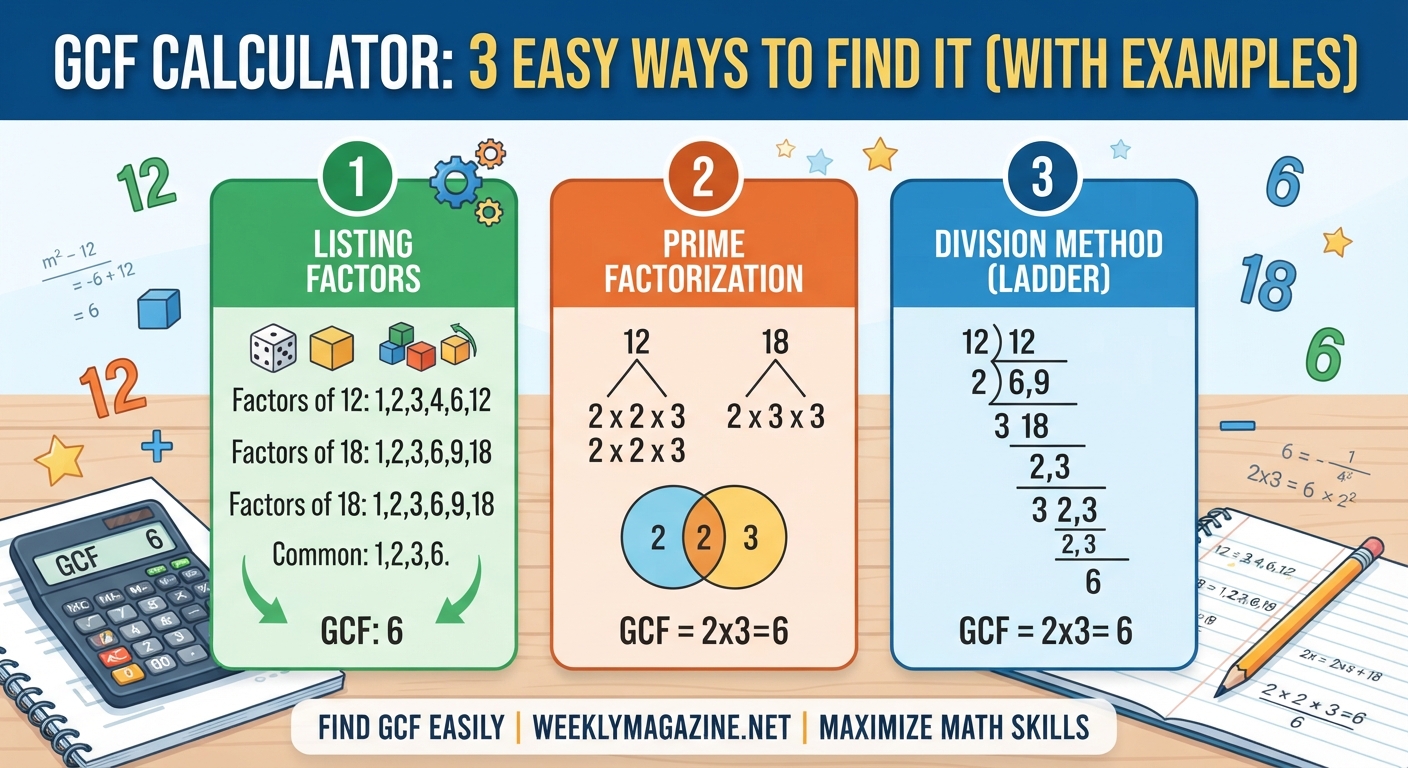
Staring at two numbers and trying to figure out their greatest common factor by hand can eat up more time than it should, especially once the numbers get bigger than a simple textbook example. A GCF calculator solves this instantly, but understanding the three actual methods behind that instant answer turns a mysterious tool into something you can genuinely use with confidence.
This guide walks through exactly how a GCF calculator works, all three common methods for finding the answer by hand, and where this concept actually shows up outside a math worksheet.
What Does GCF Actually Stand For?
GCF stands for Greatest Common Factor, the largest whole number that divides evenly into two or more numbers with nothing left over. If you have ever simplified a fraction, you have already used this concept, whether or not you called it by name at the time.
The same value goes by a few other names depending on the textbook or country, including Greatest Common Divisor (GCD) and Highest Common Factor (HCF). All three terms describe the exact same number, just with different labels.
How Does a GCF Calculator Find the Answer?
Behind the scenes, a calculator typically runs one of two efficient methods, either breaking each number down into its prime factors, or applying the Euclidean algorithm, a fast repeated-division technique that avoids factoring large numbers entirely.
Either approach lands on the same correct answer. Calculators favor these methods specifically because they scale well even with large numbers, where manually listing every factor would become impractically slow.
Method 1: Listing Factors by Hand
The most beginner-friendly method involves writing out every factor of each number, then circling the factors they share, and finally picking the largest shared value.
For example, the factors of 12 are 1, 2, 3, 4, 6, and 12. The factors of 18 are 1, 2, 3, 6, 9, and 18. The numbers they share are 1, 2, 3, and 6, making 6 the greatest common factor.
This method works well for small numbers but becomes tedious and error-prone once the numbers grow larger, which is exactly where the next two methods become more practical.
Method 2: Prime Factorization
This approach breaks each number down into its prime building blocks, then multiplies together only the prime factors both numbers share.
| Number | Prime Factorization |
|---|---|
| 24 | 2 × 2 × 2 × 3 |
| 36 | 2 × 2 × 3 × 3 |
Both numbers share two 2s and one 3, so the GCF is 2 × 2 × 3, which equals 12. This method scales more reliably to larger numbers than simple listing, since prime factorization stays manageable even as the numbers grow.
Method 3: The Euclidean Algorithm
The Euclidean algorithm skips factoring entirely and instead relies on repeated division. Divide the larger number by the smaller number, then replace the larger number with the smaller number and the smaller number with the remainder. Repeat until the remainder reaches zero.
The last non-zero remainder in that process is the GCF. This method is what most calculators actually use internally for large numbers, since it works efficiently no matter how big the starting values are.
Worked Example: Finding the GCF of 24 and 36
Using the Euclidean algorithm on 24 and 36: divide 36 by 24, leaving a remainder of 12. Divide 24 by 12, leaving a remainder of 0. Since the last non-zero remainder was 12, the GCF of 24 and 36 is 12, matching the result from the prime factorization method above.
Seeing the same answer confirmed through two completely different methods is a useful way to double-check your work, whether by hand or when verifying a calculator’s output.
GCF vs LCM: How Are They Different?
GCF finds the largest number that divides evenly into a set of numbers, while LCM, or Least Common Multiple, finds the smallest number that all the given numbers divide into evenly. They answer opposite questions using related math.
These two concepts are often taught together because they share the same underlying prime factorization, and many calculators offer both GCF and LCM results side by side for exactly this reason.
Why Simplifying Fractions Depends on GCF
To reduce a fraction to its simplest form, you divide both the numerator and denominator by their GCF. The fraction 18/24, for example, simplifies to 3/4 once you divide both numbers by their GCF of 6.
This is arguably the single most common practical use of GCF in everyday math, showing up constantly in cooking measurements, construction calculations, and any situation involving ratios that need to be expressed in their simplest terms.
How to Use a GCF Calculator for More Than Two Numbers
Finding the GCF of three or more numbers works the same way, just extended across every value. Most calculators handle this by finding the GCF of the first two numbers, then finding the GCF of that result and the next number, repeating until every number has been included.
This step-by-step approach means the calculator never needs to compare more than two numbers at once, keeping the underlying math manageable regardless of how many numbers are in your original set.
Common Mistakes When Calculating GCF
- Confusing GCF with LCM, since the two are often taught in the same lesson
- Missing a shared prime factor during manual prime factorization
- Stopping the Euclidean algorithm too early, before the remainder actually reaches zero
- Forgetting that the GCF of any number and zero is simply that number itself
- Assuming the GCF must always be a small number, when large numbers can still share a large common factor
GCF in Algebra: Factoring Polynomials
Beyond plain numbers, GCF also applies to algebraic expressions. Factoring out the greatest common factor from a polynomial like 6x squared plus 9x means identifying that 3x divides evenly into both terms, leaving 3x times the expression 2x plus 3.
This algebraic use of GCF becomes a foundational skill for later topics, including factoring quadratics and simplifying rational expressions, making early comfort with basic GCF calculations genuinely useful well beyond elementary arithmetic.
Is GCF the Same as GCD or HCF?
Yes, GCF, GCD, and HCF all describe the exact same mathematical value, just using different regional or textbook terminology. American textbooks typically use GCF, many international and academic sources use GCD, and some British and Commonwealth curricula favor HCF.
If you see any of these three abbreviations, you can safely assume they are asking for the same calculation, so a GCF calculator will correctly answer a GCD or HCF question as well without any adjustment needed.
When Should You Use a Calculator Instead of Solving by Hand?
Small numbers under 50 are usually fast enough to solve manually using the listing method, especially with practice. Once numbers climb into the hundreds or thousands, prime factorization or the Euclidean algorithm becomes necessary, and a calculator saves meaningful time and reduces the risk of a careless error.
Students learning the concept for the first time benefit most from working through smaller examples by hand before relying on a calculator, since this builds genuine number sense rather than just producing an answer without understanding.
GCF With Word Problems
Real-world GCF problems often show up disguised as word problems rather than plain number pairs. A classic example asks how many identical gift bags can be made from 24 chocolates and 36 candies, using every item with nothing left over, which is really just asking for the GCF of 24 and 36.
Recognizing this pattern, dividing a group of items into equal, non-overlapping sets, is the key skill for spotting when a word problem is secretly a GCF question in disguise.
A Quick Glossary of Related Terms
- Factor: a whole number that divides evenly into another number with no remainder
- Prime number: a number greater than 1 with exactly two factors, itself and 1
- Prime factorization: breaking a number down into the prime numbers that multiply together to form it
- Multiple: the result of multiplying a number by a whole number
- Coprime numbers: two numbers whose only common factor is 1, meaning their GCF equals 1
How Teachers Use GCF to Build Toward Algebra
Elementary and middle school teachers introduce GCF primarily through fraction simplification, but the concept quietly lays groundwork for algebraic factoring years later. Students who genuinely understand GCF with plain numbers tend to grasp polynomial factoring more easily once that topic arrives.
This is part of why GCF remains a persistent topic across multiple grade levels rather than something taught once and left behind, reappearing in slightly more complex forms as students progress through their math education.
GCF and Coprime Numbers
When two numbers share no common factors other than 1, they are called coprime, or relatively prime. Their GCF is simply 1, which sometimes surprises students expecting a larger shared value between two numbers that otherwise look unrelated.
Coprime pairs show up frequently in cryptography, scheduling problems, and certain areas of computer science, making this seemingly simple edge case more practically relevant than it might first appear in a basic math lesson.
How GCF Relates to Ratios and Proportions
Simplifying a ratio works exactly like simplifying a fraction, dividing both sides by their GCF to express the relationship in its smallest possible whole numbers. A ratio of 15 to 25, for instance, simplifies to 3 to 5 once divided by their GCF of 5.
This connection means GCF skills transfer directly into other math topics involving comparisons between quantities, reinforcing why building a solid foundation with GCF pays off across multiple areas of math rather than just one isolated topic.
Practicing GCF Problems Before a Test
Students preparing for a math quiz or exam often benefit from working through a mix of small and large number pairs, using a calculator afterward to verify their manual work rather than relying on it from the start.
This approach builds both speed and genuine confidence, since students who can solve problems by hand and confirm their answer with a calculator tend to perform more reliably under timed test conditions than those who rely on a tool exclusively.
GCF Calculator vs Manual Calculation for Everyday Use
Outside a classroom, a calculator makes far more practical sense than manual calculation, particularly for tasks like dividing supplies evenly, scaling a recipe using whole-number ratios, or working out fabric or material cuts with the least amount of waste.
Manual methods remain valuable primarily as a learning tool and for quick mental checks with small numbers, while a calculator becomes the more efficient choice the moment real-world numbers stop being conveniently small and round.
How GCF Appears in Computer Science
The Euclidean algorithm used to calculate GCF is also a foundational algorithm in computer science, taught in introductory programming courses as an early example of an efficient, elegant solution to a mathematical problem.
Understanding GCF conceptually before encountering it again in a programming context tends to make that later material click faster, since the underlying logic remains identical, just expressed in code rather than arithmetic steps on paper.
Questions to Ask Yourself Before Solving a GCF Problem
- Are the numbers small enough to list factors quickly, or large enough to need prime factorization?
- Is the question actually asking for GCF, or is it secretly asking for LCM instead?
- Does the problem involve plain numbers, or is it a word problem describing equal groups?
- Would double-checking with a calculator help confirm a manually calculated answer?
Running through these quick questions before diving into calculations helps avoid the most common early mistake, applying the right method to the wrong question, which happens more often than an actual arithmetic error.
How GCF Connects to Simplifying Algebraic Fractions
Beyond basic fractions, GCF also plays a role in reducing algebraic fractions, where both the numerator and denominator contain variables. Identifying the greatest common factor between terms like 4x and 6x squared allows the expression to be simplified before any further algebraic manipulation.
This skill becomes especially important in later math courses, where unsimplified expressions can make otherwise straightforward equations look far more complicated than they actually are.
Building Number Sense Through GCF Practice
Regularly working through GCF problems, even simple ones, strengthens a broader sense of how numbers relate to each other, which pays dividends across nearly every other area of math. Students who practice this regularly often find themselves spotting patterns and shortcuts naturally, without consciously thinking through every step.
This kind of intuitive number sense is difficult to teach directly but develops reliably through consistent practice, making GCF exercises more valuable long-term than their simple appearance might initially suggest.
Final Thoughts
A GCF calculator turns a process that can genuinely trip people up, especially with larger numbers, into an instant, reliable answer. Understanding the three underlying methods, listing factors, prime factorization, and the Euclidean algorithm, means you are never fully dependent on the tool and can verify results by hand whenever needed, whether you are working through homework, a word problem, or an algebra assignment.
Whether you are simplifying a fraction, factoring a polynomial, or just checking homework, knowing how the calculation actually works makes the result far more useful than a number alone. You can review additional worked examples through Khan Academy’s greatest common factor lessons if you want extra practice beyond this guide.
For more practical math tools and guides like this one, visit WeeklyMagazine.net.
Frequently Asked Questions (FAQs)
1. What is the GCF of two numbers?
The GCF, or Greatest Common Factor, is the largest whole number that divides evenly into both numbers with no remainder left over.
2. How do you find the GCF step by step?
List the factors of each number, identify the factors they share, and select the largest shared value, or use prime factorization or the Euclidean algorithm for larger numbers.
3. What is the difference between GCF and LCM?
GCF finds the largest number that divides evenly into a set of numbers, while LCM finds the smallest number that all the given numbers divide into evenly.
4. Is GCF the same as GCD?
Yes, GCF and GCD refer to the exact same value. GCF is more common in American textbooks, while GCD is used more broadly in academic and international contexts.
5. How is GCF used to simplify fractions?
Dividing both the numerator and denominator of a fraction by their GCF reduces the fraction to its simplest form without changing its actual value.
6. Can a GCF calculator handle more than two numbers?
Yes, most calculators find the GCF across three or more numbers by comparing them sequentially, applying the same core method to each pair in turn.
7. What is the GCF used for in algebra?
GCF is used to factor polynomials by pulling out the largest shared term from each part of an expression, simplifying it before further algebraic work.
8. What is the fastest way to find GCF for large numbers?
The Euclidean algorithm, based on repeated division, is generally the fastest method for large numbers, since it avoids the need to fully factor either value.
About the Author
Syeda is a global link building specialist and content writer. She specializes in creating clear, well-researched educational content that helps students and everyday readers understand math concepts with confidence.