

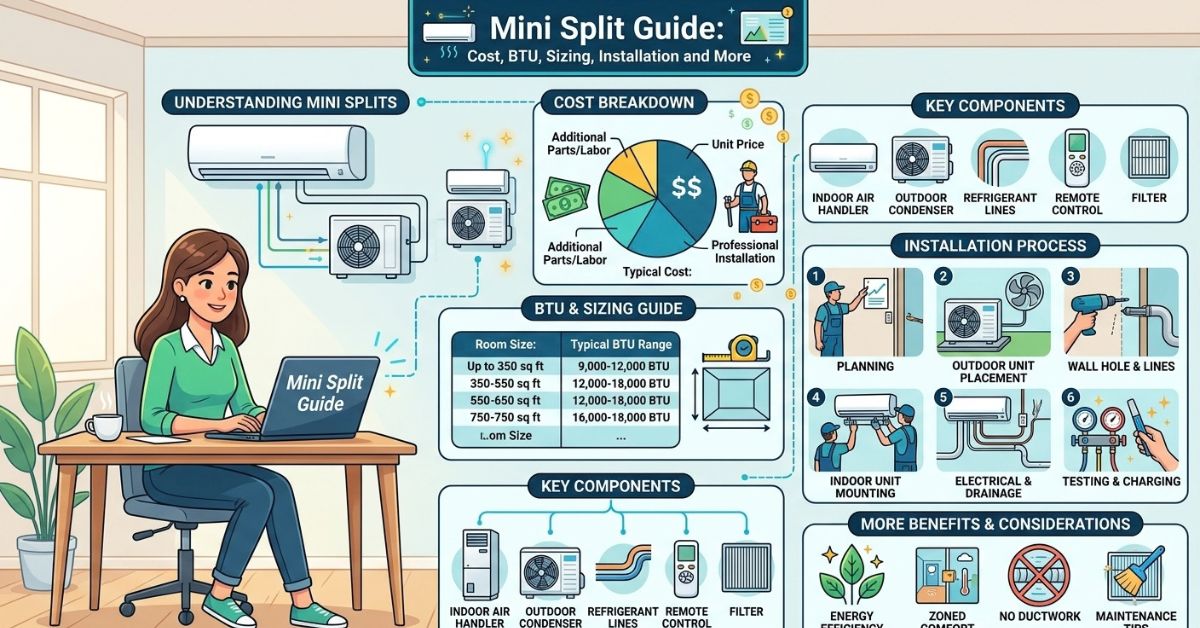
A mini split is a heating and cooling system that does not need traditional ductwork.
It can cool or heat one room or several rooms. This makes it useful for bedrooms, home offices, garages, additions, and homes without existing ducts.
A basic mini split has an outdoor unit and one or more indoor units. The units are connected by refrigerant tubing, electrical wiring, and a drain line where needed.
What Is a Mini Split?
A mini split is a ductless heating and cooling system.
Unlike central air, it does not send conditioned air through a large network of ducts.
Instead, an indoor air handler sends cooled or heated air directly into the room.
A single zone system usually has one indoor unit connected to one outdoor unit.
A multi zone system can connect several indoor units to one outdoor unit, depending on the system.
How Does a Mini Split Work?
A mini split uses refrigerant to move heat.
During cooling, the indoor unit takes heat from the room. The refrigerant carries that heat to the outdoor unit.
The outdoor unit releases the heat outside.
The cooled refrigerant then returns to the indoor unit and the process continues.
A mini split heat pump can also reverse this process.
During heating, the system takes available heat from outdoor air and moves it inside.
What Are the Main Parts of a Mini Split?
A typical mini split has three important parts.
Outdoor Unit
The outdoor unit contains the compressor and other components that help move heat.
Indoor Unit
The indoor unit contains the coil and fan that deliver conditioned air into the room.
Connecting Lines
The indoor and outdoor units are connected through a small conduit.
It can contain refrigerant tubing, electrical wiring, and a condensate drain.
Why Do People Choose a Mini Split?
One major reason is that it does not require traditional ductwork.
This can make it useful for older homes, room additions, garages, and spaces where adding ducts would be difficult.
Another benefit is zone control.
You can control the temperature of individual rooms instead of cooling the entire house at the same level.
Mini splits can also be efficient because they deliver conditioned air directly into the space.
What Are the Disadvantages of Mini Split Systems?
Mini splits also have some disadvantages.
The indoor unit is usually visible on the wall or ceiling.
The initial equipment and installation cost can also be higher than a simple window AC or portable AC.
The system also needs regular filter cleaning and maintenance.
Another point is ventilation.
A mini split mainly conditions and recirculates indoor air. It is not automatically a replacement for a dedicated whole home ventilation system.
How Much Does a Mini Split Cost?
The answer depends on the system.
The mini split cost can change based on BTU capacity, brand, number of zones, indoor unit type, installation difficulty, electrical work, and local labor.
This is why searches such as how much is a mini split, how much does a mini split cost, how much are mini splits, and how much do mini splits cost can have different answers.
The equipment price is also different from the complete installed price.
For an accurate quote, compare the unit price and installation cost separately.
What Is the Cost of a Mini Split AC?
The cost of mini split AC depends on the size and features of the system.
A small single zone system will normally have a different price from a large multi zone system.
A system with heating, advanced controls, higher efficiency, or multiple indoor units can also cost more.
The same applies to ductless AC cost and split AC unit cost.
Installation conditions can have a major effect on the final price.
How Much Does a Mini Split System Cost for 1,000 Sq Ft?
There is no single price or BTU size that is correct for every 1,000 square foot home.
The required capacity depends on insulation, windows, ceiling height, climate, sunlight, and other factors.
ENERGY STAR recommends proper sizing and says contractors should use a Manual J calculation to determine the heating and cooling needs of a home.
This is more reliable than choosing a unit from square footage alone.
What BTU Mini Split Do You Need?
BTU measures the cooling and heating capacity of an air conditioning system.
Common mini split sizes include:
- 12,000 BTU
- 18,000 BTU
- 24,000 BTU
- 36,000 BTU
The right size depends on the space and its heating and cooling load.
A unit that is too small may struggle to keep the room comfortable.
A unit that is too large may also create comfort and performance problems.
Proper sizing matters.
12,000 BTU Mini Split
A 12,000 BTU mini split is a common choice for smaller spaces.
Some Della models in this capacity are listed for spaces up to around 550 square feet, but the correct size depends on the actual room conditions.
Do not choose a 12,000 BTU unit only because the room size appears to match.
Insulation and climate also matter.
18,000 BTU Mini Split
An 18,000 BTU mini split provides more capacity than a 12,000 BTU model.
Some 18,000 BTU systems are designed for spaces around 1,000 square feet, depending on the model and conditions.
An 18,000 BTU mini split is approximately 1.5 tons of cooling capacity.
However, a 1,000 square foot space does not automatically require an 18,000 BTU system.
A proper load calculation is still important.
3 Ton Mini Split
A 3 ton mini split is approximately 36,000 BTU.
This is a much larger system than a 12,000 BTU or 18,000 BTU unit.
A 3 ton system may be used for larger spaces or multi zone applications.
The correct capacity should always be based on the actual heating and cooling load.
BTU to Ton Conversion
The common HVAC conversion is simple.
- 12,000 BTU is about 1 ton.
- 18,000 BTU is about 1.5 tons.
- 24,000 BTU is about 2 tons.
- 36,000 BTU is about 3 tons.
- So, 18,000 BTU to a ton is approximately 1.5 tons.
Single Zone and Multi Zone Mini Split
A single zone mini split is designed for one main indoor space.
A multi zone mini split can connect multiple indoor units to one outdoor unit.
This can be useful when you want separate temperature control in different rooms.
For example, one indoor unit can serve a bedroom while another serves a living room.
The exact number of indoor units depends on the outdoor unit and manufacturer specifications.
Dual Zone Mini Splits
Dual zone mini splits are designed to serve two indoor zones.
They can be useful for two bedrooms, a bedroom and living room, or other two room layouts.
Each indoor unit can generally have its own temperature control.
This gives you more control than a single room system.
Ceiling Cassette Mini Split
A ceiling cassette mini split is installed in or against the ceiling.
It distributes conditioned air across the room through multiple directions.
This design can provide a cleaner appearance than a traditional wall mounted indoor unit.
Carrier describes ceiling cassette systems as ductless indoor units that can be used in single zone and multi zone applications.
Mini Split vs Window AC
A window AC is installed directly in a window opening.
A mini split does not need a window opening.
This makes a mini split useful when you have a narrow window AC unit space or when you do not want to block a window.
A window unit is usually simpler to install.
A mini split can provide better zone control and can also provide heating when you choose a heat pump model.
Best Air Conditioner for Small Windows
If your window is very small, finding the best air conditioner for small windows can be difficult.
A narrow window AC may not provide the capacity or fit you need.
A mini split can be an alternative because its indoor unit is installed on a wall, ceiling, or floor depending on the model.
It does not need the AC cabinet to sit inside the window.
Portable AC vs Mini Split
A portable AC stays inside the room.
Most portable AC systems need an exhaust method to remove hot air.
This is why people often search for how to vent a portable air conditioner without a window.
A mini split works differently.
It uses a separate outdoor unit connected to the indoor unit through refrigerant lines.
Della Mini Split Guide
Della mini split systems are available in several capacities and configurations.
Della products include options for different room sizes and applications.
The company also lists mini split products with heating and cooling features.
When comparing a Della system, check the exact model number.
Different models can have different BTU ratings, voltage requirements, features, and warranty terms.
Della AC and Della Air Conditioner
Searches for Della AC, Della AC unit, Della air conditioner, and Della split unit can refer to different products.
Some may be mini splits.
Others may be portable or window air conditioners.
Always check the exact product category before buying.
Della 18000 BTU Mini Split
A Della 18000 BTU mini split is designed for higher capacity cooling and heating than a 12,000 BTU model.
The exact coverage depends on the model.
Check the manufacturer’s specifications before using an 18,000 BTU unit for a particular room.
Della 14000 BTU Portable Air Conditioner
A Della 14000 BTU portable air conditioner is different from a Della mini split.
A portable AC is designed to remain inside the room and normally uses an exhaust hose.
A mini split has a separate outdoor unit.
These two systems should not be compared only by their BTU numbers.
Della Portable Air Conditioner
A Della portable air conditioner can be useful when permanent installation is not practical.
It may also suit renters or rooms where a mini split installation is not possible.
Check the venting and drainage instructions for the exact model.
Della Window Air Conditioner
A Della window air conditioner is designed for window installation.
This is different from a Della split unit.
Before buying, measure the window opening and check the product dimensions.
Della Mini Split Manual
If you need a Della mini split manual, use the exact model number.
The manual can provide information about installation, remote control settings, cleaning, error codes, electrical requirements, and maintenance.
Do not use a manual for a different model.
Della Mini Split Warranty
The Della mini split warranty can depend on the product and purchase conditions.
Check the official warranty terms for the exact model before buying.
Keep your receipt and product information in case you need warranty service.
Della Mini Split Parts
When looking for Della mini split parts, always match the exact model number.
Parts are not automatically compatible between different mini split systems.
This is especially important for electrical parts, controls, indoor components, and outdoor components.
Mini Split Installation
Mini split installation involves mounting the indoor unit, placing the outdoor unit, connecting refrigerant lines, making electrical connections, and setting up the condensate drain where required.
The two units need to be positioned correctly.
The refrigerant lines also need proper installation.
Carrier notes that ductless systems need a small wall opening for the connection between the indoor and outdoor units.
Can You Install a Mini Split Yourself?
You may see searches such as DIY ductless mini split, DIY mini split AC, and DIY mini split heat pump.
Some systems are marketed for easier installation.
However, electrical work and refrigerant related work can require specific skills, tools, permits, or licensed professionals depending on local rules.
Always follow the manufacturer’s installation instructions.
Mini Split Wattage
Mini split wattage varies by model.
A 12,000 BTU system will not necessarily use the same amount of electricity as an 18,000 BTU or 36,000 BTU system.
Efficiency, voltage, operating conditions, and compressor design also affect electricity use.
Check the model’s electrical specifications instead of using a general wattage number.
How Many Amps Does a Mini Split Use?
The answer depends on the model.
Voltage, BTU capacity, efficiency, and electrical design all affect current requirements.
If you are asking how many amps a mini split uses, check the manufacturer’s nameplate and installation manual.
An electrician or HVAC professional can also confirm the correct circuit requirements.
How to Clean a Mini Split
Regular cleaning helps keep the system working properly.
Start with the indoor filters.
Remove and clean them according to the manufacturer’s instructions.
Keep the outdoor unit free from leaves, dirt, and other debris.
If the indoor coil or blower is heavily dirty, professional cleaning may be needed.
How to Clean a Window AC Unit
The steps for how to clean a window AC unit are different from cleaning a mini split.
A window AC is a self contained unit.
A mini split has separate indoor and outdoor components.
Always follow the cleaning instructions for your exact system.
AC Fan Not Working
If your AC fan not working problem occurs, first check the thermostat or remote settings.
Also check whether the system has power.
A dirty filter can also affect airflow.
If the indoor fan does not start, there is an electrical issue, or an error code appears, professional service may be needed.
AC On but Not Blowing Air
If the AC is on but not blowing air, check the temperature setting and fan setting first.
Then check the filter and power supply.
Do not remove electrical covers unless you know how to work safely with HVAC electrical components.
If the problem continues, contact a qualified technician.
Portable AC Leaking Water
A portable AC leaking water can have several possible causes.
The drain may be full.
The drainage system may be blocked.
High humidity can also create more condensate.
Follow the specific instructions for your portable AC model.
A portable AC and mini split have different drainage systems.
How Long Does a Mini Split Last?
A properly maintained mini split can provide many years of service.
Carrier says ductless systems can provide around 10 to 15 years of reliable use, although actual life depends on maintenance, installation, climate, usage, and equipment quality.
Regular cleaning and professional maintenance can help protect system performance.
What Should You Check Before Buying a Mini Split?
Before buying, check the following:
BTU capacity
Room size
Climate
Energy efficiency rating
Heating capability
Single zone or multi zone design
Voltage
Indoor unit type
Installation requirements
Warranty
Parts availability
Noise level
Manufacturer support
Do not choose a system based on BTU alone.
Mini Split Buying Mistakes to Avoid
One common mistake is choosing a unit only by square footage.
Another is ignoring installation requirements.
Some buyers also compare equipment prices without considering labor and electrical work.
It is also important to check whether the system provides heating if you need year round use.
Most importantly, make sure the system is properly sized.
ENERGY STAR states that a system that is too large or too small can struggle to provide the expected comfort and performance. Also read this
Stamp Duty Calculator 2026: Calculate SDLT, First Time Buyer, Second Home and Property Tax.
Final Thoughts
A mini split can be a useful option for heating and cooling rooms without traditional ductwork.
It can work well for individual rooms, additions, older homes, garages, offices, and multi zone applications.
The right system depends on your space, climate, BTU requirement, installation conditions, and budget.
Before buying, compare the exact model specifications instead of choosing only by brand name or BTU.
For sizing, a professional load calculation is the safest way to determine the required capacity. ENERGY STAR specifically recommends using a Manual J calculation for proper HVAC sizing.
For more detailed technical information, Carrier’s official mini split guide explains the main components, operation, zone options, and installation basics.
Frequently Asked Questions
What is a mini split for?
A mini split is used to heat or cool individual rooms or zones without traditional ductwork. It can be useful for bedrooms, additions, offices, garages, and homes without existing ducts.
What are the disadvantages of mini split systems?
Common disadvantages include the higher initial cost compared with some window or portable AC systems, visible indoor units, regular maintenance, and the need for proper installation.
What is the price of a mini AC in Pakistan in 2026?
The price depends on the brand, BTU capacity, features, installation, and local market. Mini split, portable AC, and window AC prices can be very different.
Are mini splits really worth it?
A mini split can be useful when you need room by room temperature control or do not have traditional ductwork. Whether it is the right choice depends on your home, climate, installation cost, and heating and cooling needs.