
Take Home Pay Calculator UK 2026/27
Knowing your salary is useful, but knowing how much money you actually receive is even more important.
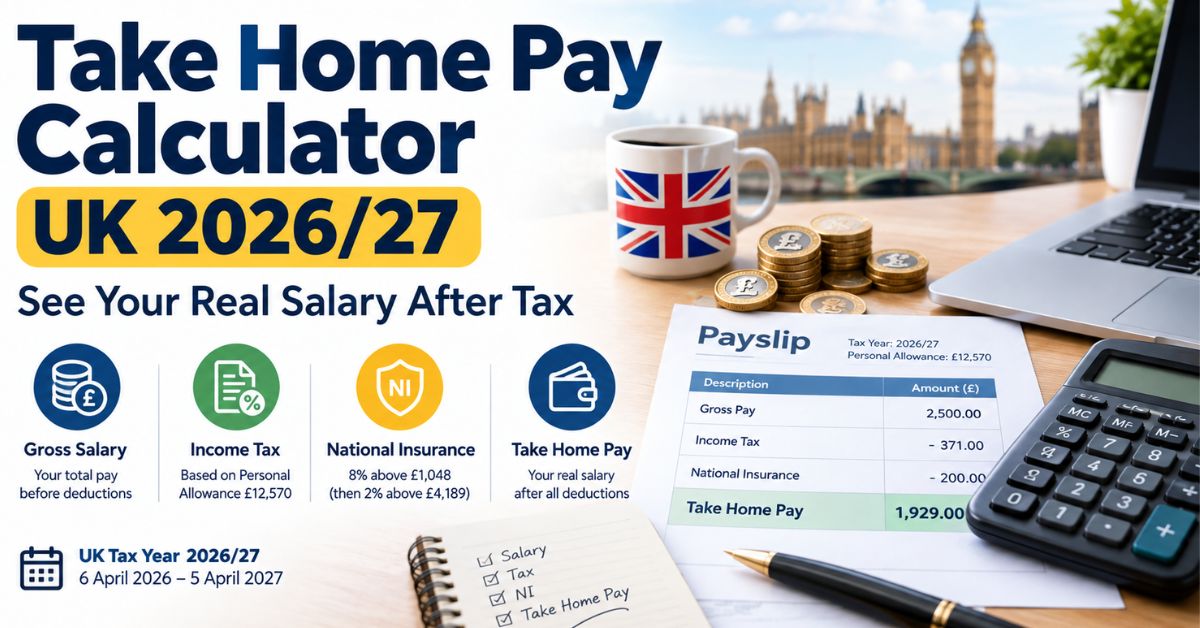
Your advertised salary is your gross pay. Your take home pay is the amount that remains after deductions such as Income Tax and National Insurance. Depending on your circumstances, pension contributions and student loan repayments can also reduce the amount you receive.
A take home pay calculator helps turn your annual salary into a more useful figure. You can see an estimate of your yearly, monthly, weekly or hourly income after common deductions.
For the 2026/27 tax year, the standard Personal Allowance is £12,570. For most employees in England, Wales and Northern Ireland, Income Tax is charged at 20 percent on taxable income up to £50,270, 40 percent from £50,271 to £125,140 and 45 percent above £125,140. Scotland uses different Income Tax bands.
What Is Take Home Pay?
Take home pay is the amount of money you receive from your employment after deductions have been taken from your gross salary.
Your gross salary is the amount stated in your employment contract before deductions. For example, someone earning £35,000 a year has a gross annual salary of £35,000.
That does not mean they receive £35,000 in their bank account.
Income Tax and National Insurance are normally deducted through PAYE before the salary reaches the employee. Other deductions may also apply depending on the employee’s situation.
The amount left after these deductions is commonly called net pay or take home pay.
This is the figure that can be more useful when planning rent, household bills, savings, debt payments and everyday spending.
How Does a Take Home Pay Calculator Work?
A take home pay calculator starts with your gross income and estimates the deductions that apply to you.
The calculation can normally begin with your annual salary. That salary is then considered against the applicable Income Tax bands and National Insurance thresholds.
The calculator may also consider other information such as your tax code, pension contribution, student loan plan and whether you are paid monthly, weekly or at another frequency.
The result gives you an estimated net income.
For example, if your salary is £35,000, your take home pay will be lower than your gross salary because part of your earnings can be subject to Income Tax and National Insurance.
Your actual payslip can still be different because your personal circumstances and payroll information may affect the final amount.
Income Tax And Your Take Home Pay
Income Tax is one of the main deductions that affects your salary.
For the 2026/27 tax year, the standard Personal Allowance is £12,570. This means that someone with the standard allowance can generally receive the first £12,570 of income without paying Income Tax.
For England, Wales and Northern Ireland, the basic Income Tax rate is 20 percent. The higher rate is 40 percent and the additional rate is 45 percent.
The higher rate applies to taxable income above £50,270, while the additional rate applies to income above £125,140 when the standard Personal Allowance is considered.
These figures do not mean that someone earning £60,000 pays 40 percent on their entire salary.
Only the portion that falls within the relevant tax band is taxed at that rate.
This is an important point when estimating salary after tax because moving into a higher tax band does not mean your entire income suddenly becomes subject to the higher rate.
National Insurance And Net Pay
National Insurance is another important part of the calculation for many employees.
For most employees in the 2026/27 tax year, Class 1 National Insurance is charged at 8 percent on earnings between £12,570 and £50,270.
Earnings above £50,270 are generally subject to a 2 percent employee National Insurance rate.
National Insurance is normally deducted automatically from your pay through PAYE, so you do not usually need to make a separate payment for it when you are employed.
The exact calculation can vary depending on your National Insurance category and employment circumstances.
Scotland Has Different Income Tax Rates
If you live in Scotland, your Income Tax calculation can be different from the calculation used in England, Wales and Northern Ireland.
For 2026/27, Scotland has several Income Tax bands, including a starter rate of 19 percent, a basic rate of 20 percent, an intermediate rate of 21 percent, a higher rate of 42 percent, an advanced rate of 45 percent and a top rate of 48 percent.
The Personal Allowance remains £12,570 under the standard allowance rules.
Because Scottish tax bands are different, a salary calculator should know whether you are a Scottish taxpayer before estimating your net salary.
Pension Contributions Can Change Your Take Home Pay
Workplace pension contributions can reduce the amount that reaches your bank account.
The effect depends on your pension arrangement and contribution rate.
For example, if your employer operates a workplace pension and you contribute a percentage of your qualifying earnings, that contribution can affect your net pay.
Some pension arrangements also receive tax relief in different ways. Because of this, the effect on take home pay is not always as simple as subtracting the pension percentage directly from your salary.
If your calculator includes a pension option, entering your actual contribution can give you a more useful estimate.
Student Loan Repayments
Student loan repayments can also affect your monthly take home pay.
These repayments are generally linked to your income and the type of student loan you have. This means two people earning the same salary can receive different net pay if their student loan circumstances are different.
Student loan repayments are separate from Income Tax and National Insurance.
If you have a student loan, selecting the correct repayment plan in a salary calculator can make the estimate more relevant to your actual payslip.
Student loan thresholds and rules can change, so calculations should use the rates that apply to the relevant tax year.
Take Home Pay Example
Suppose an employee earns £35,000 per year and receives the standard Personal Allowance.
Their gross monthly salary before deductions would be approximately £2,916.67.
The employee would then have deductions calculated according to the applicable Income Tax and National Insurance rules.
The final amount received each month would therefore be lower than £2,916.67.
The exact figure can change if the employee has pension contributions, student loan repayments, a different tax code or other payroll deductions.
This is why simply dividing an annual salary by 12 does not tell you your actual monthly take home pay.
Why Your Payslip Can Be Different From An Estimate
A salary calculator provides an estimate rather than replacing your employer’s payroll calculation.
Your actual payslip can be affected by your tax code, pension arrangements, benefits, salary sacrifice, student loan repayments and other deductions.
Your tax code is particularly important because it tells your employer how much tax to deduct from your pay.
An emergency tax code or a change in your circumstances can also affect the amount deducted during a particular pay period.
For this reason, a calculator is most useful for planning and comparison. Your payslip remains the best source for the exact amount you have actually received.
Annual Salary To Monthly Take Home Pay
Many people search for a monthly salary calculator because annual salary figures are not always easy to relate to everyday expenses.
If a job advert says that a position pays £42,000 per year, you may want to know what that means each month after tax.
A take home pay calculator can estimate the monthly amount after the relevant deductions.
You can then compare that figure with rent, utilities, transport, food, savings and other regular expenses.
This can be particularly useful when comparing two job offers that have different salaries or different pension arrangements.
Monthly Salary To Annual Net Pay
The calculation can also work in the opposite direction.
If you know approximately how much you receive each month, you may want to understand your annual net income.
A calculator can help convert your estimated monthly take home pay into an annual figure.
Keep in mind that monthly payments can vary in some situations because of bonuses, overtime, irregular payments or changes to deductions.
Your annual payslips or P60 will provide the actual figures for your tax year.
Take Home Pay For Different Salaries
Your take home pay changes as your gross salary changes.
A salary of £25,000 will have different deductions from a salary of £35,000.
A salary of £50,000 will also have a different result from a salary of £75,000.
The difference is not simply the difference between the two gross salaries because Income Tax and National Insurance are calculated using different thresholds and rates.
This is why using a calculator is more useful than applying one fixed percentage to every salary.
It can also help when negotiating a new salary because you can focus on the amount that may actually reach your bank account rather than looking only at the headline annual figure.
What Information Do You Need To Calculate Take Home Pay?
The more accurate the information you provide, the more useful the estimate can be.
You may need your gross annual salary or hourly rate.
You may also need to select your location because Scotland has different Income Tax rates.
Other useful information can include your tax code, pension contribution and student loan plan.
If you receive bonuses, overtime or other taxable payments, these may also affect your overall calculation.
For a basic estimate, however, your gross salary and location can provide a useful starting point.
Take Home Pay Calculator UK 2026/27
A UK take home pay calculator can make salary comparisons much easier.
Instead of looking only at gross salary, you can estimate what could remain after the main deductions.
For the 2026/27 tax year, the standard Personal Allowance is £12,570. Employee National Insurance for most employees is generally 8 percent between the relevant primary threshold and upper earnings limit, followed by 2 percent above the upper earnings limit. The annual thresholds for these figures are £12,570 and £50,270 respectively.
These rates are based on current rules and can change in future tax years.
If you are making an important financial decision, check your latest payslip and official HMRC information as well.
For the latest official UK Income Tax information, you can check GOV.UK Income Tax rates and allowances.
Monthly Salary Calculator UK
A monthly salary calculator is useful when you want to understand your expected pay on a regular basis.
For example, an annual salary can be divided into monthly gross pay, but the amount you actually receive will depend on the deductions applied through payroll.
This makes net monthly pay more useful than gross monthly pay for many budgeting decisions.
You can use the result to estimate how much money may be available after tax and other deductions.
Hourly Wage And Take Home Pay
Hourly workers can also use salary calculations to estimate their net income.
If you know your hourly rate and average working hours, you can estimate gross weekly or annual earnings before calculating deductions.
However, working hours can change from week to week.
Overtime, holiday pay and irregular shifts can therefore make the actual amount different from a simple annual estimate.
For employees with changing hours, using recent payslips alongside a calculator can provide a more realistic picture.
Final Thoughts
Your gross salary tells you what you earn before deductions.
Your take home pay tells you what you can actually expect to receive after the deductions that apply to your circumstances.
Income Tax, National Insurance, pension contributions and student loan repayments can all affect the final figure.
A take home pay calculator gives you a convenient way to estimate your net income and understand how a salary may translate into monthly or weekly pay.
For the most accurate estimate, enter your actual salary and relevant personal details, then compare the result with your payslip once you start receiving payments. Also read this Stamp Duty Calculator 2026: Calculate SDLT, First Time Buyer, Second Home and Property Tax.
Frequently Asked Questions
Monthly salary calculator UK
A monthly salary calculator estimates how much of your monthly gross salary you may receive after Income Tax, National Insurance and other applicable deductions. It can be useful for budgeting and comparing job offers.
Monthly take home pay calculator
A monthly take home pay calculator estimates the amount you could receive in your bank account each month after common payroll deductions. The result can vary depending on your tax code, pension, student loan and other circumstances.
Tax calculator UK
A UK tax calculator estimates Income Tax and other deductions based on your earnings and circumstances. The calculation can differ depending on whether you are a taxpayer in Scotland or in England, Wales or Northern Ireland.
Take home tax calculator
A take home tax calculator estimates your net salary after applicable Income Tax and National Insurance deductions. Some calculators also include pension contributions and student loan repayments.
Take home pay UK
Take home pay in the UK is the amount remaining from your gross earnings after applicable deductions. Common deductions include Income Tax and National Insurance, while pension and student loan deductions may also apply.
Hourly wage calculator UK
An hourly wage calculator can estimate gross and net earnings based on your hourly rate and working hours. The final take home amount can vary when hours, overtime or other payments change.
HMRC take home pay calculator
HMRC provides official information and tools for understanding Income Tax and National Insurance. A third party take home pay calculator can provide a convenient estimate, but your employer’s payroll calculation and payslip determine your actual deductions.