
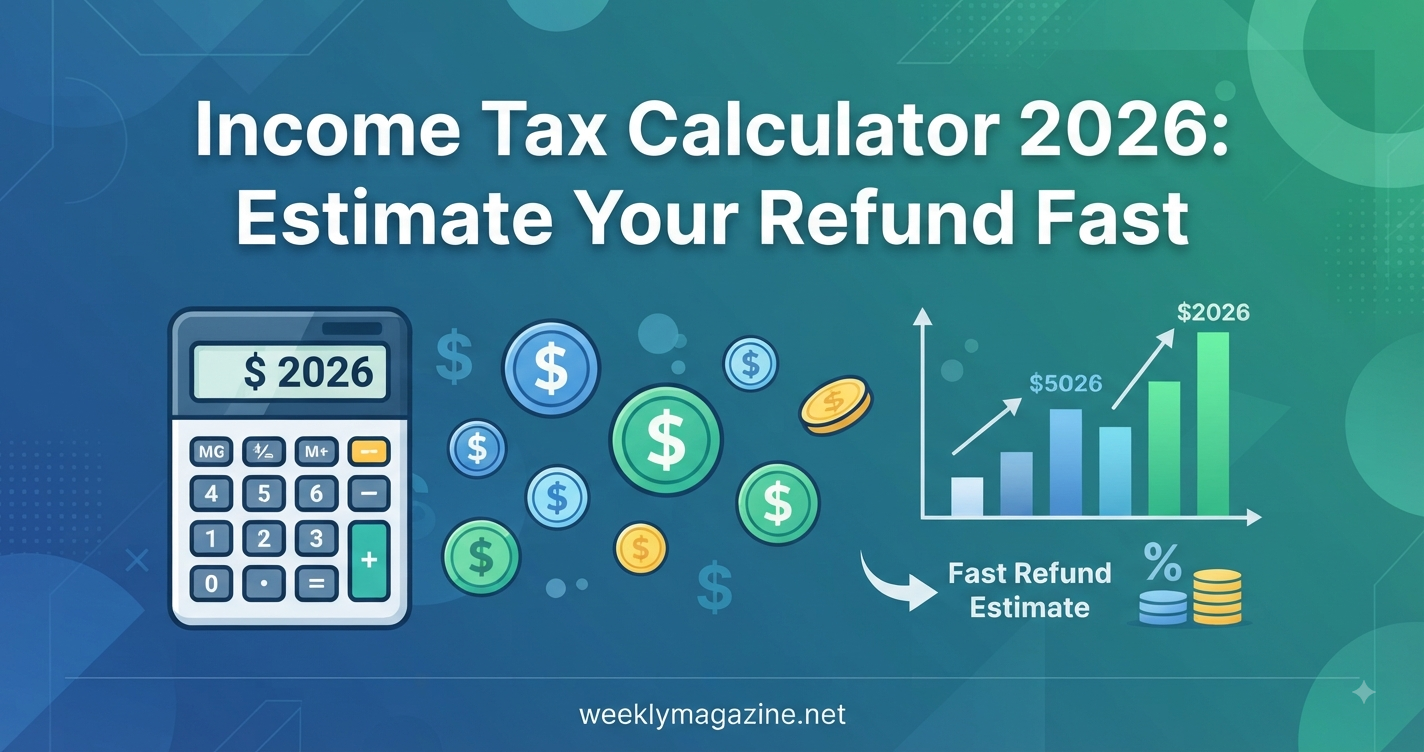
Income Tax Calculator 2026: Estimate Your Refund in Minutes
Figuring out how much tax you owe, or how big your refund might be, used to mean digging through confusing IRS worksheets. Today an income tax calculator does that work for you in seconds. You enter a few numbers about your income and filing status, and the tool instantly shows your estimated federal tax, your tax bracket, and whether you can expect money back or a bill.
This guide walks through everything worth knowing about using an income tax calculator in 2026. You will learn how the calculation actually works, what numbers to have ready, how deductions change your result, and how to avoid the small mistakes that throw off an estimate.
What Is an Income Tax Calculator and How Does It Work?
An income tax calculator is a free online tool that estimates how much federal (and often state) income tax you owe based on your income, filing status, deductions, and credits. Instead of manually applying tax bracket math yourself, you simply type in your details and the calculator runs the numbers instantly.
Behind the scenes, these tools apply the same progressive tax system the IRS uses. Your income is split into portions, and each portion is taxed at a different rate. The calculator adds these portions together, then subtracts any deductions or credits you qualify for, to land on your final estimated tax liability.
Why Should You Use an Income Tax Calculator in 2026?
Tax rules change nearly every year, whether through inflation adjustments to brackets, new credits, or updated standard deduction amounts. Using an updated calculator means you are working with current numbers instead of outdated assumptions from a previous tax year.
People use these calculators for several practical reasons. Some want to know how a new job offer or raise will affect their take-home pay. Others want to check whether they are having too much or too little withheld from their paycheck. And many simply want a quick refund estimate before they officially file.
Checking your numbers mid-year, rather than waiting until tax season, also gives you time to adjust your withholding if needed. That small step can prevent an unpleasant surprise bill in April.
What Details Do You Need Before You Start?
Most income tax calculators ask for a handful of simple inputs. Having these ready in advance makes the process faster and more accurate.
- Your filing status (single, married filing jointly, married filing separately, or head of household)
- Your total gross income for the year, including wages, freelance income, and any bonuses
- Retirement contributions, such as 401(k) or traditional IRA amounts
- Whether you plan to take the standard deduction or itemize
- Any dependents you plan to claim
- Federal tax already withheld from your paychecks, if you want a refund estimate
How Are Federal Income Taxes Actually Calculated?
The United States uses a progressive tax system, which simply means higher portions of your income are taxed at higher rates, while lower portions stay at lower rates. Nobody pays one flat rate on their entire income.
Here is the basic sequence a calculator follows: it starts with your gross income, subtracts adjustments and deductions to reach your taxable income, then applies the tax bracket rates to that taxable income in layers. Finally, it subtracts any tax credits you qualify for to reach your total tax owed.
What Are the Latest Federal Tax Brackets?
Tax brackets are adjusted most years to account for inflation, so the exact income thresholds shift slightly from year to year. The structure itself, however, stays consistent: there are multiple brackets ranging from 10 percent at the lowest level up to 37 percent at the highest level of taxable income.
Because bracket thresholds differ by filing status, a single filer and a married couple filing jointly will see different dollar cutoffs for each rate. This is exactly why a calculator is so useful. It applies the correct bracket automatically based on the filing status you select, so you do not need to memorize the current thresholds yourself.
How Is Your Taxable Income Figured Out?
Your taxable income is not the same number as your total salary. It is calculated by starting with your gross income, then subtracting pre-tax contributions like retirement account deposits, and finally subtracting either the standard deduction or your itemized deductions.
This is one of the most common areas of confusion. Someone earning $70,000 a year rarely pays tax on the full $70,000, because deductions typically reduce that number by a meaningful amount before any tax rate is even applied.
Marginal Tax Rate vs Effective Tax Rate: What’s the Real Difference?
Your marginal tax rate is the rate applied to your last dollar of income, meaning the highest bracket you reach. Your effective tax rate is different. It is your total tax bill divided by your total income, which gives you the average rate you actually paid across all your earnings.
Because of how progressive brackets work, your effective rate is almost always lower than your marginal rate. A good income tax calculator shows both numbers, which gives a much clearer picture of your real tax burden than looking at your bracket alone.
How Do Deductions and Tax Credits Lower Your Bill?
Deductions and credits work differently, and mixing them up is a common source of confusion. A deduction reduces your taxable income before the tax rate is applied. A credit, on the other hand, reduces your final tax bill directly, dollar for dollar.
This means a $1,000 tax credit is generally more valuable than a $1,000 deduction, since the credit cuts your tax bill by the full amount, while a deduction only saves you a percentage of that amount based on your tax bracket.
Standard Deduction or Itemized Deduction: Which Wins for You?
Most taxpayers take the standard deduction because it is simple and, for many people, larger than what they could claim by itemizing. It is a fixed dollar amount based on your filing status, and it requires no receipts or extra paperwork.
Itemizing makes more sense if your deductible expenses, such as mortgage interest, large medical bills, or charitable donations, add up to more than the standard deduction amount. A calculator that lets you toggle between both options can quickly show which choice saves you more money.
How Much Do State Taxes Add to Your Total?
Federal tax is only part of the picture for most Americans. Most states also charge their own income tax, with rates and rules that vary significantly from state to state. A handful of states, including Texas, Florida, and Washington, charge no state income tax at all.
If you live in a state with income tax, using a calculator that includes a state tax estimate gives you a far more complete and realistic picture of your total tax burden, rather than just the federal portion.
Will This Tool Tell You Your Refund Amount?
Yes, as long as you enter how much has already been withheld from your paychecks throughout the year. The calculator compares that withheld amount against your estimated total tax liability. If you paid in more than you owe, the difference is your estimated refund. If you paid in less, that difference becomes your estimated balance due.
Keep in mind this is an estimate, not a guarantee. Your actual refund depends on the final numbers you report when you officially file, along with any last-minute changes to your income or deductions.
Are Online Income Tax Calculators Trustworthy?
Reputable calculators, especially those built by established financial platforms or based on current IRS formulas, are generally quite accurate for estimation purposes. They will not replace a licensed tax professional for complex situations, but for a straightforward W-2 employee, the numbers are usually close to what you will see on your actual return.
Accuracy depends heavily on the information you enter. A calculator can only be as precise as the numbers you give it, so double-checking your income and deduction figures before hitting calculate makes a real difference.
What Errors Ruin the Accuracy of Your Tax Estimate?
A few small mistakes tend to throw off results more than people expect.
- Entering gross income instead of the correct taxable income base
- Forgetting to include freelance, side-gig, or bonus income
- Selecting the wrong filing status
- Leaving out retirement contributions that lower taxable income
- Guessing at withholding amounts instead of checking your actual pay stub
How Often Should You Recheck Your Withholding?
It is worth revisiting your withholding whenever something changes, such as a new job, a raise, marriage, having a child, or picking up freelance work on the side. Even without major life changes, checking once mid-year is a smart habit that helps you avoid year-end surprises.
Is the Calculation Different If You’re Self-Employed?
Self-employed individuals face an extra layer, known as self-employment tax, which covers Social Security and Medicare contributions that an employer would normally split with you. This is on top of regular federal income tax, so a self-employed calculator input typically produces a noticeably higher total than a W-2 employee earning the same amount.
If you are self-employed, look specifically for a calculator that accounts for self-employment tax and quarterly estimated payments, since a basic W-2-focused tool will likely understate what you owe.
What’s the Smartest Way to Use a Tax Calculator?
Treat the result as a planning tool rather than a final answer. Run the numbers early in the year to get ahead of any withholding adjustments, then check again closer to filing season once your income picture is more complete.
Comparing a couple of different calculators can also be useful, especially if your situation includes freelance income, multiple jobs, or significant deductions, since small differences in how each tool handles edge cases can shift the estimate slightly.
Which Common Tax Credits Should You Check For?
Beyond deductions, several widely used credits can meaningfully lower your final tax bill, and a good calculator will ask about them directly.
- Child Tax Credit: available to parents of qualifying children under a certain age, and it reduces your tax bill dollar for dollar
- Earned Income Tax Credit (EITC): aimed at low to moderate income workers, particularly those with children
- Education credits: for taxpayers paying qualified tuition and education expenses
- Child and Dependent Care Credit: for expenses related to care that allows you to work or look for work
Missing an eligible credit is one of the most common reasons people overestimate what they owe, so it is worth double-checking whether any of these apply to your situation before finalizing your numbers.
How Should You Read and Interpret Your Calculator Results?
Once you get your results, look beyond just the bottom line number. Most calculators break your estimate into several parts: your taxable income, your tax bracket, your total federal tax owed, and your effective tax rate.
Understanding each part separately helps you make smarter decisions. For example, seeing that you are near the edge of a higher bracket might change how you think about a year-end bonus or additional freelance income, since only the portion above that threshold gets taxed at the higher rate.
Income Tax Calculator for Different Life Situations
Your ideal calculator inputs shift depending on your life stage and financial situation. Here is how a few common scenarios typically play out.
Recent Graduates and First-Time Filers
If you just started your first job, your main task is understanding how your salary translates into take-home pay after taxes. A simple W-2 based calculator with your salary and filing status is usually all you need at this stage.
Married Couples
Married couples often want to compare filing jointly versus filing separately, since the two options can produce noticeably different results depending on each spouse’s income level. Running both scenarios through a calculator side by side makes the better choice obvious.
Parents With Dependents
Adding dependents changes your results significantly, both through the Child Tax Credit and through a lower overall taxable income base in some cases. Make sure your calculator specifically asks how many dependents you plan to claim.
Freelancers and Gig Workers
As covered earlier, self-employment income requires an extra self-employment tax calculation on top of standard federal tax, so freelancers should seek out a calculator built specifically for self-employed situations.
Simple Ways to Legally Reduce Your Tax Bill
While a calculator estimates what you owe, a few common, fully legal strategies can actually lower that number before you file.
- Increasing pre-tax retirement contributions, such as a 401(k) or traditional IRA
- Contributing to a Health Savings Account if you have an eligible high-deductible health plan
- Timing charitable donations to maximize itemized deductions in a given year
- Tracking deductible business expenses carefully if you are self-employed
- Reviewing eligibility for education or dependent care credits every year, since eligibility rules can shift
Running these adjustments through a calculator before and after shows you exactly how much difference each strategy makes to your final number, which is far more useful than guessing.
A Quick Glossary of Tax Terms Worth Knowing
- Gross income: your total earnings before any taxes or deductions are taken out
- Taxable income: the portion of your income that is actually subject to tax after deductions
- Withholding: the amount your employer sends to the IRS directly from each paycheck on your behalf
- Tax bracket: the income range associated with a specific tax rate under the progressive system
- Adjusted Gross Income (AGI): your gross income after specific adjustments, used as the starting point for many deductions and credits
Income Tax Calculator vs Hiring a Tax Professional
A calculator is excellent for quick estimates, planning ahead, and understanding how changes to your income affect your tax bill. It is fast, free, and available any time you need it.
A tax professional becomes more valuable when your situation includes multiple income streams, business ownership, investment income, or major life changes like buying a home or getting divorced. In these cases, a professional can catch details a calculator might miss and help you plan strategies a simple tool cannot account for.
Many people use both. They rely on a calculator throughout the year for quick check-ins, then bring their numbers to a professional at filing time for a final, accurate return.
How Does an Income Tax Calculator Help With Budgeting?
Beyond filing season, an income tax calculator is genuinely useful for everyday budgeting. Knowing your realistic take-home pay, rather than just your gross salary, helps you set a rent budget, plan savings goals, or decide whether you can afford a new expense.
This is especially useful when comparing job offers. Two offers with the same listed salary can result in noticeably different take-home pay depending on the state you live in and how your benefits are structured, and a calculator makes that difference visible immediately.
What Happens After You Get Your Estimate?
Once you have a number in front of you, decide whether any action is needed. If your estimate shows you owe more than expected, consider adjusting your W-4 withholding with your employer so more tax is taken out of each paycheck going forward.
If your estimate shows a larger refund than you need, some people choose to reduce their withholding slightly and keep more money in each paycheck throughout the year instead of waiting for a lump sum refund later. Either choice is valid. It simply depends on whether you prefer steady cash flow or a bigger check once a year.
Final Thoughts
An income tax calculator turns a confusing, multi-step process into a quick, understandable estimate. Whether you are checking your withholding, planning for a big life change, or simply curious about your expected refund, having accurate current numbers in front of you makes tax planning far less stressful.
Stick to well-reviewed calculators, keep your income and deduction details accurate, and recheck your numbers whenever your financial situation changes. For more practical financial guides and tools like this one, visit WeeklyMagazine.net.
Frequently Asked Questions (FAQs)
1. Is there a free income tax calculator for the USA?
Yes, most reputable income tax calculators are completely free to use. You simply enter your income, filing status, and deductions to get an instant estimate of your federal tax and possible refund.
2. What is a paycheck tax calculator?
A paycheck tax calculator estimates how much federal, state, and payroll tax will be withheld from a single paycheck based on your salary, pay frequency, and filing details, helping you understand your actual take-home pay.
3. Does a state income tax calculator show my total tax burden?
A dedicated state income tax calculator estimates only your state-level tax. For your full picture, you should combine it with a federal calculator, or use a combined tool that covers both at once.
4. How accurate is a U.S. income tax calculator for 2026?
A calculator updated with current 2026 tax brackets and deduction amounts is generally very accurate for standard W-2 income situations, though complex cases may still benefit from a tax professional’s review.
5. How do I calculate the federal income tax rate for a single filer?
Enter your total income, select “single” as your filing status, and apply the standard deduction unless you plan to itemize. The calculator will then apply the correct bracket rates for single filers automatically.
6. Can an income tax refund calculator tell me exactly what I’ll get back?
It gives a close estimate based on the income and withholding details you provide, but your exact refund is only confirmed once you officially file your return with the IRS.
7. What is a federal and state income tax calculator?
This type of calculator estimates both your federal tax liability and your state tax liability together, giving you one combined total instead of calculating each separately.
8. How much federal income tax would I pay on $200,000?
The exact amount depends on your filing status and deductions, since your income is taxed in layered brackets rather than one flat rate. Entering $200,000 into an updated calculator with your correct filing status will give you a precise estimate.
About the Author
Syeda is a global link building specialist and content writer. She specializes in creating clear, well-researched financial and personal finance content that helps everyday readers make informed decisions.