
Whether you are scaling a recipe, resizing an image, or working through a math assignment, proportions show up more often than most people realize. A proportion calculator takes the manual cross multiplication out of the process, giving you the missing number instantly instead of working it out step by step on paper.
This guide covers everything worth knowing about using a proportion calculator, from the basic math behind it to the everyday situations, in the kitchen, at work, and in the classroom, where solving a proportion quickly actually matters.
What Is a Proportion Calculator?
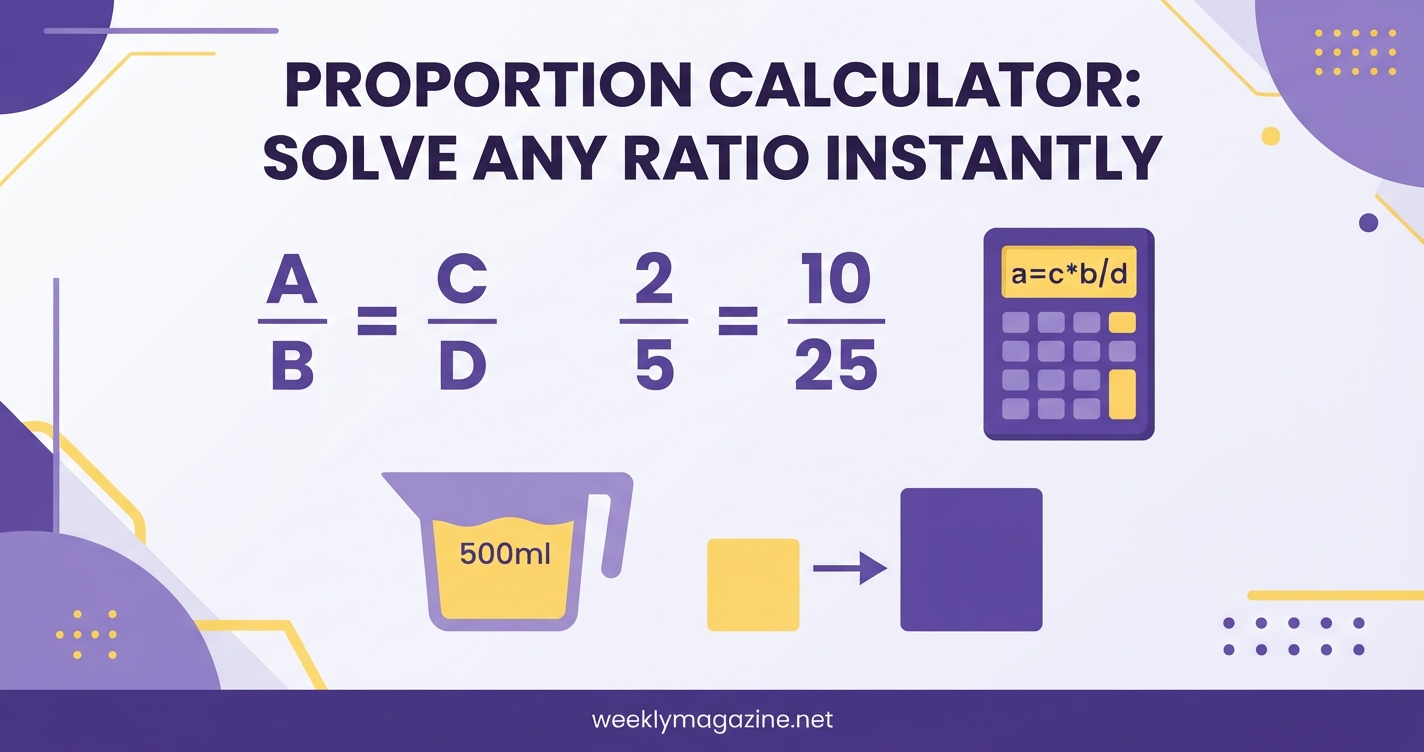
A proportion calculator is a free online tool that solves for a missing value in a proportion, which is simply an equation stating that two ratios are equal. Enter three of the four numbers involved, and it instantly solves for the fourth.
These tools remove the need to manually cross multiply and divide, which is especially useful when working with larger numbers, decimals, or unfamiliar values where a small arithmetic mistake could easily throw off the final answer.
How Does This Type of Tool Work?
Behind the scenes, the calculator applies a technique called cross multiplication. Given a proportion written as a is to b as c is to d, it multiplies a by d and b by c, then rearranges the resulting equation to solve for whichever value is missing.
This is the exact same method taught in most math classes, just automated so you get the answer instantly rather than working through each multiplication and division step by hand.
What Is a Proportion in Math?
A proportion is simply a statement that two ratios are equal to each other. For example, saying that 2 is to 4 as 3 is to 6 is a proportion, since both ratios simplify to the same value.
Proportions come up whenever something needs to scale consistently, whether that means adjusting a recipe for more servings, resizing an image without distorting it, or converting between units using a known conversion rate.
How Do You Solve a Proportion Using Cross Multiplication?
To solve a proportion by hand, you multiply diagonally across the equation, setting the two resulting products equal to each other. From there, simple algebra isolates the unknown value on one side of the equation.
While this process is straightforward with small, clean numbers, it becomes noticeably more tedious with decimals or larger figures, which is exactly where a calculator saves real time and reduces the chance of a careless mistake.
How Do You Actually Use One?
Using one of these tools requires no advanced math background. Most calculators follow a simple, consistent process regardless of design.
- Enter the first ratio, meaning the first two related numbers
- Enter the second ratio, leaving the unknown value blank or marked
- Click calculate to instantly solve for the missing number
- Double-check that your known values are entered in the correct matching positions
What Information Do You Need to Enter?
You need exactly three known values out of the four total values in a proportion. As long as three numbers are known, the calculator has everything required to solve for the fourth missing value.
Pay close attention to the order in which you enter your numbers, since a proportion depends on matching quantities being placed in the correct corresponding positions across both ratios.
Direct Proportion vs Inverse Proportion: What’s the Difference?
In a direct proportion, both quantities increase or decrease together at the same rate. If one value doubles, the other doubles as well. This is the most common type of proportion problem and the type most basic calculators are built to solve.
In an inverse proportion, one quantity increases while the other decreases at a related rate, such as speed and travel time for a fixed distance. Some advanced calculators offer a separate mode specifically for inverse proportions, since the underlying math works differently.
Real-Life Uses of Proportions
Proportions appear constantly outside the classroom. Nurses use them to calculate medication dosages based on a patient’s weight. Photographers and designers use them to resize images without distorting their original shape.
Shoppers use proportions to compare unit prices between different package sizes, and travelers use them to convert currency or distance using a known exchange or conversion rate, all relying on the exact same underlying math.
How Proportions Are Used in Cooking and Recipes
Scaling a recipe up or down is one of the most familiar everyday uses of a proportion. If a recipe serving four people calls for two cups of flour, a proportion calculator quickly tells you how much flour is needed to serve six, eight, or any other number of people.
This becomes especially useful for baking, where precise ratios between ingredients directly affect texture and results, making accurate scaling far more important than in many other types of cooking.
How Proportions Are Used in Scale Drawings and Maps
Architects, engineers, and mapmakers rely heavily on proportions to represent real-world distances at a smaller, manageable scale. A map might use a scale where one inch represents one mile, and a proportion calculator quickly converts any measured distance on the map into its real-world equivalent.
This same principle applies to blueprints, model building, and any situation where a smaller representation needs to stay mathematically accurate to the full-size original.
Common Mistakes to Watch Out For
- Entering numbers in the wrong position, mismatching which values correspond to each other
- Mixing up direct and inverse proportion problems, which require different approaches
- Forgetting to keep units consistent across both sides of the proportion
- Rounding intermediate results too early, slightly affecting the final answer
- Assuming every ratio problem is a proportion, when some situations call for a different type of calculation entirely
Proportion Calculator vs Ratio Calculator: What’s the Difference?
A ratio calculator typically simplifies or compares a single ratio, such as reducing 8 to 12 down to its simplest form of 2 to 3. A proportion calculator goes a step further, solving for a missing value when two ratios are set equal to each other.
In practice, many calculators combine both functions in one tool, since simplifying ratios and solving proportions are closely related skills that often get used together in the same math problem.
How Reliable Are These Results?
The underlying math is completely exact, since cross multiplication is a proven algebraic method rather than an estimate. As long as the input values are accurate, the calculator’s output will be precisely correct every time.
Any error in a real-world application typically traces back to inaccurate starting numbers or mismatched units, not any limitation in the calculator or the math itself.
How Students Can Use This Tool to Learn Faster
Rather than using this tool purely to skip the work, students often benefit most by solving a proportion by hand first, then checking the answer afterward. This builds real understanding while still catching careless mistakes along the way.
Teachers sometimes recommend using it specifically for larger or messier numbers, while reserving simple, clean values for manual practice, keeping both speed and genuine comprehension in the learning process.
Proportions in Business and Finance
Businesses regularly use proportions when scaling production, adjusting budgets, or calculating profit margins based on a known ratio. If a company knows the cost-to-revenue ratio for a small batch, a proportion calculator quickly projects the expected numbers at a much larger scale.
Financial analysts also rely on proportional thinking when comparing company performance metrics across different time periods or company sizes, since raw numbers alone often fail to tell a fair, comparable story.
Proportion Calculator for Different Skill Levels
Elementary and Middle School Students
Students first learning proportions typically work with simple whole numbers, so a calculator at this stage is most useful for checking answers rather than doing all the work automatically.
High School Algebra Students
As problems introduce decimals, larger figures, and multi-step word problems, a calculator becomes genuinely time-saving, letting students focus on correctly setting up the proportion rather than getting stuck on arithmetic.
College Students and Professionals
At higher levels, proportional reasoning often appears embedded within larger problems, such as unit conversions, statistics, or scientific calculations, where a fast and reliable calculator speeds up a much bigger overall task.
How Proportions Connect to Percentages
Percentages are really just a specific type of proportion, comparing a value to 100. Understanding this connection makes proportion calculators genuinely useful for percentage problems, such as figuring out what percentage one number represents of another.
This overlap is why many proportion calculators also double as simple percentage tools, since the underlying cross multiplication process works identically for both types of problems.
Setting Up a Proportion Correctly
The most common source of error is not the math itself, but setting up the proportion incorrectly in the first place. Labeling each quantity clearly before entering any numbers helps avoid mismatched values that produce a technically calculated but practically wrong answer.
A useful habit is writing out the relationship in plain words first, such as “cups of flour to number of servings,” before converting it into numbers. This small step catches setup errors before they ever reach the calculator.
Using a Proportion Calculator for Unit Conversions
Many everyday unit conversions, such as miles to kilometers or ounces to grams, are technically proportion problems built around a known, fixed conversion rate. A proportion calculator handles these conversions just as reliably as it handles more traditional textbook proportion problems.
This makes it useful well beyond the math classroom, extending naturally into travel planning, cooking with international recipes, or any situation involving a shift between measurement systems.
Proportions in Science and Healthcare
Medical professionals rely on proportional reasoning constantly, particularly when calculating medication dosages based on a patient’s body weight or age. A small setup error in this context carries far more weight than a typical classroom mistake, which is why double-checking calculator inputs matters so much in these settings.
Scientists similarly use proportions when scaling lab experiments up or down, converting between measurement units, or analyzing data sets where a known ratio needs to be applied consistently across a larger or smaller sample.
A Quick Glossary of Proportion-Related Terms
- Ratio: a comparison between two quantities, often written as a fraction or with a colon
- Proportion: a statement that two ratios are equal to each other
- Cross multiplication: the method used to solve a proportion by multiplying diagonally across the equation
- Direct proportion: a relationship where two quantities increase or decrease together at the same rate
- Inverse proportion: a relationship where one quantity increases as the other decreases
Tips for Getting Reliable Results Every Time
- Write out your known values clearly before entering them into the calculator
- Confirm whether your problem involves a direct or inverse proportion before solving
- Keep matching units consistent across both sides of the proportion
- Use the calculator to verify manual work rather than skipping practice entirely, especially while still learning
- Round your final answer only at the very last step, not during intermediate calculations
Proportion Calculator vs Percentage Calculator
While closely related, these two tools serve slightly different purposes. A percentage calculator focuses specifically on comparisons to 100, such as finding what percent one number is of another. A proportion calculator works more broadly, solving for any missing value across two equal ratios, whether or not 100 is involved at all.
Many everyday percentage problems can technically be solved with a proportion calculator, since a percentage is simply a proportion with one side fixed at 100, giving you flexibility depending on which tool feels more intuitive for a given problem.
How Photographers and Designers Use Proportions
Resizing an image without distorting it depends entirely on maintaining a consistent proportion between the original width and height. This kind of tool quickly determines the correct new height for a given new width, or vice versa, keeping the image looking natural rather than stretched or squished.
This same principle applies to print design, where scaling a logo or graphic for different materials, from a business card to a large banner, requires keeping the same underlying proportional relationship intact at every size.
Practicing With the Calculator Before an Exam
Students preparing for a math test often use this kind of tool to quickly generate and verify practice problems, entering different known values to build speed and confidence recognizing proportion patterns before facing timed exam conditions.
This kind of repeated practice, paired with instant verification, tends to build stronger recall than working through only a small number of textbook examples, since it exposes students to a wider variety of number combinations and problem types.
How Businesses Use Proportional Scaling
Beyond finance, businesses apply proportional thinking when scaling operations, such as determining how many staff members are needed as customer volume grows, or how much raw material a factory needs as production increases. These scenarios all boil down to the same core proportion math.
Marketing teams also use proportions when analyzing conversion rates across different traffic volumes, since raw numbers alone rarely tell the full story without being placed in proportion to the total audience or budget involved.
Why Setup Errors Are More Common Than Calculation Errors
Once a proportion is correctly set up, solving it is simply mechanical, whether done by hand or with a calculator. The real skill lies in correctly identifying which numbers belong in which position, since even a perfectly executed calculation produces a wrong answer if the initial setup was flawed.
This is why experienced problem solvers often spend more time double-checking their setup than worrying about the arithmetic itself, trusting the calculator to handle the mechanical part accurately once the relationships are correctly identified.
How Proportions Support Everyday Decision Making
Beyond formal math problems, proportional thinking quietly shapes many everyday decisions, from comparing grocery store deals to estimating travel time based on distance already covered. Recognizing these situations as proportions, even informally, often leads to better, more confident choices.
This kind of tool makes quick mental math effortless, turning a rough guess into a precise, reliable number whenever a decision genuinely benefits from an exact answer rather than an estimate.
Final Thoughts
A proportion calculator turns a common but easy-to-mess-up math process into a fast, reliable tool you can use for schoolwork, cooking, budgeting, or nearly any situation involving scaled comparisons and consistent ratios. Whether you are resizing a recipe, checking a scale drawing, converting units, or verifying classwork, having an accurate instant answer removes unnecessary guesswork.
Double-check that your values are entered in the correct matching positions, keep your units consistent, and use the calculator to reinforce your understanding rather than replace it entirely. For more practical educational tools and guides like this one, visit WeeklyMagazine.net.
Frequently Asked Questions (FAQs)
1. How do I solve a proportion using a calculator?
Enter three of the four known values in the proportion, keeping matching quantities in their correct positions, and the calculator instantly solves for the missing fourth value using cross multiplication.
2. What is the difference between a ratio and a proportion?
A ratio compares two quantities to each other, while a proportion states that two ratios are equal. A proportion always involves two ratios, while a ratio on its own is just one comparison.
3. Can a proportion calculator handle inverse proportions?
Many calculators handle direct proportions by default, though some offer a separate mode for inverse proportions, where one quantity increases as the other decreases.
4. How is a proportion calculator used for recipe scaling?
Enter the original recipe amount and serving size along with your desired new serving size, and the calculator scales every ingredient proportionally to match.
5. How accurate are online proportion calculators?
They are completely accurate for the math itself, since cross multiplication is an exact algebraic method. Any error typically comes from inaccurate or mismatched input values.
6. Are proportion calculators useful for map reading?
Yes, they are commonly used to convert a measured distance on a map into its real-world equivalent based on the map’s stated scale ratio.
7. Why does the order of numbers matter in a proportion?
Proportions rely on matching quantities being placed in corresponding positions across both ratios. Entering numbers out of order produces an incorrect result even with the right values.
8. Is a proportion calculator helpful for students?
Yes, it is especially useful for checking manual homework answers, working through larger or decimal numbers, and building confidence before moving on to more advanced algebra topics.
About the Author
Syeda is a global link building specialist and content writer. She specializes in creating clear, well-researched educational content that helps students and everyday readers understand math concepts with confidence.