
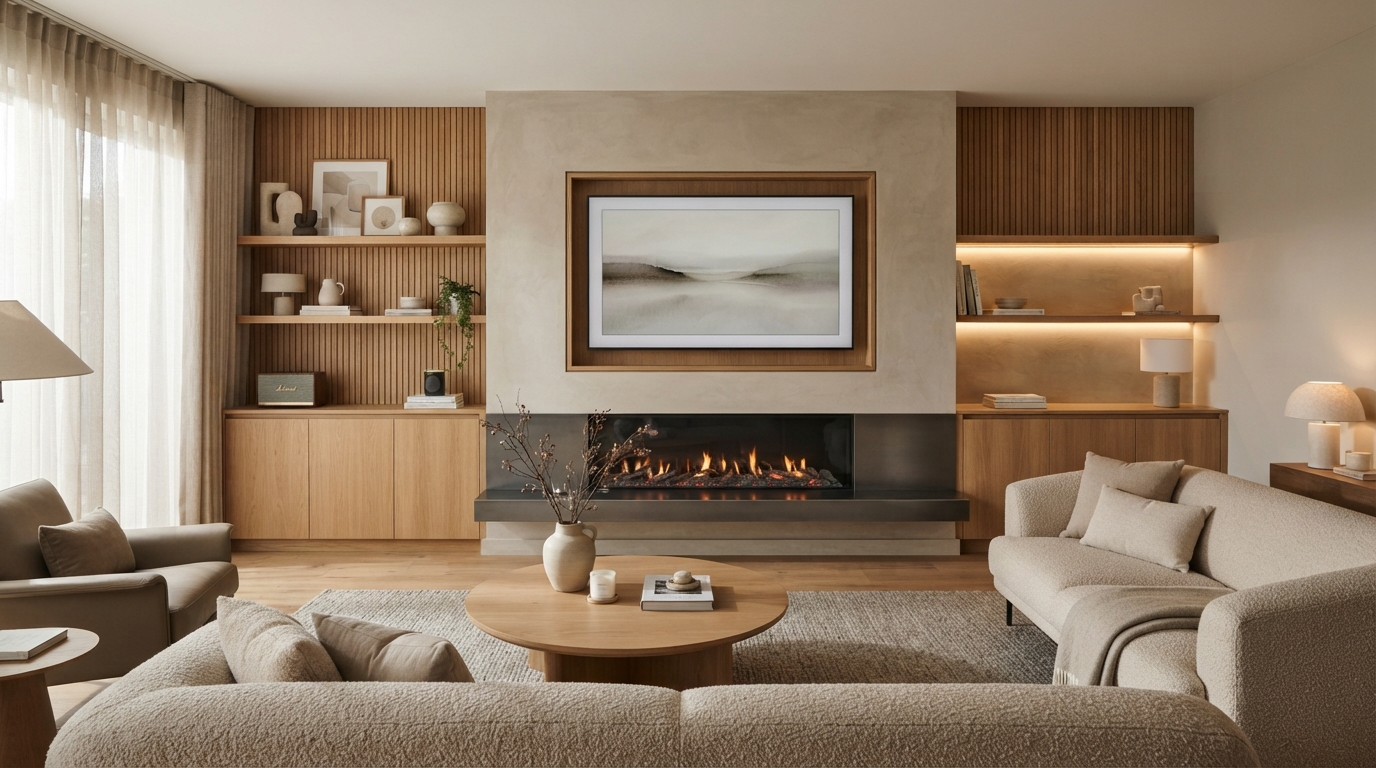
A great media wall design can do much more than give your television a place to sit. Done well, it can bring storage, lighting, technology, architectural detail and even a fireplace together in one considered feature. In 2026, the strongest approach is not simply to make the biggest wall possible. It is to make the wall feel as though it belongs to the room from the beginning.
That shift matters. Current interior-design thinking increasingly treats the television as one element within a larger composition rather than the only focal point. Modern TV wall design, integrated cabinetry, concealed equipment and carefully controlled lighting can make a living room feel calmer while still keeping entertainment at the centre of everyday life.
Recent design coverage also places greater emphasis on proportion, viewing comfort, integrated storage and restraint. A media wall that looks impressive in a photograph can still be uncomfortable or visually heavy if the screen is too high, the fireplace is poorly scaled, the cabinetry is too deep or the wall is overloaded with decoration.
This guide explains how to approach a modern media wall from the planning stage through to finishes, storage and lighting, so you can create something that looks good today and continues to work as your room changes.
What Is a Media Wall?
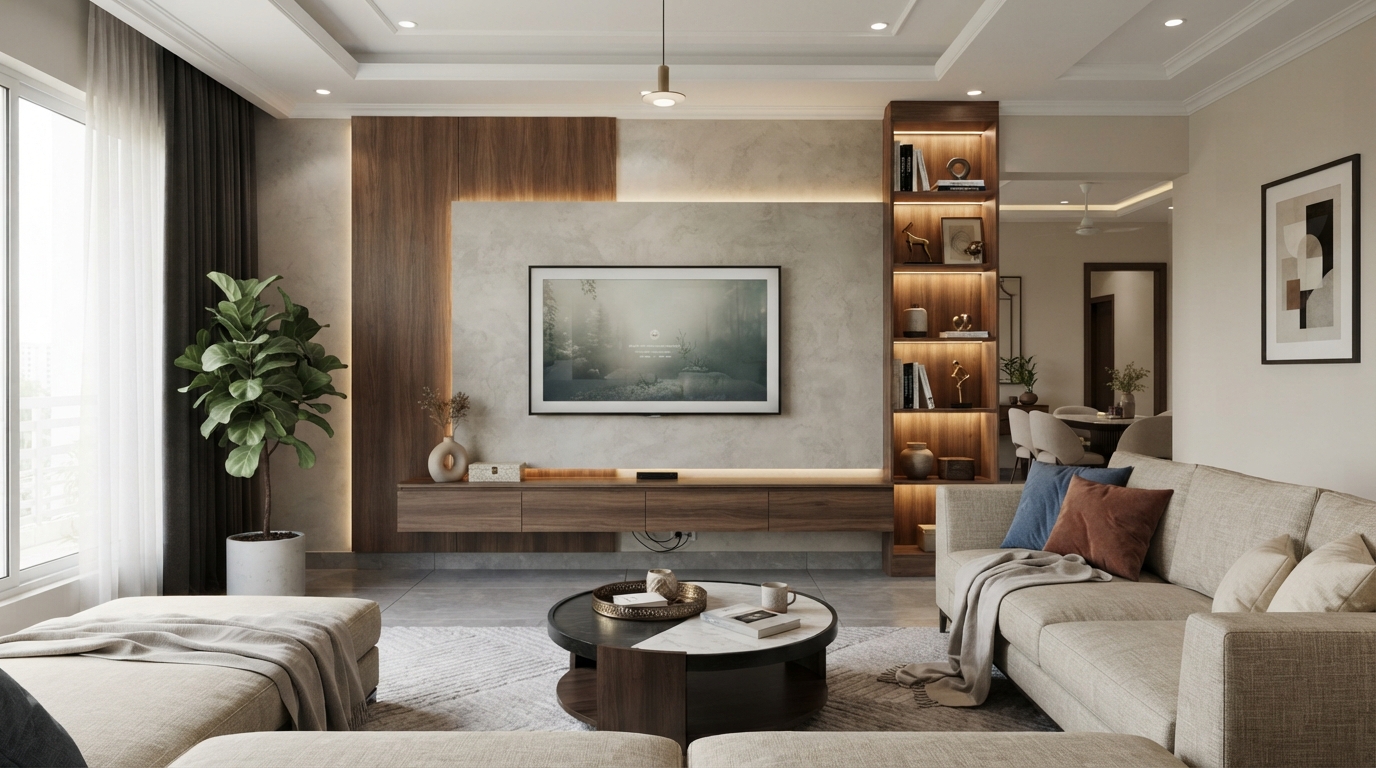
A media wall is a built-in or semi-built-in feature that combines a television with some combination of storage, cabinetry, shelving, decorative panels, lighting and other entertainment equipment.
Unlike a conventional TV stand, a built in media wall is designed around the room itself. It can run across part or all of a wall, rise vertically toward the ceiling or create a defined focal area behind the television.
The exact configuration depends on the room.
A compact apartment might need nothing more than a slim TV recess and floating cabinet. A large family living room may benefit from full-height cupboards, display niches and a linear electric fireplace.
The important point is that there is no single correct formula.
The best living room media wall responds to the size of the room, viewing position, available wall width, storage requirements and overall interior style.
Why Media Wall Design Has Become So Popular
The traditional television setup often creates a collection of unrelated objects.
There may be a TV sitting on a console, a soundbar below it, games consoles on a shelf, cables running behind furniture and decorative objects competing for attention.
A thoughtfully planned media wall brings those elements into one visual system.
It can hide equipment behind doors, route cables inside the structure and provide a deliberate backdrop for the screen.
There is also a practical space-saving advantage. Wall-mounted technology and built-in storage can reduce the amount of floor furniture required, which is particularly useful in smaller rooms. Designers discussing compact living rooms increasingly recommend integrating the television into a broader focal wall rather than allowing it to dominate the room as an isolated black rectangle.
That is why media wall ideas are no longer limited to luxury houses. They can be adapted to apartments, family rooms, open-plan spaces and smaller living rooms.
Start With the Room, Not the Television
One of the easiest mistakes is buying a television first and designing everything around its dimensions.
The screen is important, but it is only one part of the composition.
Before choosing finishes or cabinet styles, measure the wall.
Record the wall’s width and height, the position of windows and doors, the location of electrical outlets and the distance between the proposed screen and the main seating position.
Also consider what happens when people walk through the room.
A visually attractive wall can become frustrating if a doorway cuts through one side of the composition or if a cabinet blocks a natural circulation route.
Think about the sofa as well.
Your television should be positioned for comfortable everyday viewing, not simply at the most visually convenient point on the wall.
Sony’s current guidance notes that viewing distance depends on screen size and resolution and that the centre of a wall-mounted screen should be approximately aligned with the viewer’s eye level from the normal seating position.
Get the Proportions Right
Proportion is arguably the most important part of a successful media wall design.
A media wall can contain beautiful materials and expensive technology and still look wrong if its dimensions do not relate to the room.
A common problem is making the feature too narrow for the wall.
The result can look like a large piece of furniture placed against a much larger wall rather than a genuinely integrated architectural feature.
The opposite problem can also occur.
A very deep or visually heavy installation can make a modest room feel smaller.
The goal is balance.
Look at the relationship between the television, fireplace, cabinetry, shelves and surrounding negative space.
If the television is the primary focal point, the surrounding design should frame it without competing with it.
If the fireplace is equally important, both elements should feel deliberately connected.
Current media-wall guidance similarly emphasizes scaling the fireplace, TV and cabinetry as one composition rather than selecting each element independently.
Should a Media Wall Go Floor to Ceiling?
A floor-to-ceiling installation can create a strong architectural effect, but it is not automatically the best choice.
In a room with high ceilings, full-height cabinetry can make the wall feel intentional and substantial.
In a smaller room, however, a lighter arrangement may be more successful.
One useful approach is to establish a clear horizontal or vertical line that relates to something already present in the room.
For example, the top of the media wall might align with a doorway, window frame or another architectural feature.
This prevents the installation from appearing randomly sized.
A full-height TV feature wall is especially effective when the intention is to make the media area feel like part of the architecture rather than a piece of furniture.
TV Placement: Comfort Comes First
A television that looks perfectly centred can still be uncomfortable to watch.
Mounting height deserves careful attention.
If the screen is positioned too high, viewers may spend long periods looking upward. This is particularly common when a TV is mounted above a fireplace.
The ideal position depends on the room, sofa height, screen size and viewing habits.
Do not blindly follow a single measurement from an online diagram.
Sit on the actual sofa.
Look toward the proposed screen position.
Then consider whether the centre of the display feels natural.
The manufacturer’s mounting instructions also matter. Sony, for example, advises checking the TV’s weight, dimensions and VESA mounting pattern and ensuring that the wall and mounting mechanism can safely support the television.
This is one area where aesthetics should never override installation safety.
Media Wall With Fireplace: The Most Popular Combination
A media wall with a fireplace has become one of the most recognizable contemporary living-room layouts.
The appeal is obvious.
The television provides entertainment while the fireplace introduces warmth and a second visual anchor.
The challenge is making the two elements feel balanced.
A linear electric fireplace positioned beneath a centred television is one of the cleanest solutions.
The fireplace should not look like an unrelated rectangle that happens to sit under the screen.
Its width, height and surrounding margins should relate to the entire wall.
A fireplace that is dramatically narrower than the television can make the lower section feel weak.
An oversized fireplace can overwhelm the screen and become the dominant element.
The safest approach is to consider the television, fireplace and surrounding cabinetry together before selecting the final dimensions.
Is It Safe to Put a TV Above a Fireplace?
It can be possible, but the answer depends on the specific fireplace, television, mounting arrangement and manufacturer’s requirements.
Never assume that every TV can be installed directly above every fireplace.
Check the fireplace manufacturer’s required clearances and the television manufacturer’s temperature and installation guidance.
An electric fireplace is often selected for media-wall applications because many models are designed specifically for this type of installation, but that does not eliminate the need to follow the product instructions.
The construction should also leave appropriate access for electrical components and ventilation where required.
A beautiful TV and fireplace wall should be designed around safety as well as appearance.
Built-In Storage That Actually Helps
Storage is one of the strongest reasons to choose a media wall.
Instead of creating an installation that is purely decorative, use the available space to solve everyday problems.
Closed cabinets can hide:
gaming consoles
streaming devices
remote controls
Blu-ray players
routers
cables
children’s toys
books and miscellaneous living-room items
Open shelving serves a different purpose.
It can display books, photographs, ceramics, plants and carefully selected objects.
The best designs often combine both.
Closed storage keeps visual clutter under control, while a smaller amount of open shelving gives the wall personality.
This approach is consistent with recent entertainment-unit design trends, where the objective is increasingly to conceal equipment while retaining useful display space.
Open Shelving or Closed Cabinets?
There is no universal winner.
Choose more closed storage if your priority is a calm, minimalist appearance.
Choose some open shelving if you enjoy displaying books, artwork or decorative pieces.
A completely open media wall can become visually busy very quickly.
A completely closed wall can sometimes feel too solid.
The most successful media wall storage usually has a deliberate ratio between the two.
Think about what you actually own before deciding.
If you have several games consoles, speakers and devices, hiding them may be more valuable than adding another decorative shelf.
Concealing Wires and Technology
Cable management should be planned before construction, not after the wall has been finished.
This includes power cables, HDMI connections, network cables, speaker wiring and any future connections you may need.
If everything is installed correctly, the finished wall can look remarkably clean.
If the cable route has not been considered, even a premium installation can end up with visible wires.
Create an access strategy.
You may need removable panels, service spaces or accessible cabinets depending on the equipment.
Do not permanently seal components that may need maintenance.
Also remember that technology changes.
A cable route that works for today’s television and console may not be ideal for the equipment you buy three years from now.
Building a little flexibility into the system can prevent unnecessary renovation later.
Choosing the Right Media Wall Materials
The material palette has a major influence on the character of the room.
Popular options include painted MDF, natural or engineered timber, wood-effect panels, stone-effect finishes, plaster-style surfaces and decorative slatted panels.
The right choice depends on the existing interior.
Wood
Oak and other warm wood tones can soften a media wall and make the television feel less stark.
Timber-look finishes are particularly effective in contemporary and Scandinavian-inspired interiors.
Painted cabinetry
Painted joinery creates a more seamless appearance.
A wall painted in the same or a closely related colour as the cabinetry can make the whole installation feel architectural.
Slatted panels
Wood slat media walls add texture and vertical rhythm.
They work particularly well when used selectively rather than across every available surface.
Stone and textured finishes
Stone-effect panels can introduce a stronger luxury aesthetic.
They are particularly effective around fireplaces, although the pattern and scale need to suit the room.
Plaster-style finishes
A softer textured surface can create a more understated result.
This is useful if you want the television to become part of the background rather than the main decorative statement.
Colour Ideas for a Modern Media Wall
Black is an obvious choice because it visually connects with the television screen.
But it is not the only option.
Warm neutrals, muted greens, earthy browns, soft greys and natural timber can produce a more residential feel.
A dark media wall can look dramatic, but in a smaller room it may create a heavy visual block.
Lighter finishes can help the installation blend into the surrounding space.
One increasingly useful strategy is to treat the entire wall as part of the room’s colour scheme rather than choosing the media-wall colour in isolation.
For example, a warm beige wall, oak cabinetry and cream upholstery can create a softer composition than a stark black-and-white arrangement.
Lighting Can Make or Break the Design
Good media wall lighting should support the room rather than compete with the television.
Hidden LED strips can be placed inside shelving, beneath floating cabinets or around selected architectural details.
The aim is subtle illumination.
Bright lights immediately behind the screen can become distracting, especially when watching movies at night.
Dimmable lighting gives you greater control.
You might want stronger illumination while entertaining guests and a softer setting during a film.
LED technology is particularly useful for integrated accent lighting because modern LED products are highly energy efficient and can offer dimming and colour-tuning options. ENERGY STAR notes that LED lighting can use up to 90% less energy than incandescent lighting.
The important design principle is restraint.
You do not need every shelf glowing.
One or two carefully positioned lighting layers can be enough.
Small Living Room Media Wall Ideas
A small living room does not automatically need a tiny design.
It needs a carefully edited one.
Wall-mounted storage can free up floor space.
A shallow cabinet can provide essential storage without projecting too far into the room.
A recessed television can create a cleaner appearance where construction allows it.
Floating furniture can also help preserve visible floor area.
Avoid filling every centimetre with shelves and decoration.
Negative space is valuable.
A smaller living room media wall often looks better when it has fewer materials, fewer objects and a clearer visual hierarchy.
Designers working with compact rooms increasingly recommend integrating the television into a cohesive focal wall while keeping the surrounding joinery slim and purposeful.
Large Living Room Media Wall Ideas
A larger room gives you more freedom.
You can consider full-width cabinetry, tall storage towers, display niches or a substantial fireplace.
However, more space does not mean every feature needs to be used.
A large wall can become overwhelming if it contains too many textures, colours and decorative objects.
One strong material combined with a secondary texture is often more sophisticated than five competing finishes.
For example, warm oak cabinetry paired with a softly textured neutral backdrop can create enough visual interest without becoming busy.
Symmetrical vs Asymmetrical Media Wall Designs
Symmetry is a natural choice for television walls.
A centred TV with matching storage on either side creates order and works particularly well in formal interiors.
An asymmetrical arrangement can feel more relaxed and contemporary.
For example, the television might sit slightly off-centre while one side contains tall cabinetry and the other has open shelving.
The key is not mathematical equality.
It is visual balance.
An asymmetrical design still needs a relationship between the masses, colours and empty spaces.
If one side is visually much heavier, the room can feel unbalanced.
Minimalist Media Wall Design
Minimalism does not mean having nothing on the wall.
- It means deciding what does not need to be visible.
- A minimalist media wall design might feature:
- A flush-mounted TV
- One continuous background finish
- Handleless cabinetry
- Concealed equipment
- Minimal open shelving
- Integrated warm lighting
- Few decorative objects
This style works especially well when the room already contains strong furniture or architectural details.
The television becomes integrated into the room rather than fighting for attention.
Luxury Media Wall Ideas
Luxury is often associated with expensive materials, but visual quality is more strongly influenced by proportion and detailing.
A high-end media wall may use:
- Natural timber veneer
- Large-format stone
- Custom cabinetry
- Soft-close doors
- Integrated lighting
- Recessed technology
- Precise shadow gaps
- Flush finishes
- The difference is in execution.
A cheaper material installed precisely can look more sophisticated than an expensive material used without attention to scale.
Recent media-wall guidance similarly stresses that premium results often come from restraint rather than simply adding more features.
How to Make a TV Less Noticeable
Some homeowners love the television as a focal point.
Others would prefer it to disappear when it is not being used.
There are several approaches.
A darker background can reduce the visual contrast around the screen.
Artwork can create alternative focal points.
Built-in cabinetry can frame the television.
Some modern display technologies can also show artwork or photography when not being used as a conventional screen.
A hidden TV design can be especially attractive in rooms that need to serve multiple purposes.
The important thing is to make the technology feel intentional rather than pretending it does not exist.
Common Media Wall Design Mistakes
Making the wall too deep
Depth takes away floor space.
Always consider how far the finished structure will project into the room.
Mounting the TV too high
A high screen may look impressive from the doorway but become uncomfortable from the sofa.
Choosing the fireplace first
The fireplace should be selected as part of the complete composition.
Ignoring cable access
Plan for current and future technology before closing the wall.
Using too many materials
Three different textures can quickly become visual noise.
Overloading open shelves
Shelving is not automatically decorated.
Leave breathing room.
Forgetting ventilation and access
Technology needs appropriate installation conditions.
Designing from a photograph
An inspirational image may look beautiful but belong to a room with completely different dimensions.
Use inspiration for ideas, not measurements.
A Practical Media Wall Planning Checklist
Before construction begins, confirm:
| Planning point | What to check |
| Wall dimensions | Width, height and available depth |
| TV | Screen size, weight and mounting requirements |
| Viewing position | Sofa location and comfortable viewing angle |
| Fireplace | Model, size and manufacturer clearances |
| Storage | Devices, books, toys and household items |
| Cabling | Power, HDMI, network and speaker connections |
| Lighting | LED location, switches and dimming |
| Materials | Compatibility with existing interior |
| Access | Future maintenance and equipment replacement |
| Style | Colour, texture and decorative approach |
This simple checklist can prevent expensive changes later.
How Much Storage Should a Media Wall Have?
There is no ideal percentage.
Storage should reflect how the room is actually used.
A family room with children may need substantial closed cabinetry.
A minimalist apartment may need only a small cabinet for a streaming box and a few accessories.
Ask yourself what currently creates clutter.
If your existing TV stand is overflowing with books, consoles and cables, the new wall should solve that problem.
Do not add shelves simply because there is available wall space.
Should You Build a Media Wall Yourself?
A simple floating shelf and TV combination can be suitable for experienced DIY homeowners.
A complex built-in media wall is different.
Once electrical work, structural mounting, cabinetry, recessed fireplaces, ventilation or significant wall alterations are involved, professional advice becomes much more important.
TV mounting itself requires attention to wall strength, bracket compatibility and the weight of the television. Sony’s current installation guidance specifically warns that improper wall mounting can cause injury or property damage and recommends following model-specific requirements.
The more complicated the design, the more valuable careful planning becomes.
What Will Media Wall Design Look Like in 2026?
The direction for 2026 is less about one particular colour or material and more about integration.
Technology is becoming visually quieter.
Storage is becoming more concealed.
Lighting is becoming more subtle.
And the television is increasingly treated as part of the room rather than something that has to dominate it.
Warm timber, textured neutral finishes, integrated cabinetry, carefully scaled fireplaces and restrained lighting all fit comfortably within this direction.
Another important development is flexibility.
Homeowners want living rooms that can accommodate movie nights, family time, entertaining and everyday life.
That means the best modern media wall is not necessarily the one with the most features.
It is the one that solves the most problems without making the room feel over-designed.
The Best Media Wall Design Is the One That Fits Your Life
It is tempting to copy a spectacular media wall from Pinterest or an interior-design magazine.
But your room may have different proportions.
Your sofa may sit closer to the wall.
Your television may be smaller.
You may need more storage.
You may not want a fireplace at all.
That is why a successful media wall design begins with the room rather than the trend.
Measure first.
Decide how you use the space.
Choose the television position based on comfortable viewing.
Plan storage around real possessions.
Route cables before construction.
Then select materials, colours and lighting.
When those decisions are made in the right order, the final design tends to feel effortless.
And that is ultimately what makes a media wall successful.
It should not look like a collection of features attached to a wall.
It should look as though the room was designed around it.
Frequently Asked Questions
What is the best media wall design for a small living room?
A slim, wall-mounted TV combined with shallow storage and a simple background finish is often effective. Avoid excessive shelving and deep cabinetry because they can make the room feel smaller.
Should a media wall include a fireplace?
Not necessarily. A fireplace can add warmth and create a second focal point, but a well-designed TV and storage wall can work equally well without one.
What size should a media wall be?
The size should relate to the wall, television, furniture and room proportions. There is no universal width that works for every home.
How high should a TV be on a media wall?
The screen should be positioned for comfortable viewing from the normal seating position. The centre of the screen should generally feel close to seated eye level rather than being positioned purely for visual drama.
Is a TV above an electric fireplace a good idea?
It can be, provided the specific television and fireplace manufacturers’ installation and clearance requirements are followed. Never assume that every combination is automatically safe.
Are media walls still popular in 2026?
Yes. Current 2026 design coverage continues to focus on media walls, particularly integrated TV storage, fireplace combinations, concealed technology and better proportions.
What material is best for a media wall?
There is no single best material. Painted cabinetry, timber, textured panels, stone-effect surfaces and plaster-style finishes can all work. The choice should complement the existing room.
How can I hide TV cables in a media wall?
Cable routes should be planned before the wall is finished. Allow suitable access for power, HDMI, networking and other equipment, and follow applicable electrical and installation requirements.
Does a media wall make a room look smaller?
It can if it is too deep, dark or visually busy. A shallow design with controlled colours, appropriate storage and some negative space can actually make a room feel more organized.
Should media wall shelves be open or closed?
A combination is often the most practical. Closed cabinets hide technology and clutter, while open shelves provide space for books, artwork and decorative pieces.
What lighting works best on a media wall?
Subtle, dimmable LED accent lighting is generally more useful than bright decorative lighting. Place illumination where it enhances shelves or architectural details without creating distracting glare on the screen. ENERGY STAR provides further information on LED efficiency and lighting performance.
Can a media wall be updated later?
Yes, if it is designed with future access in mind. Accessible cable routes and service spaces can make it easier to replace televisions, streaming equipment and other technology later.
Final Thoughts
A well-planned media wall can completely change the character of a living room.
But the secret is not simply adding a television, fireplace and shelves to the same wall.
It is the relationship between them.
Good media wall ideas begin with proportion. They consider viewing comfort before decoration, storage before styling and cable planning before the final finish.
They also leave room for the way people actually live.
If you are planning a media wall in 2026, focus less on copying a particular photograph and more on creating a composition that suits your room, your technology and your lifestyle.
When the proportions are right, the storage is useful, the lighting is subtle and the technology is properly integrated, the result can feel less like an entertainment unit and more like a natural part of the architecture. Also read Cottagecore Bedroom Ideas: 21 Cozy Looks to Copy for 2026!
That is the real goal of modern media wall design.