
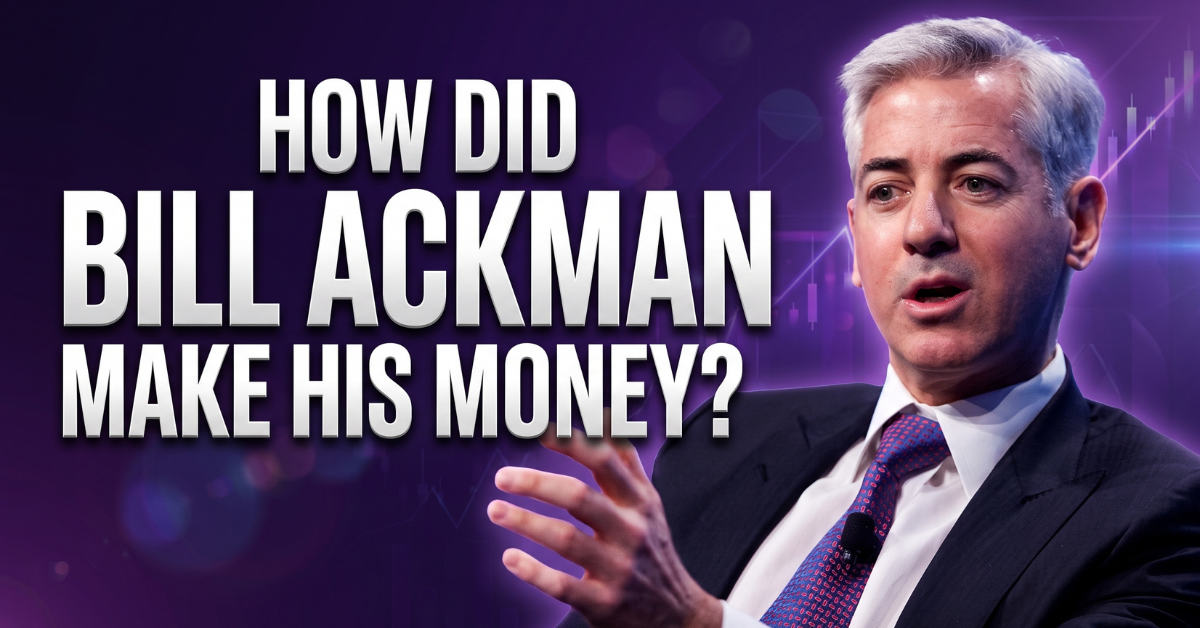
Bill Ackman made his money by running the hedge fund Pershing Square and owning a big share of it. He earns fees from outside investors, and he profits when his own stock picks rise. Bloomberg listed his net worth at $8.4 billion in November 2025. This guide walks through his early career, his fee model, his best and worst trades, and his 2026 moves.
How Did William Ackman Make His Money in Short?
The Two Income Streams: Fees and His Own Fund Stake
Ackman earns in two ways. Pershing Square charges its investors fees, and Ackman also owns a large part of the firm and its funds. Fortune reported that he is believed to own nearly half of Pershing Square. The same report said he brought home $610 million in 2023 even though he made few changes to the portfolio.
Bill Ackman Net Worth: Why Estimates Do Not Match
Net worth numbers for Ackman vary a lot. Bloomberg gave $8.4 billion in late 2025. Forbes valued him at $4.3 billion in May 2024, before a funding round lifted the value of his firm. Some low quality sites show figures between $1.4 billion and $3 billion with no source. Readers should trust only dated numbers from Bloomberg or Forbes.
Bill Ackman Early Life and Career Before Pershing Square
His Father’s Mortgage Firm and Harvard MBA
Ackman did odd jobs as a kid, like washing cars and lawn care. His parents paid his college and business school tuition, but he covered his own living costs. After college he joined his father’s real estate mortgage firm and became one of its top producers. Then he went to Harvard Business School, according to his own account.
How William Ackman Raised Money by Cold Calling the Forbes 400
Ackman said he had no family connections to rely on. So he raised his first money by cold calling people on the Forbes 400 list. That effort funded his first hedge fund.
Gotham Partners and the Golf Course Losses
Ackman founded Gotham Partners in 1992 with his Harvard classmate David Berkowitz, as Barchart reports. In the early 2000s Gotham put money into golf courses. Those deals lost money, and the debt grew too big, FinChat notes. Gotham unwound, and Ackman started over.
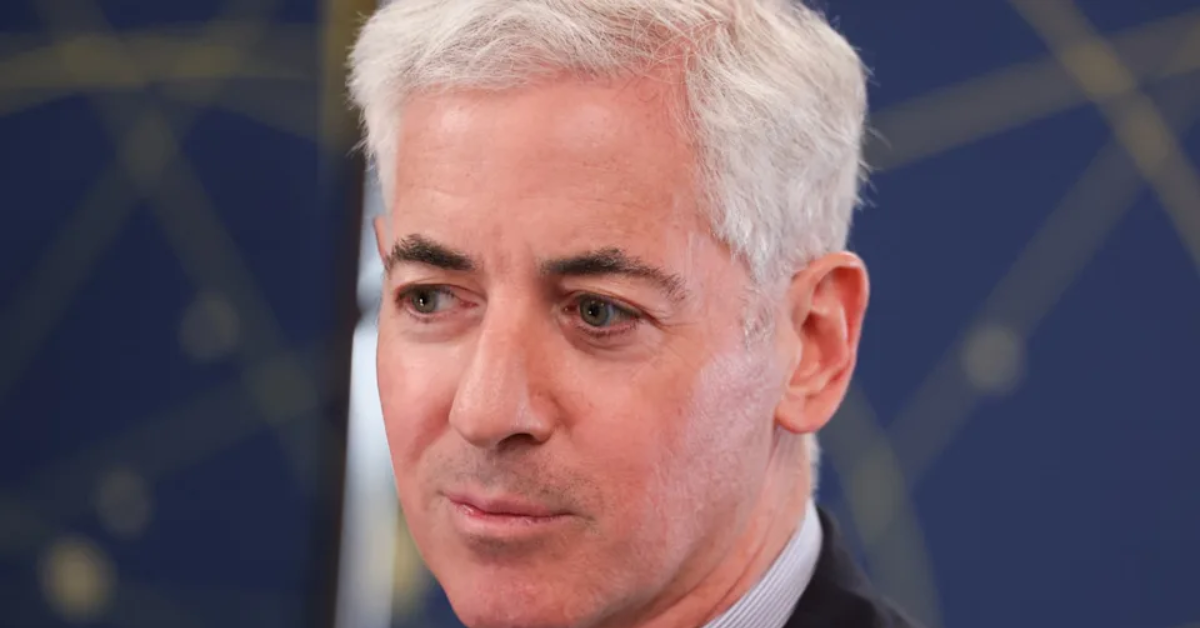
How Bill Ackman Built Pershing Square
Launching Pershing Square in 2004 with $54 Million
Pershing Square Capital Management opened in 2004 with a mere $54 million. Part of it came from his own money and part from his former partner Leucadia National, according to Wikipedia.
Hedge Fund Fees Explained
Fees drive his income. Pershing Square Holdings pays 1.5% a year in management fees on its net assets. It also pays a 16% performance fee on gains above a high water mark. Investors in the older private funds pay 20% on gains. Management fees arrive every quarter. Performance fees arrive only when the fund gains.
Pershing Square Holdings and the Rise in Assets Under Management
Most of the firm’s assets sit in Pershing Square Holdings, a closed end fund that trades in London. It held 15 positions and managed $19.3 billion at the end of October 2025, according to Bloomberg. In 2024 Ackman sold a stake in his management company at a value above $10 billion. Since 2004 the fund has returned about 17% a year.
Bill Ackman’s Activist Investing Strategy
How a Concentrated Portfolio Works
Pershing Square usually holds about 10 positions. Few holdings mean each win counts for a lot. It also means each loss hurts.
Taking a Stake and Pushing for Change
As an activist investor, Ackman buys a big stake and then pushes management to act. At Wendy’s he pressed the company to spin off Tim Hortons. At Canadian Pacific he pushed to replace the CEO with Hunter Harrison.
Short Selling and Hedging
Ackman first became famous by shorting the bond insurer MBIA and buying credit default swaps on its debt. He later used the same tools to protect the fund. A short bet profits when a price falls, so it can offset losses elsewhere.
Bill Ackman’s Biggest Wins
MBIA Short During the 2008 Crisis
Ackman bet against MBIA as the housing market cracked. CNBC reported that the trade earned about $1 billion.
General Growth Properties Turnaround
Ackman bought into the mall owner five months before it filed for bankruptcy. Pershing earned $1.6 billion, about 30 times what it paid, per the same CNBC report.
Canadian Pacific Railway
In 2011 Ackman led a campaign to install a new CEO at the railroad. The stock then nearly tripled from his entry price. He reopened a position at the end of 2021 and called his earlier sale a big regret.
Wendy’s and Chipotle
Wendy’s gave Pershing an early activist win through the Tim Hortons spin off. In September 2016 Ackman took a $1.2 billion stake in Chipotle. Pershing exited Chipotle in the fourth quarter of 2025, Daytraders reports.
The 2020 Credit Hedge That Turned About $27 Million into $2.6 Billion
In February 2020 Ackman bought credit default swaps that paid off as the pandemic hit. Pershing closed them on March 23 for $2.6 billion. Ackman later said, It cost us only $27 million. He then used the cash to buy stocks while prices were low.
Howard Hughes and Universal Music
In May 2025 Pershing Square paid $900 million for 9 million new Howard Hughes shares. That lifted its stake to 46.9% and made Ackman executive chair. In April 2026 Pershing proposed a €9.4 billion takeover of Universal Music Group. Bloomberg later reported in June 2026 that Pershing was set to exit its Universal Music stake.
Bill Ackman’s Biggest Losses
Valeant Pharmaceuticals
Pershing bought Valeant in early 2015 at an average of $196.72 a share. It sold at about $11, and losses topped $4 billion. The fund fell 20.5% in 2015 and 13.5% in 2016, per Fortune. Investors pulled over $1 billion in 2016.
Herbalife and the Fight with Carl Icahn
Ackman shorted Herbalife and called the company a pyramid scheme. On CNBC in 2013 Icahn mocked him as a crybaby in the schoolyard. The trade ended in 2018 with a loss near $1 billion.
J.C. Penney, Target and Borders
Target cost Pershing about 90% of its stake, or $1.8 billion. Ackman called it one of the greatest disappointments of his career. Borders lost 99% of its value in bankruptcy, CNBC reports. J.C. Penney cost his fund more than $600 million.
Bill Ackman’s Wealth in 2026: Pershing Square USA and the Buffett Playbook
The 2026 Pershing Square USA IPO
On March 10, 2026 Pershing Square filed for a dual listing on the NYSE. It covered the firm’s shares and a new fund called Pershing Square USA, priced at $50. Ackman had scrapped a similar launch in 2024. The new fund’s IPO closed at about $5 billion on April 30.
Permanent Capital and Why It Matters for His Income
A hedge fund must return money when investors leave. A closed end fund keeps it. Fortune describes this as permanent capital and a key part of the Warren Buffett playbook. More stable assets mean steadier fee income for Ackman.
Current Holdings
In the fourth quarter of 2025 Pershing opened a stake in Meta and added to Amazon. It also kept its large Howard Hughes position. Holdings change every quarter, so readers should check the latest 13F filing at SEC.gov.
Bill Achman or Bill Ackman: Which Spelling Is Correct?
Same Investor, One Correct Spelling
The correct spelling is Ackman. Many people type Achman by mistake when they search for him.
William Ackman, Bill Ackman and Pershing Square CEO: Name Variations Explained
William A. Ackman is his formal name, and Bill is the short form. All of these labels point to the same founder and CEO of Pershing Square.
Lessons from How Bill Ackman Built His Wealth
What Retail Investors Can Learn
His 2020 hedge shows the value of protecting a portfolio before trouble hits. His fee model shows why costs matter. His history also shows that deep research and patience can pay off.
What They Should Not Copy
Valeant shows the danger of a big bet that goes wrong. His public fights show how a loud campaign can backfire. Most investors also lack the permanent capital that lets Ackman ride out losses.
Must Read
FAQs
How many core holdings does Pershing Square have?
Pershing Square reported 11 US stock positions worth $13.7 billion in its first quarter 2026 13F. Brookfield, Amazon, Uber, Microsoft and Restaurant Brands International made up about 78% of that value, per the filing data.
How can I see what Bill Ackman is buying right now?
Search Pershing Square Capital Management (CIK 0001336528) on SEC EDGAR and open its latest 13F. Filings arrive within 45 days of quarter end. A 13F leaves out shorts, cash and most non US holdings.
What is the difference between Pershing Square and Berkshire Hathaway?
Pershing Square manages outside money and charges fees, including a 1.5% management fee at Pershing Square Holdings. Berkshire owns whole businesses and charges no management fee. Both use permanent capital.
Can Bill Ackman turn Howard Hughes Holdings into the next Berkshire Hathaway?
It is possible but unproven. Ackman calls the plan a “modern-day version of Berkshire”. Berkshire needed more than half a century to reach its size. Howard Hughes is only at the start.
Why did Bill Ackman lose $4 billion on Valeant?
He trusted the wrong management. Ackman wrote that “we misjudged the prior management team,” per BNN. The stock lost over 95% of its value before he sold in March 2017.
How do top investors learn from their mistakes?
They review the loss and change their rules. After Valeant Ackman took “100% of the responsibility” and learned that even strong management teams can fail. Lou Simpson said his team always does post-mortems.
Did Bill Ackman come from a rich family?
He came from a well off business family. His father led Ackman-Ziff Real Estate Group. His billionaire status came later through Pershing Square, which opened in 2004 with only $54 million.
Is Bill Ackman a Trump supporter?
Ackman endorsed Donald Trump on X on July 13, 2024, per The New Arab. He had long donated to Democrats and backed Nikki Haley in the Republican primary.
Conclusion
Bill Ackman built his wealth through fees, his own stake in Pershing Square, and a handful of huge trades. His wins came from research and hedging. His losses came from concentration and stubbornness. In 2026 he is chasing steadier income through permanent capital.