
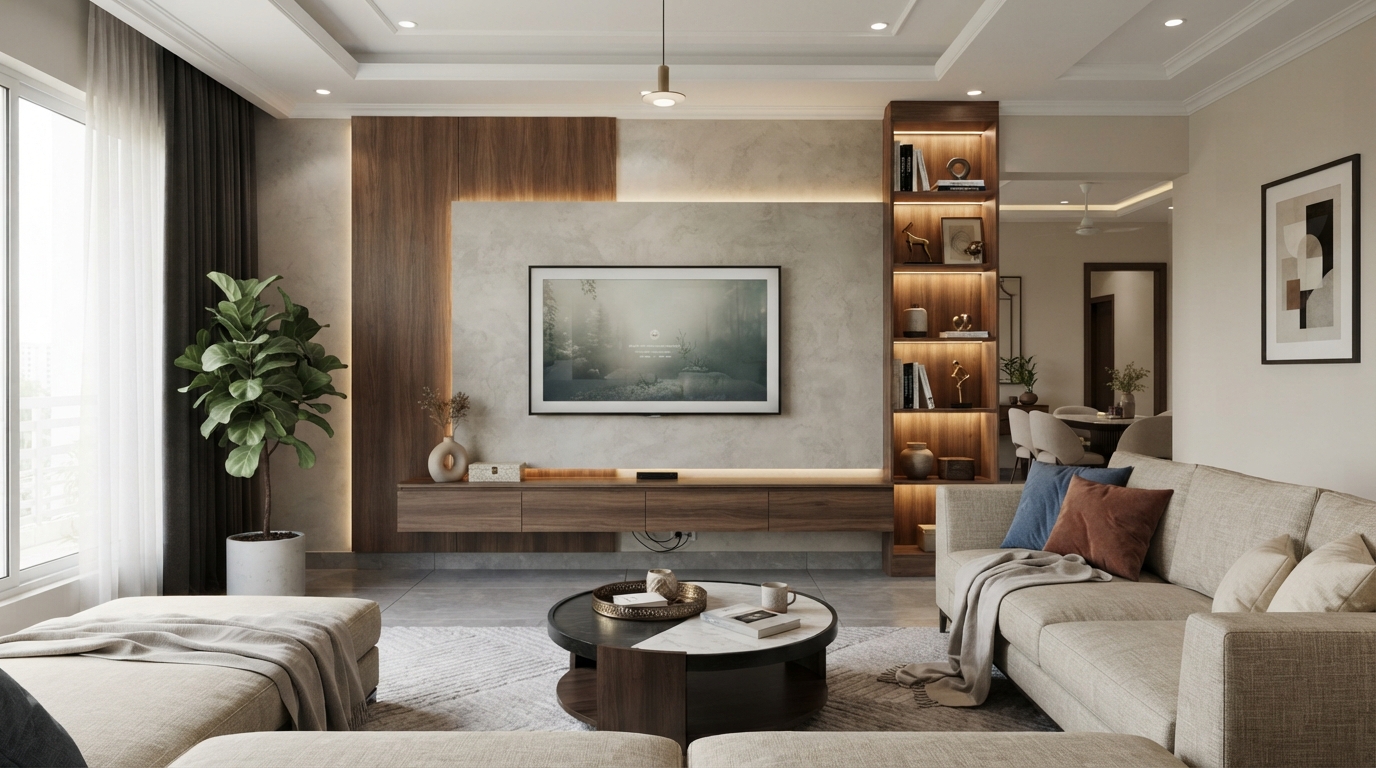
A television may be the most-used feature in a living room, but that does not mean it has to look like a black rectangle attached to an otherwise empty wall. A thoughtful tv wall design can turn that awkward area into a balanced focal point while solving practical problems such as storage, cables, lighting and equipment placement. Current interior-design coverage is moving strongly toward media walls that feel integrated with the architecture rather than simply decorating the space around a screen.
Recent design guides repeatedly emphasize built-ins, wood and slatted surfaces, floating consoles, textured backdrops and layered lighting, while Google search results increasingly answer the same topic through quick summaries and AI-generated overviews.
That shift matters because the best television wall is not necessarily the most expensive one. It is the one that makes sense for the size of the room, the position of the sofa, the screen size, your storage needs and the overall style of your home. Whether you have a compact apartment, a family lounge or a large open-plan living room, the right design can make the television feel like part of the room instead of something added at the last minute.
What Makes a Good TV Wall Design?
A successful TV wall has to perform several jobs at once.
First, it needs to create visual balance. A television is naturally attention-grabbing, particularly when its screen is switched off. The wall treatment gives that dark rectangle a context and prevents it from appearing isolated.
Second, it should support everyday functionality. Streaming devices, gaming consoles, soundbars, remotes, speakers and cables all need somewhere to go. A beautiful wall that leaves wires hanging beneath the television is not really a finished design.
Third, the wall should work with the rest of the room. Its materials, colours and proportions should connect with the flooring, sofa, coffee table, curtains and other architectural features.
Finally, comfort matters. A TV mounted at an awkward height or placed too close to the seating area can make an otherwise attractive room frustrating to use.
That is why good tv wall design begins with planning rather than decoration.
15 TV Wall Design Ideas Worth Considering
1. Warm Wood Panel TV Wall
Wood remains one of the easiest ways to make a television wall feel warmer and more sophisticated.
A large screen can look visually harsh against a plain white wall. Timber panels, veneer, engineered wood or carefully selected wood-look finishes soften that effect and introduce texture without requiring a complicated decorative scheme.
Vertical slats are particularly useful when you want the ceiling to appear taller. Horizontal arrangements can make a wall feel wider.
For a contemporary home, combine a wood backdrop with a simple floating console and limited decoration. The television becomes part of the composition rather than the only thing on the wall.
2. Minimalist Floating Media Wall
If you prefer clean interiors, a floating media console can be enough to transform the wall.
Instead of filling the entire area with cabinets, use a simple panel behind the television and a slim console underneath. The gap between the floor and console creates visual lightness and makes cleaning easier.
This approach works especially well in smaller rooms because bulky floor-to-ceiling cabinetry can make the space feel crowded.
Keep the finish restrained. A matte painted surface, subtle wood panel or soft textured finish can provide enough interest without competing with the screen.
3. Built-In Storage Around the TV
Storage is one of the biggest reasons homeowners choose a built-in media wall.
Instead of treating storage and the television as separate elements, cabinetry can frame the screen. Closed cupboards hide electronics and everyday clutter, while open shelves can display books, artwork or carefully selected objects.
The important part is proportion.
If every inch of the wall becomes shelving, the result can feel busy. Leave breathing room around the television and use closed storage for items that do not need to remain visible.
A well-planned built-in can also eliminate the need for a separate television cabinet.
4. Stone or Marble-Look Feature Wall
Stone adds instant visual weight and can give a living room a more luxurious appearance.
Natural stone, porcelain slabs and high-quality stone-look surfaces can all work behind a television. Veined finishes create a dramatic effect, while quieter stone textures are better for understated interiors.
If the stone is visually strong, keep the surrounding furniture simple.
One common mistake is combining a highly patterned stone wall with heavily decorated shelves, ornate furniture and multiple accent colours. The result becomes visually noisy.
Let the wall be the statement.
5. Fluted or Slatted TV Wall
Fluted panels are popular because they add depth while maintaining a relatively simple geometric rhythm.
They can cover the entire wall or be limited to the central television zone. A partial treatment is often more economical and can create a stronger focal point.
For a modern interior, combine vertical fluting with a floating console and warm ambient lighting.
For a softer look, choose a natural wood tone. For a more dramatic room, a painted fluted surface can provide texture without introducing another colour family.
6. Painted Accent TV Wall
You do not always need panels, stone or custom carpentry.
Sometimes paint is the smartest solution.
A deeper tone behind the television can help the screen visually recede when it is switched off. Charcoal, deep olive, muted navy, warm taupe and earthy brown can all create a sophisticated background.
This is also one of the easiest options for renters or homeowners working with a limited budget.
If you want the design to feel intentional, paint the entire feature wall rather than creating a small random rectangle behind the screen.
7. TV Wall With a Floating Shelf
A floating shelf can work when you want decoration without building a complete media wall.
Place one substantial shelf beneath the television or use carefully positioned shelves on one side. Avoid filling them with small decorative objects.
A few books, a plant, a framed photograph or one sculptural object are usually enough.
The purpose of the shelf should be to support the composition, not compete with the television.
8. TV Wall With Concealed Storage
Not everything needs to be displayed.
In a family home, the television area often collects remotes, controllers, chargers, toys and electronic accessories. Closed cabinetry can keep those items out of sight.
Handle placement matters too. Push-to-open doors or discreet hardware can maintain a clean appearance.
If you are designing custom cabinetry, tell the carpenter exactly which devices need to be stored before construction begins. A cabinet that looks beautiful but cannot accommodate the soundbar, console or ventilation requirements will quickly become inconvenient.
9. Gallery-Style TV Wall
Some interiors benefit from embracing the television instead of trying to hide it.
A gallery-style composition can place artwork, photographs or decorative objects around the screen. The trick is to establish a visual relationship between the pieces.
Do not simply scatter frames randomly.
A restrained colour palette helps the arrangement feel cohesive. Black frames, natural wood frames or a combination of two complementary finishes can work particularly well.
This approach is especially useful when you want the television area to feel connected to an art-focused interior.
10. TV Wall With Integrated Lighting
Lighting can completely change how a media wall looks after sunset.
Hidden LED strips behind a panel, underneath shelves or within cabinetry can create a gentle glow without becoming the main attraction.
For residential interiors, warm light generally creates a more relaxed atmosphere. The U.S. Department of Energy notes that warm residential lighting commonly falls around 2700K to 3000K, while colour temperature describes the visual warmth or coolness of the light source.
Avoid placing a bright light directly in the viewer’s line of sight.
The goal is ambient illumination, not another screen competing with the television.
11. Modern TV Wall With a Fireplace
If your room and climate make a fireplace practical, combining it with the television can create a strong architectural focal point.
A common arrangement places a linear fireplace below the screen, often within a wider media wall.
However, this requires careful planning. Heat management, manufacturer clearances, ventilation and mounting requirements should be confirmed before construction.
Do not copy a fireplace-TV arrangement from an image without checking the specifications of your actual equipment.
The visual rule is simple: the fireplace and television should feel like one composition rather than two unrelated rectangles.
12. Small Living Room TV Wall
Small rooms require restraint.
A common mistake is assuming that a small room needs a small design. In reality, too many small decorative elements can make the wall feel even more crowded.
Instead, use one strong backdrop.
A slim wood panel, painted accent wall, floating console or shallow built-in can provide enough structure without consuming valuable floor space.
Choose wall-mounted furniture where possible and keep the floor underneath visually open.
13. Asymmetrical TV Wall
Not every television has to sit exactly in the centre of a wall.
An asymmetrical layout can be more interesting when doors, windows or architectural features make a symmetrical arrangement impossible.
For example, the television may sit slightly off-centre while tall shelving occupies one side.
The important thing is intentional balance.
The empty space on one side should be visually countered by the weight of the shelving, furniture or architectural feature on the other.
14. Simple TV Wall for a Budget Renovation
If your budget is limited, focus on the elements that make the biggest visual difference.
Start with:
A clean wall finish
A properly mounted television
Concealed cables
A simple floating console
One accent material
Soft lighting
You do not need a full custom media wall to create an attractive result.
A fresh coat of paint combined with cable management and a well-proportioned console can make a surprisingly large difference.
15. Full-Height Media Wall
For larger rooms, a full-height installation can give the television wall architectural presence.
This may include cabinetry, open shelving, vertical panels, lighting and closed storage extending from floor to ceiling.
The danger is overbuilding.
If the entire wall becomes filled with compartments, the design can start looking like a showroom. Use a mixture of closed and open sections, repeat a limited material palette and maintain clear visual zones.
The strongest full-height walls usually have one dominant idea rather than ten competing ones.
How to Choose the Right TV Wall Material
Material selection should begin with the room, not a trend.
Wood
Best for warmth, texture and natural interiors.
Wood works particularly well with beige, cream, taupe, white, charcoal and earthy palettes.
Stone
Best when you want a premium or dramatic appearance.
Large-format surfaces can reduce the number of visible joints and create a cleaner backdrop.
Paint
Best for affordable transformations and minimalist rooms.
It is also easy to change later.
Fluted Panels
Best for adding texture and vertical rhythm.
They work particularly well in contemporary interiors.
Wallpaper
Best when you want pattern or subtle texture without major construction.
Choose a finish that does not create distracting reflections around the television.
MDF or Decorative Wall Panels
Best for custom geometric arrangements, cabinetry and painted feature walls.
These materials can be used to create a tailored appearance without requiring expensive natural materials.
How High Should a TV Be Mounted?
This is one area where appearance should not override comfort.
The ideal mounting height depends on the seating position, screen size and personal preference. A common design principle is to position the screen so that your normal viewing angle feels natural rather than forcing you to look upward.
The best way to judge it is to sit on your actual sofa before finalizing the mounting position.
Do not decide the height while standing.
This simple test can prevent one of the most common media-wall mistakes: mounting the television much higher than it needs to be.
If the TV is going above a fireplace, additional care is required because the ideal viewing height and fireplace construction requirements can conflict.
What TV Size Works Best for a Living Room?
The answer depends on viewing distance rather than simply the size of the wall.
A huge screen can overwhelm a small seating area, while a small television may look lost on a large feature wall.
Current viewing-distance guidance from RTINGS uses viewing angle as a major factor and notes that approximately 30 degrees can serve as a mixed-use baseline, while around 40 degrees offers a more immersive cinematic experience.
Samsung similarly recommends considering both screen size and viewing distance and gives a 40-degree field-of-view approach for immersive viewing.
For that reason, measure the distance from the main seating position to the TV wall before choosing the screen.
Also measure the actual width and height of the television, not just its advertised diagonal size.
A 65-inch television, for example, is not 65 inches wide. Its physical dimensions matter when you are designing the panel, cabinetry or shelving around it.
TV Wall Design and Cable Management
Cable management is one of those details that separates a polished installation from a temporary-looking setup.
Before mounting the television, identify every connection you will need.
Think about:
Power
HDMI cables
Soundbar connections
Gaming consoles
Streaming devices
Network cables
Antenna or satellite connections
Future equipment
If you are building a custom media wall, plan cable routes before the wall is closed.
If construction is not possible, paintable cable channels can provide a cleaner alternative to exposed wires.
Never assume you will “hide the cables later.” Once the wall is finished, fixing the problem can become much more difficult.
Should a TV Wall Have Storage?
For many homes, yes.
But the amount of storage depends on how the room is used.
If your television is mainly used for streaming, a simple floating console may be sufficient.
If the room contains gaming equipment, speakers, books, children’s items or multiple devices, built-in storage becomes much more useful.
A good media wall separates what should be visible from what should disappear.
Open shelving is for display.
Closed cabinets are for clutter.
That simple distinction can make the whole room feel calmer.
How Lighting Changes a TV Wall
Lighting should support the television rather than compete with it.
Avoid placing a strong downlight directly above the screen if it creates reflections.
Instead, consider:
Soft LED backlighting
Shelf lighting
Cabinet lighting
Wall sconces
Dimmable ambient lights
Floor lamps positioned away from the screen
Layering is more effective than relying on a single bright ceiling fixture.
The U.S. Department of Energy also notes that LED lighting quality involves factors beyond colour temperature, including colour fidelity and CRI.
For a warm residential media area, a dimmable warm-white source is often more comfortable than an intensely cool light.
How to Make a TV Wall Look Expensive
Luxury does not always come from expensive materials.
It often comes from proportion and restraint.
A few details make a major difference:
Use consistent gaps between panels.
Keep the television level.
Hide cables.
Choose one main feature material.
Match the console width to the composition.
Use warm, controlled lighting.
Avoid unnecessary decoration.
Make cabinetry lines align.
Keep colours within a coherent palette.
A simple wall executed accurately can look more premium than an expensive wall filled with mismatched details.
TV Wall Design for a Small Apartment
In an apartment, every centimetre matters.
A floating console can keep the floor visually open.
A vertical panel can create the impression of height.
A wall-mounted television eliminates the need for a bulky stand.
Shallow cabinetry can provide storage without projecting too far into the room.
Mirrors can sometimes help increase the sense of space, although they should be positioned carefully so they do not introduce unwanted reflections into the viewing area.
The best small-space design is usually the one that does less, but does it better.
TV Wall Ideas for Large Living Rooms
Large rooms give you more freedom, but they also create a different problem: scale.
A television can look surprisingly small when surrounded by a huge blank wall.
That is where a wider media composition helps.
Consider extending the feature wall beyond the screen with cabinetry, shelving or a textured material.
A large console can visually anchor the lower part of the wall.
Tall elements can balance the vertical space.
The objective is to make the television feel appropriately scaled to the room rather than simply making the television itself larger.
Common TV Wall Design Mistakes
Mounting the TV Too High
A high television may look impressive in a photograph but become uncomfortable during everyday viewing.
Ignoring Viewing Distance
Choose the TV based on the seating arrangement, not only the available wall.
Using Too Many Materials
Wood, marble, fluting, mirrors, LED strips and decorative panels may all look good individually. Together they can become excessive.
Forgetting Equipment
Plan for the devices you actually own.
Leaving Cables Visible
Even an expensive feature wall can look unfinished when cables hang beneath the screen.
Overcrowding Shelves
A shelf is not automatically better because it contains more objects.
Ignoring Glare
Glossy finishes and badly positioned lights can create reflections on the screen.
Copying a Design Without Considering the Room
A beautiful Pinterest or Instagram-style wall may not work with your ceiling height, sofa position, windows or architectural layout.
A Practical Planning Checklist
Before starting your project, measure:
Wall width
Wall height
Sofa-to-wall distance
Television dimensions
Console dimensions
Socket positions
Cable routes
Window and door locations
Available storage space
Lighting positions
Then decide:
What style suits the room?
Do you need storage?
Do you want a full feature wall or a smaller backdrop?
Which material will be the main visual feature?
Where will the cables go?
How will the wall look when the TV is switched off?
How will it look at night?
That last question is often overlooked.
A TV wall should not only look good during daylight when the room is being photographed. It should work at 8 p.m. when your family is actually using it.
A Simple Formula for a Balanced TV Wall
If you are unsure where to start, use this formula:
One main material + one storage solution + controlled lighting + clean cable management + restrained decoration.
For example:
Wood panel + floating console + warm LED + hidden cables + two decorative objects.
Or:
Painted feature wall + built-in cabinets + shelf lighting + concealed equipment + minimal artwork.
Or:
Stone-look panel + low console + soft side lighting + hidden cables + no additional decoration.
These combinations work because they create hierarchy.
The eye knows what to look at first.
Should You DIY a TV Wall?
Simple projects such as painting, removable decorative panels or styling a floating shelf may be suitable for DIY.
More complicated work involving electrical wiring, heavy cabinetry, wall reinforcement, structural changes or fireplace installation should be handled by appropriately qualified professionals.
The television mount itself also needs to be installed according to the wall construction and mount manufacturer’s requirements.
A design can be beautiful, but safety and structural support should always come before appearance.
What Is Trending in TV Wall Design Right Now?
Current 2026 design coverage shows a clear movement toward warmer and more integrated media spaces rather than purely decorative television panels. Wood slats, built-in storage, floating units, textured surfaces, hidden wiring and layered lighting appear repeatedly across recent design guides.
Another noticeable direction is visual restraint.
Instead of putting several decorative materials onto one wall, designers are increasingly using one dominant surface and allowing the architecture to do the work.
That does not mean every room needs to be minimalist. It simply means that the television wall should have a clear visual idea.
Final Thoughts
The best tv wall design is not necessarily the one with the biggest television, the most expensive stone or the most elaborate cabinetry. It is the one that fits the way you actually live.
Start with the seating position and television size. Then consider storage, cables, lighting and the room’s existing materials. Only after those practical decisions are made should you choose decorative details.
For a small living room, a slim floating unit and warm wood panel may be enough. For a larger home, a full-height media wall with integrated storage may make more sense. If your budget is tight, paint, cable management and good proportions can still produce a convincing transformation.
The important thing is to treat the television wall as part of the room’s architecture rather than an isolated place to hang a screen. Also read this
Inside the Labubu Creator’s World: Fame, Design & Facts
When proportion, comfort, storage, lighting and materials work together, even a simple wall can become one of the strongest features in the entire living room.
Frequently Asked Questions About TV Wall Design
What is the best TV wall design for a modern living room?
A floating console, clean feature panel, concealed cables and subtle lighting are among the most versatile choices. Wood, fluted panels and textured neutral finishes are especially effective for modern interiors.
Which material is best for a TV wall?
There is no single best material. Wood adds warmth, stone creates a statement, paint is affordable, wallpaper adds pattern, and decorative panels offer flexibility. The best choice depends on the room and budget.
Is wood good for a TV wall?
Yes. Wood can soften the visual impact of a large screen and introduce warmth and texture. Vertical slats can also create a stronger sense of height.
Should the TV wall have a cabinet?
If you have gaming consoles, streaming devices, remotes, speakers or other equipment, storage can be extremely useful. A combination of closed cabinets and limited open shelving usually offers the best balance.
How high should a TV be mounted?
The screen should generally be positioned for comfortable seated viewing rather than simply as high as possible. Sit on your main sofa and assess the natural viewing angle before fixing the final height.
What size TV is best for my room?
TV size should be considered alongside viewing distance. RTINGS and other current viewing guides use viewing angle as an important factor rather than relying on one universal room-to-screen ratio.
Are LED lights good behind a TV?
Yes, when they are used as soft ambient lighting rather than bright decorative lighting. Dimmable warm-white LEDs are often suitable for a relaxed living-room environment.
How do I hide TV wires?
During construction, cables can be routed through a planned media-wall cavity or suitable conduit. For finished walls, surface cable-management channels can provide a cleaner solution.
Can I create a TV wall in a small living room?
Absolutely. Use shallow furniture, wall-mounted elements, a limited material palette and concealed storage. Avoid filling every available surface with shelves and decoration.
Does a TV wall make a room look smaller?
It can if the design is bulky or overloaded. A floating console, light visual weight and carefully selected materials can actually make the television area feel more organized.
What colour is best behind a TV?
Dark or mid-tone colours can help the screen blend into the wall, while warm neutrals can create a softer interior. The best colour is one that connects with the rest of the room.
Is a TV above a fireplace a good idea?
It can work visually, but heat, mounting height, ventilation and manufacturer requirements need to be considered carefully. Aesthetics should not override equipment and installation requirements.
How can I make my TV wall look expensive on a budget?
Focus on clean alignment, concealed cables, a simple feature surface, a proportionate console and good lighting. These details often have more visual impact than expensive materials.
What is the easiest TV wall upgrade?
Painting the wall, hiding cables and replacing a bulky TV stand with a slim floating console can create a noticeable improvement without a full renovation.