
Sleep problems can affect much more than bedtime. When someone regularly struggles to fall asleep or stay asleep, the effects can continue into the following day through tiredness, reduced concentration, and difficulty managing normal activities.
Daridorexant is a prescription medicine developed for adults with insomnia. It is sold under the brand name Quviviq and belongs to a newer class of medicines called dual orexin receptor antagonists, or DORAs.
Unlike medicines that broadly slow activity in the central nervous system, daridorexant works by targeting the orexin system, which plays an important role in maintaining wakefulness. This makes its mechanism particularly relevant to people looking for information about newer insomnia medicines.
But what exactly is daridorexant, how does it work, and what should patients know about its dosage and possible side effects?
What Is Daridorexant?
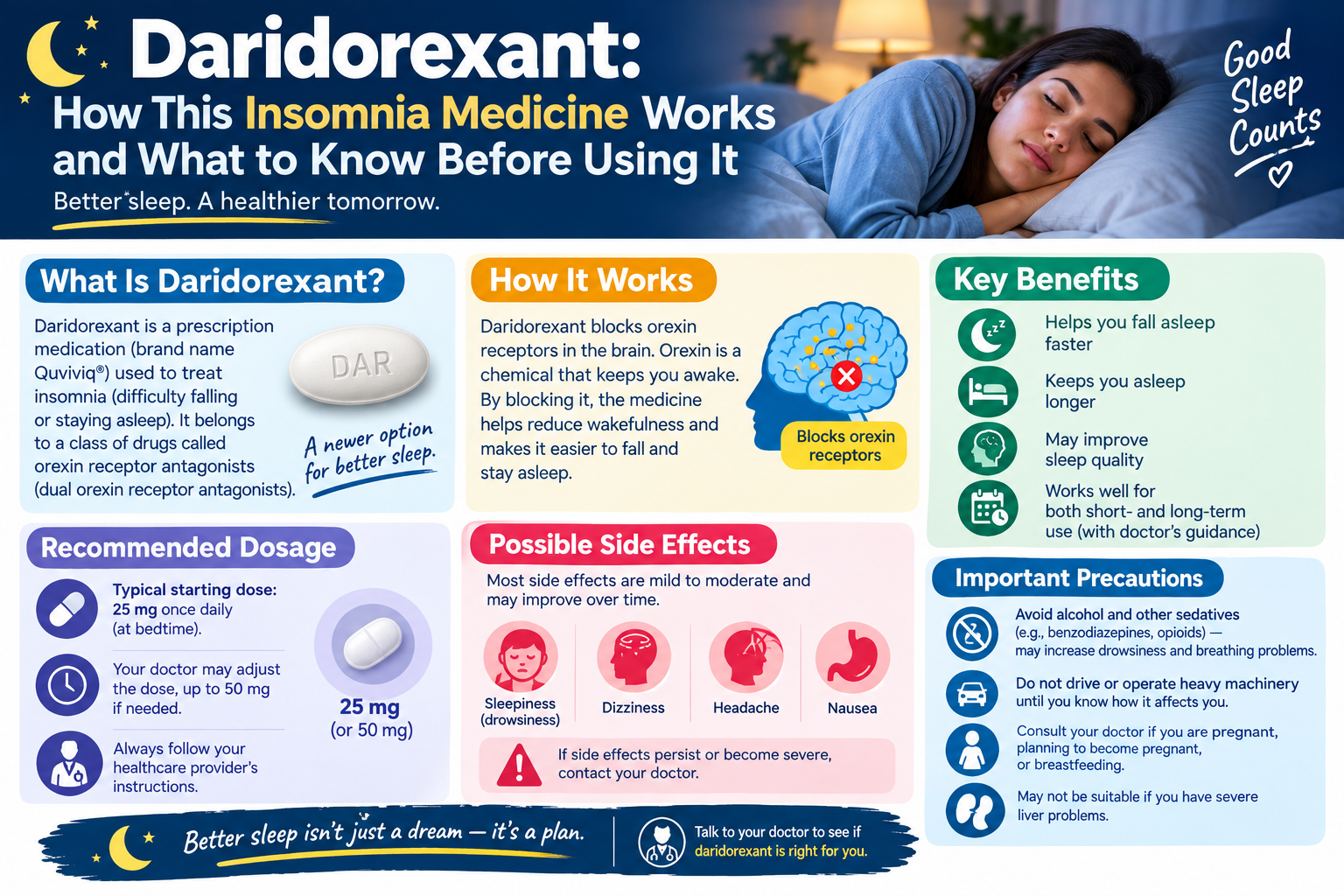
Daridorexant is a prescription medication used to treat insomnia in adults who have difficulty falling asleep, staying asleep, or both.
The medicine is marketed as Quviviq. In the United States, the prescribing information identifies daridorexant as an orexin receptor antagonist for adults with insomnia characterized by difficulties with sleep onset and/or sleep maintenance.
The European Medicines Agency describes Quviviq as a medicine for adults whose insomnia has lasted for at least three months and has a considerable impact on daytime functioning.
Daridorexant is taken as a tablet and is available in 25 mg and 50 mg strengths. It is not an over-the-counter sleep supplement and should be used according to a healthcare professional’s prescription.
What Is Daridorexant Used For?
The primary use of daridorexant is the treatment of insomnia.
Insomnia can involve different sleep difficulties. Some people have trouble falling asleep, while others wake repeatedly during the night or wake earlier than intended and cannot return to sleep.
Daridorexant is designed to address problems with both sleep initiation and sleep maintenance.
Clinical information reviewed by the European Medicines Agency found that Quviviq improved sleep measures and daytime functioning in adults with insomnia.
It is important to remember that not every sleep problem has the same underlying cause. Persistent insomnia can sometimes be related to another medical condition, medication, mental health issue, sleep disorder, or lifestyle factor. That is one reason professional evaluation can be important when sleep problems continue.
How Does Daridorexant Work?
Daridorexant belongs to a group of medicines known as dual orexin receptor antagonists.
The brain produces chemicals called orexins, which are involved in promoting wakefulness. Daridorexant blocks the action of orexin at two receptor types, helping reduce the wake-promoting signal.
This mechanism is different from simply producing generalized central nervous system depression.
The basic idea is that by reducing the brain’s wake signal, daridorexant can make it easier for a person to fall asleep and remain asleep.
This mechanism of action is one of the main reasons people search for terms such as “daridorexant mechanism of action” and “how does daridorexant work.”
What Is the Brand Name of Daridorexant?
The best-known brand name for daridorexant is Quviviq.
Quviviq contains daridorexant as its active ingredient. The medicine is available in tablet form, including 25 mg and 50 mg strengths.
Because searches may use either the generic or brand name, people researching the medicine may encounter both “daridorexant” and “Quviviq.”
What Is the Usual Daridorexant Dosage?
The prescribed dosage depends on the patient and the clinical situation.
The U.S. prescribing information lists a recommended dose of 25 mg to 50 mg once per night, taken within 30 minutes before going to bed, with at least seven hours remaining before planned awakening.
The European product information recommends 50 mg once per night for adults, with 25 mg as an option for some patients based on clinical judgment. The maximum daily dose is 50 mg.
Dosage can be affected by factors such as liver function and interactions with other medicines.
For that reason, people should not increase, reduce, or repeat a dose simply because the medicine seems less effective than expected. The prescribed instructions should be followed.
When Should Daridorexant Be Taken?
Daridorexant is generally taken in the evening within 30 minutes before going to bed.
A full night of sleep should be available after taking it. U.S. and patient information advises having at least seven hours available for sleep because taking it and then getting up too early can increase the chance of next-day drowsiness and impaired alertness.
Food can also affect how quickly the medicine takes effect. The FDA labeling notes that sleep onset may be delayed when daridorexant is taken with or soon after a meal.
Is Daridorexant a Strong Sleeping Pill?
Daridorexant is a prescription sleep medicine, but describing it simply as a “strong” sleeping pill can be misleading.
It belongs to the DORA class and works through the orexin system rather than through a broad sedative mechanism.
Its effects can vary from person to person, and the appropriate dose depends on the individual clinical situation.
Because it can cause sleepiness and impair alertness, it should still be treated as a medicine that can affect driving, coordination, and other activities requiring attention.
What Are the Common Side Effects of Daridorexant?
Like other prescription medicines, daridorexant can cause side effects.
Commonly reported effects include:
- Sleepiness
- Headache
- Fatigue
- Dizziness
- Nausea
MedlinePlus lists headache, fatigue, daytime sleepiness, dizziness, and nausea among possible side effects.
The European Medicines Agency identifies headache and somnolence, meaning sleepiness, among the most common side effects.
Some people may experience next-day drowsiness or reduced alertness. This can be particularly important for people who drive, operate machinery, work at heights, or perform tasks requiring full concentration.
Can Daridorexant Cause Next-Day Sleepiness?
Yes. Next-day sleepiness or reduced alertness can occur.
The risk is especially important when a person does not have enough time to remain in bed after taking the medicine.
MedlinePlus warns that daridorexant may impair driving and other activities requiring alertness even when a person feels awake.
Anyone taking the medicine should understand how it affects them before engaging in activities that require full mental and physical alertness.
What Are the Serious Warnings Associated With Daridorexant?
Daridorexant has several important safety warnings.
The U.S. prescribing information warns about central nervous system effects and next-day impairment. It also includes warnings concerning worsening depression or suicidal thinking, sleep paralysis, hallucinations around sleep transitions, cataplexy-like symptoms, and complex sleep behaviors.
Complex sleep behaviors can involve activities performed while a person is not fully awake.
Reported examples include sleepwalking, sleep-driving, preparing food, eating, making phone calls, or other activities that may not be remembered afterward.
If unusual sleep-related behavior occurs, medical advice should be sought promptly.
Can Daridorexant Affect Mood?
Daridorexant can be associated with changes in mood or behavior in some people.
The prescribing information warns that worsening depression or suicidal thoughts may occur. MedlinePlus also advises patients to report new or worsening depression, unusual behavior, hallucinations, confusion, memory problems, or thoughts of self-harm.
These symptoms should not be ignored. Anyone experiencing mental or behavioral changes should contact a healthcare professional promptly.
Can Daridorexant Cause Sleepwalking or Sleep-Driving?
Complex sleep behaviors are an important warning associated with daridorexant.
A person may perform activities while partially asleep and have little or no memory of them afterward.
Examples can include walking, driving, preparing or eating food, making phone calls, or other activities.
The FDA prescribing information states that daridorexant should be discontinued if complex sleep behavior occurs.
Because sleep-driving can create serious safety risks, this warning deserves particular attention.
Who Should Not Take Daridorexant?
Daridorexant is not appropriate for everyone.
The U.S. labeling lists narcolepsy as a contraindication and also states that people with a known hypersensitivity to daridorexant or its ingredients should not take it.
The European Medicines Agency likewise states that Quviviq must not be used in people with narcolepsy or known hypersensitivity to the medicine or its ingredients.
People with certain liver problems may also require different dosing or may not be appropriate candidates for treatment, depending on the severity.
A healthcare professional should review medical history before prescribing the medicine.
Can Daridorexant Interact With Other Medicines?
Yes.
Daridorexant can interact with other medicines, including some drugs that affect the CYP3A4 enzyme system.
The FDA labeling includes specific recommendations for patients taking medicines that affect CYP3A4. The European product information also identifies strong CYP3A4 inhibitors as a reason Quviviq should not be used.
Daridorexant can also have additive effects with alcohol and other central nervous system depressants.
For this reason, patients should tell their doctor or pharmacist about prescription medicines, over-the-counter products, vitamins, supplements, and herbal products they use.
Can You Drink Alcohol While Taking Daridorexant?
Alcohol should be avoided while taking daridorexant.
Alcohol can increase the sedating effects of the medicine and may worsen impairment.
The FDA patient information specifically advises not to drink alcohol while taking Quviviq because alcohol can increase its effects.
Patients should also discuss other substances or medicines that cause drowsiness with their healthcare professional.
How Long Does Daridorexant Take to Work?
Daridorexant is taken shortly before bedtime and is intended to help with sleep initiation and sleep maintenance.
However, individual responses can differ.
The European Medicines Agency reports that clinical studies showed improvements in the time patients spent awake and in the time needed to fall asleep compared with placebo.
MedlinePlus advises contacting a doctor if sleep problems do not improve within 7 to 10 days or if they become worse.
Persistent insomnia may indicate another underlying problem that needs evaluation.
Daridorexant vs. Older Sleep Medicines
Daridorexant belongs to a different class from several older insomnia medicines.
Its mechanism specifically targets orexin receptors, which are involved in wakefulness.
This does not mean it is automatically better or safer for every person. The appropriate treatment depends on factors such as the type of insomnia, other medical conditions, current medicines, age, and individual risk factors.
A healthcare professional can determine whether a DORA such as daridorexant is appropriate.
What Does Research Say About Daridorexant?
Clinical studies have evaluated daridorexant for adults with insomnia.
The European Medicines Agency reviewed two main studies and reported improvements in sleep duration and daytime functioning. In one study involving 930 patients, participants receiving 50 mg for three months reduced their nightly time awake more than those receiving placebo.
The NIH/PMC review appearing in the supplied search results also reports that daridorexant helped patients fall asleep faster and stay asleep longer compared with placebo.
These findings help explain why daridorexant has become an important subject in searches about newer insomnia treatments.
What Should You Tell Your Doctor Before Taking Daridorexant?
Before starting daridorexant, a healthcare professional should know about relevant health conditions and medicines.
Important information can include:
- Other prescription medicines
- Over-the-counter medicines
- Vitamins and supplements
- Herbal products
- Liver problems
- Breathing or lung conditions
- Sleep apnea
- Narcolepsy
- Depression or other mental health conditions
- Previous problems with substance misuse
- Pregnancy or plans for pregnancy
- Breastfeeding
MedlinePlus specifically advises patients to discuss their complete medication and health history with their doctor or pharmacist.
This information can help identify possible interactions and safety concerns.
What If You Miss a Dose of Daridorexant?
Daridorexant is generally used at bedtime when needed according to the prescription instructions.
MedlinePlus states that a dose may be taken later than usual if the person can still remain in bed for at least seven hours afterward.
If there is not enough time remaining for a full sleep period, taking the medicine may increase the risk of next-day impairment.
Patients should follow their own prescription instructions rather than taking an extra dose to compensate for a missed one.
Is Daridorexant Habit Forming?
Daridorexant may be habit forming.
MedlinePlus advises that patients should not take a larger dose, take it more frequently, or use it for longer than prescribed.
This is one reason prescription sleep medicines should be used under appropriate medical supervision.
If someone feels the medicine is no longer working as expected, increasing the dose without professional advice is not recommended.
Daridorexant and Long-Term Insomnia
Insomnia that continues for months deserves more than a short-term focus on sleep medication.
Long-lasting sleep problems can have many causes, including stress, other health conditions, medication effects, sleep disorders, and mental health concerns.
The European Medicines Agency states that treatment with Quviviq should be kept as short as possible and reassessed by a doctor within three months.
This does not mean every person will follow the same treatment timeline. The appropriate approach depends on the individual situation and medical assessment.
Frequently Asked Questions About Daridorexant
What is daridorexant used for?
Daridorexant is a prescription medicine used to treat insomnia in adults who have difficulty falling asleep, staying asleep, or both. It is marketed under the brand name Quviviq.
Is daridorexant the same as Quviviq?
Yes. Daridorexant is the active ingredient in the prescription medicine sold under the brand name Quviviq.
Is daridorexant a sleeping pill?
Daridorexant is a prescription sleep medicine for insomnia. It belongs to the dual orexin receptor antagonist class and works by blocking orexin receptors involved in wakefulness.
What are the most common daridorexant side effects?
Commonly reported side effects include sleepiness, headache, fatigue, dizziness, and nausea.
Can daridorexant cause next-day drowsiness?
Yes. Daridorexant can cause next-day sleepiness and reduced alertness, particularly when there is not enough time available for a full night’s sleep.
Can you take daridorexant with alcohol?
Alcohol should be avoided while taking daridorexant because it can increase the medicine’s effects and worsen impairment.
What is the usual daridorexant dose?
U.S. prescribing information lists 25 mg to 50 mg once per night, taken within 30 minutes before bedtime, with at least seven hours available for sleep. The exact dose should be determined by the prescribing clinician.
Is daridorexant available in 50 mg?
Yes. Daridorexant is available in 50 mg tablets, and 50 mg is the recommended adult dose in the current European product information.
Is daridorexant better than zopiclone?
There is no single answer that applies to everyone. Daridorexant and zopiclone belong to different medication classes and work differently. A healthcare professional can consider the person’s insomnia pattern, other medicines, medical history, and safety factors when selecting treatment.
Final Thoughts
Daridorexant is a newer prescription medicine for insomnia that works by targeting the brain’s orexin system, a pathway involved in wakefulness.
Its brand name is Quviviq, and it is available in 25 mg and 50 mg tablet strengths. Research and regulatory reviews have found benefits for sleep initiation, sleep maintenance, and some measures of daytime functioning in adults with insomnia.
At the same time, daridorexant can cause sleepiness, dizziness, headache, fatigue, and other effects. More serious warnings include next-day impairment, complex sleep behaviors, mood changes, and other sleep-related effects.
Because it is a prescription medicine with important interactions and safety considerations, dosage and treatment decisions should be made with a qualified healthcare professional. Also read this blog Allergic Drug: How to Recognize Symptoms, Causes & Serious Reactions.
This article is for general educational purposes and does not replace professional medical advice, diagnosis, or individualized treatment.