

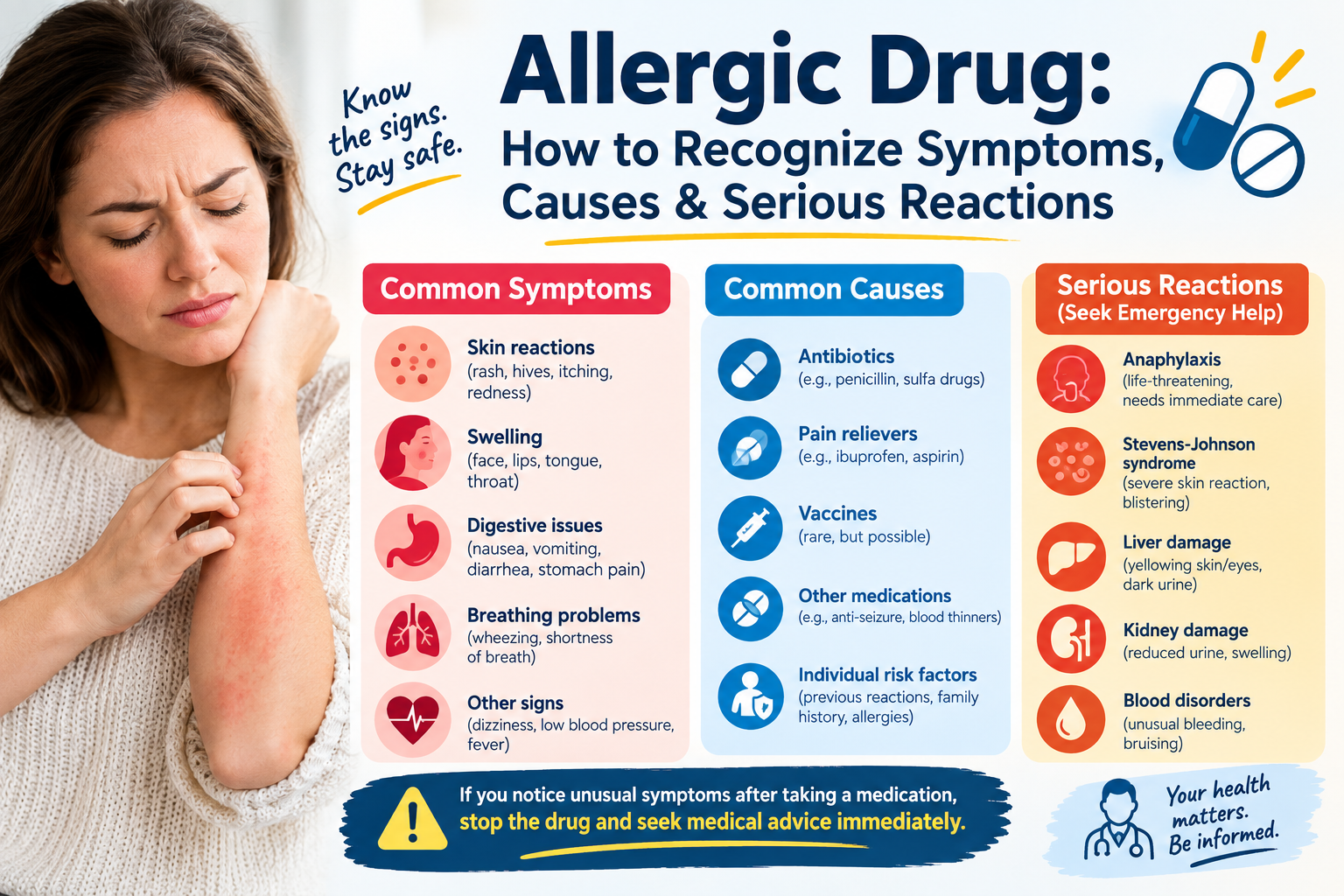
An allergic drug reaction can happen when the immune system reacts abnormally to a medicine that most people can take safely. The reaction may be mild, such as itching or a skin rash, or it can become serious and affect breathing, blood pressure, or several organs.
Many people use the terms drug allergy, medication allergy, and medicine reaction interchangeably. However, not every unwanted reaction to a medicine is a true allergy. A side effect, overdose, drug interaction, and immune-related allergy can have different causes and may require different approaches.
Understanding the difference is important, especially when symptoms appear soon after starting a new medicine.
What Is an Allergic Drug Reaction?
An allergic drug reaction is an immune-system response to a medicine. The immune system mistakenly treats a substance in the medication as harmful and activates a response against it.
A drug allergy can develop with prescription medicines, over-the-counter medicines, and, in some cases, other medicinal products. Certain medicines are more commonly associated with allergic reactions than others.
According to Mayo Clinic, common symptoms of drug allergy include hives, rash, itching, fever, swelling, and respiratory symptoms. Severe reactions can lead to anaphylaxis, which is potentially life-threatening.
A drug allergy is different from a typical side effect. For example, some medicines can cause nausea, drowsiness, or stomach upset as known effects without the immune system being involved.
That distinction matters because a person who believes every unpleasant medication effect is an allergy may unnecessarily avoid medicines that could otherwise be useful.
What Are the Most Common Allergic Drug Causes?
Almost any medicine can potentially cause an allergic reaction, but some groups appear more often in discussions of drug allergy.
Common examples include:
- Penicillin and other antibiotics
- Sulfa drugs
- Aspirin
- Ibuprofen and other NSAIDs
- Naproxen
- Certain opioid medicines
- Some antiseizure medicines
- Certain chemotherapy drugs
- Contrast materials used in some medical imaging
Cleveland Clinic lists penicillin, sulfa drugs, and NSAIDs among common causes of drug allergies. Mayo Clinic similarly identifies antibiotics such as penicillin and pain relievers such as aspirin, ibuprofen, and naproxen among medicines commonly associated with allergic reactions.
This does not mean that everyone taking these medicines will develop an allergy. A person’s previous exposure, medical history, immune response, and other factors can affect their risk.
What Are the Symptoms of an Allergic Drug Reaction?
Drug allergy symptoms can vary considerably.
Some reactions mainly affect the skin. Others can involve the nose, eyes, lungs, digestive system, cardiovascular system, or multiple organs.
Common symptoms can include:
- Itching
- Skin rash
- Hives
- Redness
- Swelling
- Fever
- Runny nose
- Watery or itchy eyes
- Wheezing
- Shortness of breath
Mayo Clinic notes that symptoms of a drug allergy can appear at different times. Some serious reactions happen within about an hour, while certain rashes and other reactions can develop hours, days, or even weeks after exposure.
Because timing can vary, a delayed reaction should not automatically be dismissed simply because symptoms did not appear immediately.
What Does a Drug Allergy Rash Look Like?
A drug allergy rash can take different forms.
Some people develop small red areas or widespread redness. Others may develop raised, itchy welts known as hives.
The appearance of a rash alone does not prove that a medicine caused an allergy.
A rash may have many possible causes, including viral infections, other medicines, skin conditions, or nonallergic drug reactions.
This is one reason medical history is important when evaluating a suspected drug allergy.
If a new rash appears after starting a medication, note when the medicine was taken, when the rash began, whether it is spreading, and whether other symptoms are occurring.
Can an Allergic Drug Reaction Cause Swelling?
Yes. Swelling can occur during a drug allergy.
Mild swelling may affect areas such as the skin or face. More serious swelling involving the lips, tongue, mouth, or throat can interfere with breathing or swallowing.
Swelling accompanied by breathing difficulty, throat tightness, severe dizziness, or loss of consciousness can be a medical emergency.
Cleveland Clinic advises immediate emergency care for severe medication-allergy symptoms such as trouble breathing, difficulty swallowing, lightheadedness, rapid heartbeat, or unconsciousness.
What Is Anaphylaxis From a Drug Allergy?
Anaphylaxis is a severe, potentially life-threatening allergic reaction.
It can affect several body systems at once and may cause:
- Difficulty breathing
- Tightness in the throat or airways
- Swelling of the tongue or throat
- Dizziness
- A sudden drop in blood pressure
- A weak or rapid pulse
- Vomiting or diarrhea
- Loss of consciousness
Mayo Clinic identifies anaphylaxis as a rare but life-threatening form of drug allergy.
If someone develops signs of anaphylaxis after taking a medicine, they need emergency medical attention rather than trying to manage a severe reaction at home.
If an epinephrine auto-injector has previously been prescribed for that person, it should be used according to their emergency plan, and emergency medical services should still be contacted.
When Should You Seek Emergency Help?
A suspected drug reaction requires urgent attention when symptoms suggest a severe allergic response.
Seek emergency medical help for symptoms such as:
- Trouble breathing
- Difficulty swallowing
- Significant throat or tongue swelling
- Fainting or loss of consciousness
- Severe dizziness
- Signs of very low blood pressure
- A rapidly worsening reaction
These symptoms can occur with anaphylaxis and should not be ignored. Mayo Clinic and Cleveland Clinic both recommend emergency care for suspected severe drug allergy reactions.
For milder symptoms, contacting a healthcare professional promptly can help determine whether the reaction is actually an allergy and what should happen with the medication.
What Is the Difference Between a Drug Allergy and a Side Effect?
This is one of the most important distinctions when discussing an allergic drug reaction.
A side effect is an unwanted effect that can occur as part of a medicine’s known effects.
A drug allergy involves the immune system.
For example, a medicine may cause drowsiness or stomach discomfort without triggering an allergic response.
On the other hand, hives, swelling, breathing problems, or certain immune-related reactions may indicate an allergy.
Mayo Clinic specifically distinguishes drug allergy from ordinary medicine side effects and drug toxicity.
That does not mean a side effect is harmless. Some nonallergic medication reactions can still be serious.
The key point is that the terms should not automatically be treated as synonyms.
What Is the Difference Between Drug Allergy and Drug Intolerance?
Drug intolerance is another term that can be confused with allergy.
A person may be unable to tolerate a medicine because it causes an unpleasant effect without the immune system mounting a true allergic response.
The symptoms may still be important enough to discuss with a healthcare professional.
The distinction matters because a confirmed allergy can affect future prescribing decisions, while an intolerance may have different implications.
For this reason, it is useful to document the exact reaction instead of simply writing “allergic” whenever a medicine causes an unwanted effect.
What Causes a Drug Allergy?
The immune system normally protects the body from harmful substances.
In a drug allergy, the immune system incorrectly recognizes a medicine or part of a medicine as a threat.
During some allergic responses, antibodies and immune cells contribute to the release of chemicals that produce symptoms.
A person may not react the first time they encounter a medicine. Sensitization can occur before a noticeable allergic reaction develops.
Mayo Clinic explains that some allergies can develop after repeated exposure, while certain immune mechanisms can produce reactions after an initial exposure.
The exact mechanism depends on the type of drug reaction.
Can a Drug Allergy Happen the First Time You Take a Medicine?
It can appear that way, but the immune system may have encountered a related substance or previously become sensitized without the person realizing it.
For some drug allergies, repeated exposure is involved in developing sensitivity.
Other reactions can occur through different immune mechanisms.
This is why the timing of a reaction is important but cannot always explain the entire situation by itself.
A healthcare professional may need to review previous medications, earlier reactions, medical conditions, and the timing of symptoms.
Can a Drug Allergy Be Delayed?
Yes.
Not all drug allergy reactions happen immediately.
Some reactions can appear hours, days, or weeks after exposure. Mayo Clinic notes that certain delayed reactions may include skin symptoms and more serious conditions affecting organs such as the liver or kidneys.
Cleveland Clinic also describes delayed drug reactions that can develop days or weeks after a medicine is taken.
This is why the question “How long after taking medicine can an allergic reaction occur?” does not have one universal answer.
The timing depends on the medicine and the type of reaction.
What Are the Most Common Drug Allergies?
When people search for a common drug allergy list, several medication groups repeatedly appear in medical references.
Penicillin and Other Antibiotics
Penicillin is one of the most commonly reported drug allergies.
Other antibiotics can also trigger allergic reactions.
A reported penicillin allergy does not necessarily mean that every related antibiotic will cause a reaction. The specific drug and the person’s documented history matter.
Sulfa Drugs
Sulfonamide-containing medicines can cause allergic reactions in some people.
Because “sulfa” can refer to different medicines, a healthcare professional should review the exact medication rather than relying only on the general label.
NSAIDs
Nonsteroidal anti-inflammatory drugs, commonly called NSAIDs, include medicines such as ibuprofen, aspirin, and naproxen.
These medicines can cause allergic or nonallergic hypersensitivity reactions in some people.
Opioid Medicines
Some opioid medicines can be associated with reactions that resemble allergy.
Not every reaction to an opioid represents the same immune mechanism, so proper medical assessment is important.
Chemotherapy and Other Specialized Medicines
Certain chemotherapy drugs and medicines used for complex medical conditions can also cause hypersensitivity reactions.
In these situations, decisions about alternative medicines or future treatment should be made by the treating medical team.
How Is a Drug Allergy Diagnosed?
There is no single test that can confirm every type of drug allergy.
Diagnosis usually begins with a detailed medical history.
A healthcare professional may ask:
- Which medicine did you take?
- What dose did you take?
- When did symptoms begin?
- What symptoms occurred?
- How long did they last?
- Did you take other medicines at the same time?
- Have you had a similar reaction before?
- Did you need emergency treatment?
- Do you have other allergies?
Mayo Clinic notes that the timing of symptoms in relation to taking a medicine is an important part of the evaluation.
Depending on the suspected medicine and reaction, an allergist may use skin testing, blood tests in selected circumstances, or a carefully supervised drug challenge.
What Is Drug Allergy Testing?
Drug allergy testing depends on the medicine and suspected reaction.
Skin testing can be useful for certain medicines, particularly penicillin-type drugs.
During a skin test, a small amount of a suspected allergen may be introduced into the skin under controlled medical conditions.
A positive result may support a diagnosis, but testing does not work equally well for every medicine.
Mayo Clinic notes that blood tests are available for only a limited number of medicines and are not routinely used for every suspected drug allergy.
A drug challenge may sometimes be considered when an allergy is uncertain and a healthcare professional believes the medicine can be tested safely.
Such testing should never be attempted at home.
How Is an Allergic Drug Reaction Treated?
Treatment depends on the severity and type of reaction.
For a suspected allergy, a healthcare professional may recommend stopping or changing the responsible medicine when medically appropriate.
Other treatments can be used to control symptoms.
These may include:
- Antihistamines for certain allergic symptoms
- Corticosteroids in selected situations
- Bronchodilators when appropriate for breathing-related symptoms
- Epinephrine for anaphylaxis
- Medical monitoring for serious reactions
Mayo Clinic explains that treatment may involve stopping the suspected medicine, treating current symptoms, and, in specific situations, considering approaches that allow necessary medicines to be used under specialist supervision.
Do not independently stop an essential prescription medicine without contacting the prescribing healthcare professional unless emergency guidance tells you to do so.
Can You Take Another Medicine If You Are Allergic to One Drug?
Sometimes an alternative medicine is available, but the answer depends on the specific drug and reaction.
For example, being allergic to one antibiotic does not automatically mean that every antibiotic is unsafe.
Similarly, a reported allergy may need to be evaluated to determine whether it was a true allergy, an intolerance, or another type of reaction.
A healthcare professional can choose an alternative based on the original medicine, the reaction, the reason the medicine is needed, and the person’s medical history.
What Is Drug Desensitization?
Drug desensitization is a specialized medical procedure used in selected situations when a person needs a medicine that has previously caused an allergic reaction and suitable alternatives are not available.
Under controlled medical supervision, very small amounts of the medicine are given and gradually increased.
Mayo Clinic describes drug desensitization as one option when a person needs a medicine that has caused an allergic reaction. It is performed under careful supervision because a reaction can occur during the process.
This is not a home treatment or a method people should attempt independently.
How Can You Prevent Another Drug Allergy Reaction?
If a healthcare professional confirms a drug allergy, avoiding the responsible medicine is generally an important part of prevention.
It is also useful to keep an accurate record of the reaction.
Consider:
- Telling your doctor about the allergy
- Informing your dentist and other healthcare professionals
- Keeping the exact medicine name in your medical records
- Recording what symptoms occurred
- Asking whether related medicines need to be avoided
- Considering medical-alert identification when appropriate
Mayo Clinic recommends clearly identifying a known drug allergy in medical records and informing healthcare professionals who may prescribe or administer medicines.
What Should You Do After a Suspected Medicine Allergy?
If symptoms are mild, contact a healthcare professional and provide as much information as possible.
Write down the medicine name, dose, time it was taken, and when symptoms appeared.
If multiple medicines were taken, list all of them.
Also mention supplements and over-the-counter products because they may be relevant to the evaluation.
If the reaction includes breathing difficulty, severe swelling, fainting, or other signs of anaphylaxis, seek emergency medical help immediately.
Allergic Drug Symptoms: Quick Checklist
For a quick reference, possible drug allergy symptoms include:
Mild or moderate symptoms
- Itching
- Hives
- Rash
- Skin redness
- Swelling
- Fever
- Runny nose
- Watery eyes
Potentially severe symptoms
- Throat or tongue swelling
- Difficulty breathing
- Difficulty swallowing
- Severe dizziness
- Rapid or weak pulse
- Low blood pressure
- Loss of consciousness
A person’s symptoms can vary, and a list cannot replace medical evaluation.
Frequently Asked Questions About Allergic Drug Reactions
Which drug is most commonly associated with allergy?
Penicillin is one of the most widely reported drug allergies. Cleveland Clinic notes that around 10% of people report penicillin allergy, although some reported allergies may no longer be clinically relevant or may never have been confirmed.
What are the most common symptoms of a medicine allergy?
Common symptoms include hives, rash, itching, swelling, and fever. More serious reactions can involve breathing problems, dizziness, low blood pressure, or loss of consciousness.
Can an allergic drug reaction happen days later?
Yes. Some drug reactions, particularly certain skin and systemic reactions, can develop hours, days, or weeks after exposure.
What should I do if medicine causes a rash?
Contact a healthcare professional, especially if the rash is new after starting a medicine or is accompanied by swelling, fever, breathing problems, or other symptoms. A rash alone does not establish that the medicine caused a true allergy.
What is the difference between drug allergy and side effects?
A drug allergy involves an immune response, while an ordinary side effect is an unwanted effect associated with a medicine that does not necessarily involve the immune system.
Can drug allergies be treated?
Yes, treatment depends on the reaction. A healthcare professional may recommend stopping or changing the suspected medicine, symptom-directed treatment, or emergency treatment such as epinephrine for anaphylaxis. Also read this section about education.
Final Thoughts
An allergic drug reaction can range from an itchy rash or hives to a serious emergency involving breathing, blood pressure, or multiple organs.
The most important step is not to assume that every unwanted medication effect is an allergy. Side effects, intolerance, toxicity, and immune-mediated drug allergies are different problems.
If you develop symptoms after taking a medicine, the timing, exact medication, dose, and type of reaction can all help a healthcare professional determine what happened.
For severe symptoms such as difficulty breathing, throat or tongue swelling, fainting, or signs of anaphylaxis, emergency medical care is essential.
A confirmed drug allergy should also be clearly documented so healthcare professionals can make safer decisions about future medicines.