
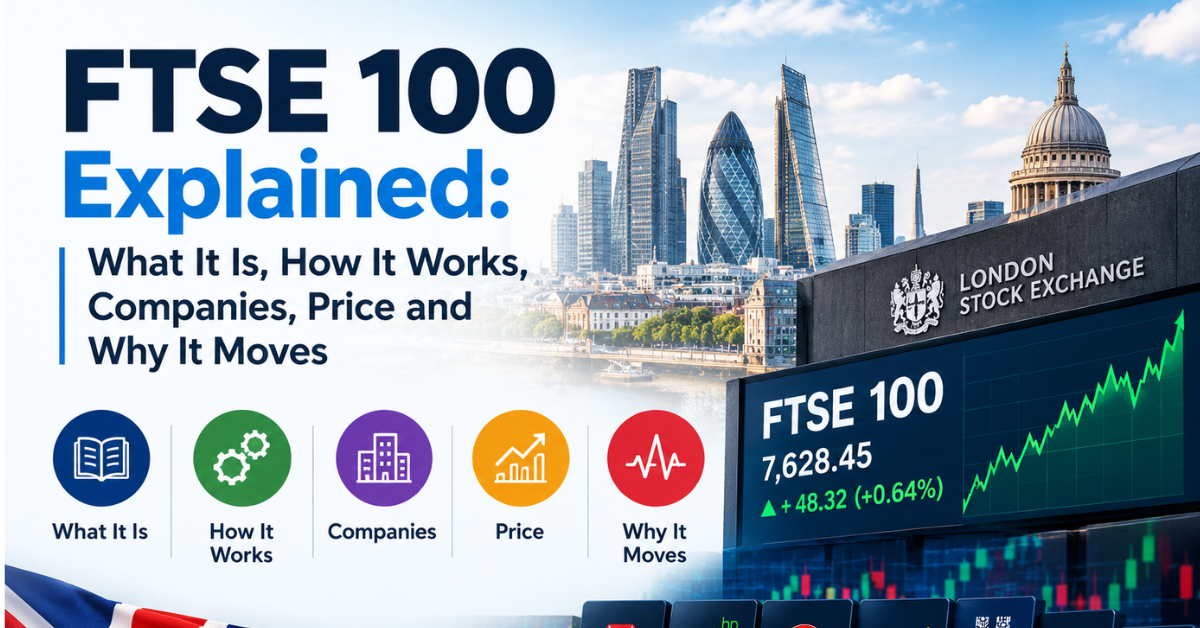
The FTSE 100 is the best known stock market index associated with the UK. It tracks 100 of the largest companies listed on the London Stock Exchange and is widely used as a quick indicator of how large UK listed companies are performing. FTSE Russell, part of LSEG, describes it as the UK’s best known index and says it comprises the 100 most highly capitalised blue chip companies listed on the London Stock Exchange.
For someone searching ftse100, the important question is not only what the number is today. It is also what the number represents, how the index is calculated, why it changes during the trading session, what companies are included and how the FTSE 100 differs from other UK indices.
This guide explains the index in simple terms without turning it into a stock picking or investment recommendation.
What Is the FTSE 100?
The FTSE 100 Index is a stock market index representing 100 of the largest companies by market capitalization within the relevant FTSE UK Index Series universe.
The index was launched in January 1984 and was created as a tradeable benchmark for the UK equity market. Its starting value was 1,000.
The FTSE 100 is often referred to informally as the Footsie.
It is important to understand that the FTSE 100 is an index, not a company.
You cannot buy the FTSE 100 itself in the same way that you buy an individual company’s ordinary shares. Instead, financial products such as index funds and exchange traded funds can be designed to track an index.
What Does FTSE Stand For?
FTSE originally came from Financial Times Stock Exchange.
The index was created through a collaboration between the Financial Times and the London Stock Exchange. The name FTSE later became associated with the index business that developed into FTSE Russell, which is now part of London Stock Exchange Group.
So, in simple terms:
FTSE = Financial Times Stock Exchange
100 = the number of companies represented in the index
The actual construction of the index is more detailed than simply taking any 100 companies from the UK market.
How Does the FTSE 100 Work?
The FTSE 100 is primarily based on company size.
A company’s representation in a market capitalisation based index depends on the value of the shares included in the index. FTSE Russell uses investability and free float adjustments when determining index weights.
This means that the FTSE 100 is not an equal weight index.
A company with a larger eligible market value can have a greater influence on the movement of the index than a smaller constituent.
A simplified example makes this easier to understand.
Imagine an index contains two companies:
| Company | Eligible market value | Approximate weight |
| Company A | £800 billion | 80% |
| Company B | £200 billion | 20% |
If Company A moves significantly, its effect on the index can be greater because it represents a larger proportion of the total index value.
The real FTSE 100 calculation is more sophisticated, but this illustrates the basic principle of market capitalisation weighting.
What Is the FTSE 100 Price?
The FTSE 100 does not have a share price in the same sense as an individual stock.
It has an index level.
For example, the Google snapshot supplied for this article showed:
| FTSE 100 data | Value in supplied snapshot |
| Index level | 10,661.62 |
| Daily change | −23.26 points |
| Daily percentage change | −0.22% |
| Open | 10,685.19 |
| High | 10,756.15 |
| Low | 10,658.22 |
| Previous close | 10,684.88 |
| 52 week high | 10,989.45 |
| 52 week low | 9,266.29 |
The supplied Google result was dated 29 September 2026, so these figures should be treated as a time specific market snapshot rather than permanent FTSE 100 values.
Index levels change throughout the trading session as the prices of constituent companies move.
Why Does the FTSE 100 Go Up or Down?
The FTSE 100 moves because the market values of its constituents change.
Several factors can influence those movements.
Company Earnings
When major companies publish financial results, investors may reassess their expectations about those businesses.
Changes in revenue, profits, margins, guidance or dividends can affect individual share prices.
Interest Rates
Interest rate expectations can influence equity valuations, borrowing costs, currencies and investor behaviour.
Changes in expectations around the Bank of England can therefore affect UK shares and the FTSE 100.
Inflation
Inflation can affect consumer spending, company costs, wages, interest rate expectations and economic growth.
As these factors change, share prices can also change.
Commodity Prices
The FTSE 100 has significant exposure to internationally oriented companies and sectors such as energy and mining.
Changes in oil, gas and metals prices can therefore influence some major constituents.
The Pound
Many large FTSE 100 companies generate substantial revenue outside the UK.
As a result, movements in sterling can affect how overseas earnings translate into pounds and can influence investor expectations.
Global Markets
The FTSE 100 does not operate in isolation.
European markets, US markets, Asian markets, bond yields, currencies and global economic news can all affect investor sentiment.
Why Is the FTSE 100 So High?
One of the People Also Ask questions shown in your supplied Google first page data is:
“Why is the FTSE 100 so high today?”
The word “high” can refer to several different things.
It may mean the index is at a high level compared with its recent history, that it has risen during the current session, or that it is near a 52 week or record level.
An index reaching a higher numerical level does not automatically mean that every constituent is rising.
Because the FTSE 100 is made up of many companies with different weights, sectors and international revenue exposure, the overall index can rise even while some individual constituents decline.
For the same reason, a falling FTSE 100 does not mean every company in the index is falling.
What Companies Are in the FTSE 100?
The FTSE 100 represents 100 qualifying large companies in the FTSE UK Index Series.
Its constituents can change over time because company market capitalisations change and the index is reviewed according to FTSE Russell’s rules.
The official LSEG page provides access to the FTSE 100 Index Constituents and related methodology resources.
The index can include companies operating in sectors such as:
- Banking
- Pharmaceuticals
- Energy
- Mining
- Consumer goods
- Telecommunications
- Insurance
- Retail
- Industrial businesses
- Technology and other services
The important point is that the FTSE 100 is not designed to represent one particular industry.
Are All FTSE 100 Companies Actually British?
Not necessarily in the everyday sense of the word “British”.
The FTSE 100 is a UK market index, but many companies listed in the index operate internationally.
Large constituents can generate revenue across Europe, North America, Asia, emerging markets and other regions.
Therefore, the FTSE 100 should not be interpreted as a pure measurement of economic activity occurring only inside the UK.
This is one reason why global commodity prices, international currencies and overseas economic conditions can have a meaningful relationship with the index.
How Often Is the FTSE 100 Reviewed?
FTSE Russell states that the FTSE 100 is reviewed quarterly as part of the FTSE UK Index Series. Free float information is also assessed as part of the review process.
Changes are implemented according to a fixed schedule, while certain unplanned events such as corporate actions can be reflected outside the normal review process.
This means the list of FTSE 100 companies is not permanently fixed.
A company can move into or out of the index as its market position changes and the applicable index rules are applied.
FTSE 100 vs FTSE 250
The FTSE 100 and FTSE 250 are both major UK market indices, but they represent different parts of the market.
| Feature | FTSE 100 | FTSE 250 |
| Number of companies | 100 | 250 |
| General segment | Large cap | Mid cap |
| Market position | Largest qualifying companies | Companies below the FTSE 100 segment |
| Use | Large UK listed companies benchmark | Mid sized UK listed companies benchmark |
FTSE Russell states that the FTSE 250 consists of mid-capitalised companies not covered by the FTSE 100 and represents approximately 15% of UK market capitalisation.
Together, the FTSE 100 and FTSE 250 form the core constituents of the FTSE 350.
What Is the FTSE 350?
The FTSE 350 combines the FTSE 100 and FTSE 250.
It therefore provides broader exposure to large and mid capitalisation companies traded on the London Stock Exchange that meet the relevant eligibility requirements.
In simple terms:
FTSE 100 = large companies
FTSE 250 = mid sized companies
FTSE 350 = FTSE 100 plus FTSE 250
This distinction is useful when reading UK stock market news because the FTSE 100 and FTSE 250 can sometimes behave differently.
What Is the FTSE All Share Index?
The FTSE All Share Index is broader than the FTSE 100.
According to LSEG, the FTSE All Share combines the FTSE 100, FTSE 250 and FTSE Small Cap indices and represents approximately 98% to 99% of UK market capitalisation.
That makes it useful when someone wants a broader representation of the UK equity market rather than focusing specifically on its largest listed companies.
How Is the FTSE 100 Calculated?
At a simplified level, a market capitalisation based index uses the value of its eligible constituent shares and converts that aggregate value into an index level using an index divisor.
FTSE Russell’s educational material explains that market capitalisation is calculated using share price multiplied by the number of shares included, with constituent weight determined by the company’s market value relative to the total index market value.
The actual FTSE methodology also accounts for free float and investability factors.
Free float essentially refers to shares that are available to public investors rather than shares subject to certain ownership restrictions.
This is why simply adding the total market values of 100 companies is not enough to reproduce the official FTSE 100 level.
What Does Free Float Mean?
Free float refers broadly to the portion of a company’s shares that is available to public investors.
Some shares may be held in ways that restrict their availability for normal public trading.
FTSE Russell adjusts its index construction for investability factors, including free float restrictions and other applicable limitations.
This helps the index better represent the portion of the market that investors can actually access.
FTSE 100 Price Return vs Total Return
Another important distinction is between a price index and a total return index.
The normal FTSE 100 price index reflects changes in constituent share prices.
A total return version also accounts for dividends.
FTSE Russell identifies the FTSE 100 Total Return Index as a measure that combines capital performance with reinvested dividend income.
This distinction matters when someone compares the long term performance of the index with an investment that actually receives dividends.
Is the FTSE 100 the Same as the UK Stock Market?
No.
The FTSE 100 is an important UK market benchmark, but it does not represent every publicly traded UK company.
There are several other FTSE indices covering different market segments.
For example:
- FTSE 100 covers large capitalisation companies
- FTSE 250 covers mid capitalisation companies
- FTSE 350 combines the FTSE 100 and FTSE 250
- FTSE All Share provides much broader UK market coverage
LSEG describes the FTSE UK Index Series as covering different capitalisation and industry segments of the UK equity market.
What Does It Mean When the FTSE 100 Rises?
When the FTSE 100 rises, the index value has increased compared with its previous level.
It generally reflects the combined movement of its constituents after their respective index weights are taken into account.
It does not mean that every FTSE 100 company has increased.
For example, some shares could fall while larger weighted constituents rise enough to push the overall index higher.
What Does It Mean When the FTSE 100 Falls?
A falling FTSE 100 means the index level has declined.
Possible causes include:
- Falling share prices among major constituents
- Weak company results
- Changes in interest rate expectations
- Commodity price movements
- Currency movements
- Global market weakness
- Economic concerns
- Geopolitical developments
The exact reason for a particular daily move needs to be assessed from the market conditions and company specific news at that time.
How to Read FTSE 100 Today
If you search FTSE 100 today, you will usually see several pieces of information.
Current Level
This tells you where the index is trading at the time of the quote.
Daily Change
This shows how many index points the FTSE 100 has gained or lost during the session.
Percentage Change
The percentage change provides a relative measure of the day’s movement.
Open
The opening level shows where the index began the trading session.
High and Low
These show the highest and lowest levels reached during the relevant session.
Previous Close
This is the index level recorded at the previous trading session’s close.
52 Week High and Low
These provide context about the highest and lowest levels reached over the preceding 52 week period.
Because market prices change continuously during trading hours, a quote seen in the morning can be different from the closing value later in the day.
What Is the FTSE 100 All Time High?
The all time high is the highest level the index has reached according to the relevant market record and measurement.
Your supplied Google AI Overview reported an all time high of 10,989.45 on July 30, 2026.
Because record levels can change whenever a new high is reached, readers checking this information should verify the latest official market data before treating a particular figure as the current record.
FTSE 100 and Dividends
Dividends are particularly relevant when discussing the FTSE 100 because the ordinary price index does not tell the complete story of shareholder income.
A company can distribute part of its profits to shareholders as dividends.
When a share goes ex dividend, its market price can adjust to reflect the dividend distribution. A price only index does not add the dividend back.
A total return index handles this differently by incorporating dividend income into its performance calculation. FTSE Russell specifically distinguishes the FTSE 100 Total Return Index from the standard index.
Is the FTSE 100 an Investment?
The FTSE 100 itself is an index, not an individual security.
Investors can gain exposure to an index through financial products designed to track it, including certain index funds and ETFs.
However, the performance of an index tracking product can differ from the headline index because of fees, tracking differences, taxation, dividends and the specific structure of the product.
This article explains how the index works and is not a recommendation to buy or sell any particular investment.
Why Do People Follow the FTSE 100?
There are several reasons the index receives so much attention.
It provides a widely recognised reference point for large UK listed companies.
It is also frequently mentioned in financial news because it gives readers a quick indication of the direction of a major segment of the UK equity market.
LSEG itself describes the FTSE 100 as a popular gauge of UK stock market health.
It is also used as a benchmark for investment products and financial analysis.
Where Can You Check FTSE 100 Data?
Your supplied Google results show several major financial platforms ranking for ftse100, including the London Stock Exchange, Google Finance, Yahoo Finance, Markets Insider, TradingView, CNBC and IG.
For authoritative index information, LSEG’s official FTSE 100 page provides the index overview, methodology resources and constituent information.
You can also use the London Stock Exchange’s market information and other established financial data platforms to compare current prices and historical information.
What Does FTSE 100 Stand For?
FTSE stands for Financial Times Stock Exchange.
The name originated from the collaboration between the Financial Times and the London Stock Exchange that created the index in the 1980s.
The “100” refers to the number of companies represented by the index.
Frequently Asked Questions About FTSE 100
What does FTSE 100 stand for?
FTSE stands for Financial Times Stock Exchange. The FTSE 100 is an index representing 100 of the largest qualifying companies in the FTSE UK Index Series by market capitalisation.
Who owns 90% of the stock market today?
This is a broader stock ownership question rather than a direct FTSE 100 question. The FTSE 100 itself is not a company and is not owned by one investor.
Individual companies represented in the index have their own shareholder structures. Ownership can include individual investors, institutions, funds and other shareholders.
Why is FTSE 100 so high today?
The FTSE 100 can reach a high level when the weighted value of its constituents increases. The reasons for a particular day’s movement can include company results, interest rate expectations, commodity prices, currency movements and global market conditions.
A high index level does not mean that every company in the index is rising.
What is the 7% rule in shares?
The “7% rule” is a trading and risk management rule of thumb associated with selling a stock after a decline of around 7% from a purchase price. It is not an official FTSE 100 rule or a requirement of the index.
Different investors use different risk management approaches, so the 7% figure should not be treated as a universal rule. The concept is separate from how the FTSE 100 itself is calculated.
What is the FTSE 100 made up of?
The FTSE 100 is made up of 100 qualifying large capitalisation companies within the FTSE UK Index Series. The constituents can change as companies move in or out of the index under FTSE Russell’s rules.
Is FTSE 100 the same as FTSE 250?
No. The FTSE 100 represents the large capitalisation segment, while the FTSE 250 represents mid capitalisation companies outside the FTSE 100 segment. The two together form the FTSE 350.
How is the FTSE 100 calculated?
The index is based on the market value of its constituents and uses an index divisor. Its methodology also applies investability and free float adjustments when determining constituent weights.
Does the FTSE 100 include dividends?
The standard price index does not represent dividend income in the same way as a total return index. FTSE Russell provides a separate FTSE 100 Total Return Index that incorporates dividend income.
How often does the FTSE 100 change its constituents?
The FTSE 100 is reviewed quarterly as part of the FTSE UK Index Series, with changes implemented according to the relevant review schedule and rules. Certain corporate actions can also affect the index outside regular reviews.
Why does the FTSE 100 move during the day?
The index moves as the prices of its constituent shares change. Because constituents have different index weights, larger weighted companies can have a greater effect on the overall index level.
Final Thoughts
The FTSE 100 is more than a number shown on a financial website. It is a structured market index designed to represent the performance of 100 large qualifying companies in the UK equity market.
To understand the index properly, it helps to look beyond the headline figure and understand market capitalisation, free float, constituent weights, index reviews, dividends and the difference between price return and total return.
The Google first page for ftse100 also shows that users are looking for more than the definition. They want the current index level, company information, market movements, news and basic questions about how the UK stock market works. This article therefore covers the informational intent around the keyword without turning the page into a stock recommendation or a simple “today” price page.Also read this Connections Hints Forbes Today: NYT Connections Hints, Answers & Strategy.