

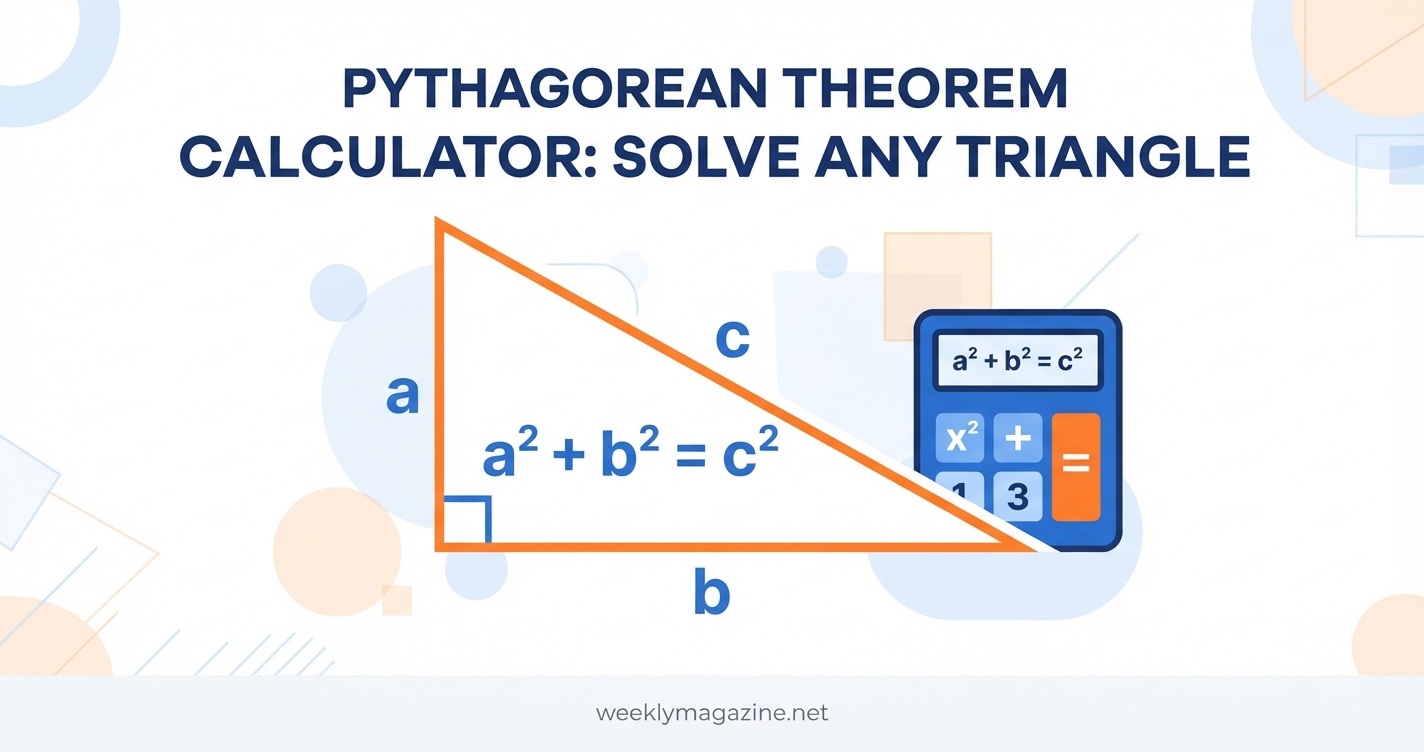
Trying to find a missing side of a right triangle without a calculator can turn a simple homework problem into a frustrating exercise in square roots and arithmetic. A Pythagorean theorem calculator removes that hassle entirely. Enter any two known sides, and it instantly solves for the third, showing your answer in seconds instead of minutes.
This guide covers everything worth knowing about using a Pythagorean theorem calculator, from the math behind it to real-world situations in construction, technology, and everyday life where this simple formula turns out to be surprisingly useful.
What Is a Pythagorean Theorem Calculator?
A Pythagorean theorem calculator is a free online tool that solves for a missing side of a right triangle. You enter the two sides you already know, and the calculator instantly returns the length of the third side using the classic Pythagorean formula.
These tools remove the need to manually square numbers, add them together, and calculate a square root by hand, which is especially helpful when working with decimals or larger numbers where mental math becomes unreliable.
How Does the Pythagorean Theorem Work?
The Pythagorean theorem describes a fixed relationship between the three sides of a right triangle, meaning a triangle with one 90-degree angle. It states that the square of the hypotenuse, the longest side, equals the sum of the squares of the other two sides.
This relationship only applies to right triangles specifically. For any other triangle shape, without a 90-degree angle, the standard Pythagorean formula does not apply, and a different approach, such as the law of cosines, would be needed instead.
What Is the Formula Behind a Pythagorean Theorem Calculator?
The formula is written as a squared plus b squared equals c squared, where a and b represent the two shorter sides, known as legs, and c represents the hypotenuse. A calculator simply automates this equation based on whichever values you provide.
If you know both legs, the calculator adds their squares together and takes the square root to find the hypotenuse. If you know the hypotenuse and one leg, it rearranges the formula to solve for the missing leg instead.
How Do You Use a Pythagorean Theorem Calculator?
Using one of these calculators is straightforward, even without any advanced math background. Most tools follow the same basic process regardless of design or layout.
- Identify which two sides of the triangle you already know
- Enter those two values into the corresponding input fields
- Select whether you are solving for the hypotenuse or a missing leg, if the tool requires this
- Click calculate to instantly see the missing side length
What Information Do You Need to Enter?
You only need two known values to solve for the third. This can be any combination, such as both legs, or the hypotenuse paired with one leg. As long as two of the three side lengths are known, the calculator has everything it needs.
Make sure your measurements use the same unit throughout, whether that is inches, centimeters, or feet, since mixing units will produce an incorrect result even though the math itself is technically correct.
How Do You Find the Hypotenuse Using This Calculator?
To find the hypotenuse, enter the lengths of both legs, labeled a and b. The calculator squares each value, adds the two squared numbers together, and then takes the square root of that sum to reveal the length of side c, the hypotenuse.
This is the most common use case for a Pythagorean theorem calculator, since finding a diagonal distance based on two known straight-line measurements comes up constantly in both schoolwork and everyday practical situations.
How Do You Find a Missing Leg Instead of the Hypotenuse?
If you already know the hypotenuse and one leg, the calculator rearranges the formula slightly. It squares the hypotenuse, subtracts the square of the known leg, and takes the square root of the result to find the missing leg length.
This version of the calculation comes up often in construction and design work, where the diagonal distance and one straight measurement are already known, and the remaining straight-line distance needs to be figured out.
What Is a Right Triangle and Why Does It Matter?
A right triangle is any triangle containing exactly one 90-degree angle. This specific angle is what makes the Pythagorean theorem applicable in the first place, since the formula relies entirely on that right angle relationship between the sides.
If a triangle does not include a 90-degree angle, the Pythagorean theorem simply does not apply, and using it anyway will produce an incorrect result. Confirming the triangle is truly a right triangle is an important first step before relying on this calculation.
Real-Life Uses of the Pythagorean Theorem
Beyond the classroom, this formula shows up constantly in practical, everyday situations. Carpenters use it to confirm that a corner is truly square before building a frame. Landscapers use it to measure diagonal distances across a yard without needing to physically walk the diagonal line.
Homeowners even use a simplified version when checking whether a piece of furniture will fit diagonally through a doorway, since the diagonal distance is often the limiting factor rather than the straight height or width alone.
Common Mistakes When Using a Pythagorean Theorem Calculator
- Mixing up which side is the hypotenuse, since it must always be the longest side opposite the right angle
- Entering measurements in different units without converting them first
- Trying to apply the formula to a triangle that does not actually have a 90-degree angle
- Rounding intermediate values too early, which can slightly throw off the final answer
- Confusing the formula for finding the hypotenuse with the rearranged version for finding a leg
Pythagorean Theorem Calculator vs Manual Calculation
Manual calculation works fine for simple, round numbers, but becomes genuinely tedious with decimals, larger figures, or when double-checking work quickly. A calculator removes any risk of a small arithmetic slip changing the final answer.
For students specifically, using a calculator to check manual work is often more valuable than relying on it exclusively, since it confirms whether the by-hand process was done correctly without skipping the learning process entirely.
How Accurate Is a Pythagorean Theorem Calculator?
The math itself is exact, since the Pythagorean theorem is a proven mathematical relationship rather than an estimate or approximation. As long as the input values are accurate, the calculator’s output will be precisely correct every time.
Any inaccuracy in a real-world application typically comes from imprecise measurements taken beforehand, not from any limitation in the calculator or the underlying formula itself.
Pythagorean Triples: What Are They?
A Pythagorean triple is a set of three whole numbers that satisfy the Pythagorean theorem perfectly, without needing a square root that produces a decimal. The most well-known example is 3, 4, and 5, since 3 squared plus 4 squared equals 5 squared exactly.
Recognizing common triples like 3-4-5, 5-12-13, or 8-15-17 can actually speed up quick mental estimates, though a calculator remains the more reliable choice for anything outside these familiar, clean number sets.
Pythagorean Theorem in Construction and Design
Builders rely on this formula constantly, most famously through the 3-4-5 method for squaring corners. Measuring 3 feet along one wall and 4 feet along the adjacent wall, the diagonal distance between those two points should measure exactly 5 feet if the corner is a true right angle.
This same principle scales up for laying out foundations, framing walls, and even designing staircases, where the rise, run, and diagonal stringer length all relate directly through this same fundamental formula.
How Students Can Use This Calculator to Learn Faster
Rather than using a calculator purely to skip the work, students often benefit most from working a problem out by hand first, then using the calculator to verify the answer. This approach builds real understanding while still catching careless mistakes.
Teachers sometimes recommend using a calculator specifically for larger or messier numbers, while reserving clean, simple numbers like 3-4-5 for manual practice, keeping both speed and genuine understanding in the learning process.
Beyond Triangles: Where Else the Formula Applies
The Pythagorean theorem extends naturally into other areas of math and science, including finding the distance between two points on a coordinate grid, which is essentially the same triangle relationship applied to horizontal and vertical distance.
It also appears in physics when calculating resultant vectors, and in everyday technology like screen size measurements, since a television or monitor’s diagonal size is calculated using this exact same formula applied to its width and height.
Pythagorean Theorem Calculator for Different Grade Levels
Middle School Students
Students first encountering this formula typically work with simple whole numbers, so a calculator at this stage is most useful for verifying answers rather than doing the heavy lifting on every problem.
High School Geometry Students
As problems introduce decimals, larger numbers, and real-world word problems, a calculator becomes genuinely time-saving, letting students focus on setting up the problem correctly rather than getting stuck on arithmetic.
College and Advanced Math Students
At higher levels, the theorem often appears embedded within larger problems, such as vector calculations or coordinate geometry, where a quick, reliable calculator speeds up a much bigger overall problem.
Understanding the History Behind the Theorem
Although named after the ancient Greek mathematician Pythagoras, evidence suggests civilizations including the Babylonians understood this same triangle relationship long before his time. The theorem remains one of the most enduring and widely taught results in all of mathematics.
Its lasting popularity comes from just how broadly useful it is, showing up in fields as varied as architecture, navigation, physics, and computer graphics, all built on the exact same simple relationship between three sides of a right triangle.
How the Formula Connects to the Distance Formula
The distance formula, used to find the straight-line distance between two points on a graph, is really just the Pythagorean theorem applied to horizontal and vertical distance. The difference in x-coordinates and y-coordinates act as the two legs of a right triangle, with the direct distance between the points acting as the hypotenuse.
Recognizing this connection helps many students understand coordinate geometry more intuitively, since it is not a separate concept to memorize but simply a new application of a formula they likely already know.
Using a Calculator to Double-Check Word Problems
Word problems often bury the actual right triangle inside a real-world scenario, such as a ladder leaning against a wall or a shortcut cutting diagonally across a park. The hardest part is usually identifying which measurements represent the legs and which represents the hypotenuse.
Once that identification is made correctly, a calculator instantly confirms the final numeric answer, letting you focus your effort on interpreting the problem rather than repeating tedious arithmetic by hand.
How the Theorem Applies to Everyday Technology
Screen sizes for televisions, monitors, and phones are always measured diagonally, using the exact same Pythagorean relationship applied to a screen’s width and height. A 55-inch television, for example, measures 55 inches along its diagonal, not along either edge.
This same principle applies to navigation and mapping tools, which frequently calculate the shortest straight-line distance between two points using this same underlying formula, even when the interface never mentions the theorem by name.
A Quick Glossary of Related Terms
- Right triangle: a triangle containing exactly one 90-degree angle
- Hypotenuse: the longest side of a right triangle, located opposite the right angle
- Leg: either of the two shorter sides that form the right angle itself
- Square root: the value that, when multiplied by itself, produces a given number
- Pythagorean triple: a set of three whole numbers that satisfy the theorem exactly
Tips for Getting the Most Out of a Pythagorean Theorem Calculator
- Sketch the triangle first, labeling the known and unknown sides clearly before entering any numbers
- Double-check that the triangle genuinely contains a right angle before applying the formula
- Keep all measurements in the same unit throughout the entire calculation
- Use the calculator to verify manual work rather than skipping the practice entirely, especially while still learning
- Round your final answer only at the very end, not during intermediate steps
Pythagorean Theorem Calculator vs Trigonometry Calculator
The Pythagorean theorem solves specifically for side lengths in a right triangle, while trigonometry calculators handle angles and side ratios more broadly, using tools like sine, cosine, and tangent. The two are closely related but solve different types of problems.
If you already know two side lengths and need the third, a Pythagorean theorem calculator is the faster, simpler choice. If you need to find an angle, or only know one side along with an angle measurement, a trigonometry calculator becomes the more appropriate tool.
How Architects and Engineers Rely on This Formula
Beyond basic construction, architects use the Pythagorean relationship when designing roof pitches, staircases, and structural supports, where diagonal measurements need to align precisely with vertical and horizontal dimensions.
Engineers apply the same formula when calculating load distances, cable lengths, and structural bracing, since many real-world support systems are essentially large-scale right triangles requiring the exact same underlying math.
Practicing With the Calculator Before an Exam
Students preparing for a geometry test often use a calculator to quickly generate and check practice problems, entering random leg or hypotenuse values to build speed and confidence recognizing the pattern before facing timed exam conditions.
This kind of repeated practice, paired with instant verification, tends to build stronger recall than working through a small number of textbook problems alone, since it exposes students to a wider range of number combinations.
How to Verify Your Triangle Is a True Right Triangle
Sometimes you already have all three side lengths and simply want to confirm whether a triangle is a right triangle in the first place. Squaring the two shorter sides, adding them together, and comparing the result to the square of the longest side reveals the answer immediately.
If the two totals match exactly, the triangle is confirmed as a right triangle. If they do not match, the shape is not a right triangle, and the standard Pythagorean formula should not be used to solve for any of its sides.
Final Thoughts
A Pythagorean theorem calculator turns a formula that can feel intimidating on paper into a fast, reliable tool you can use for homework, practical projects, or quick real-world measurements. Whether you are solving for a hypotenuse, checking a corner is square, or verifying manual classwork, having an accurate instant answer removes unnecessary guesswork.
Double-check that your triangle truly has a right angle, keep your units consistent, and use the calculator to confirm your understanding rather than replace it entirely. Whether you are working through homework, checking a construction measurement, or simply curious about a diagonal distance, this simple formula continues to prove its usefulness decades after most people first learn it. For more educational tools and guides like this one, visit WeeklyMagazine.net.
Frequently Asked Questions (FAQs)
1. How do I use a Pythagorean theorem calculator to find the hypotenuse?
Enter the lengths of both legs of the right triangle, and the calculator squares each value, adds them together, and takes the square root to give you the hypotenuse instantly.
2. Can this calculator find a missing leg instead of the hypotenuse?
Yes, if you enter the hypotenuse and one leg, the calculator rearranges the formula to solve for the missing leg by subtracting the squared leg from the squared hypotenuse.
3. Does the Pythagorean theorem work on any triangle?
No, it only applies to right triangles, meaning triangles with exactly one 90-degree angle. For other triangle shapes, a different formula such as the law of cosines is needed.
4. What is a Pythagorean triple?
A Pythagorean triple is a set of three whole numbers that satisfy the theorem exactly, such as 3, 4, and 5, without producing a decimal result when calculated.
5. How accurate are online Pythagorean theorem calculators?
They are completely accurate for the math itself, since the formula is an exact mathematical relationship. Any error typically comes from inaccurate input measurements rather than the calculator.
6. Can I use a Pythagorean theorem calculator for construction projects?
Yes, it is commonly used to verify square corners, calculate diagonal distances, and plan layouts using the same right-triangle relationship builders have relied on for generations.
7. Why do I need to know which side is the hypotenuse?
The hypotenuse is always the longest side and sits opposite the right angle. Entering values into the wrong field can produce an incorrect result, so identifying it correctly matters.
8. Is a Pythagorean theorem calculator useful for students?
Yes, it is especially helpful for checking manual homework answers, working with larger or decimal numbers, and building confidence before moving on to more advanced geometry topics.
About the Author
Syeda is a global link building specialist and content writer. She specializes in creating clear, well-researched educational content that helps students and everyday readers understand math concepts with confidence.