

As soon as a team uses more than one AI model in production, a familiar mess sets in: separate API keys and SDKs per provider, no single view of cost or usage, and an app that grinds to a halt the moment one provider has an outage. Switching to a cheaper or better model means rewriting integration code. The pattern that solves all of this at once has a name — the LLM gateway — and it is quickly becoming standard infrastructure for teams that are serious about running AI in production.
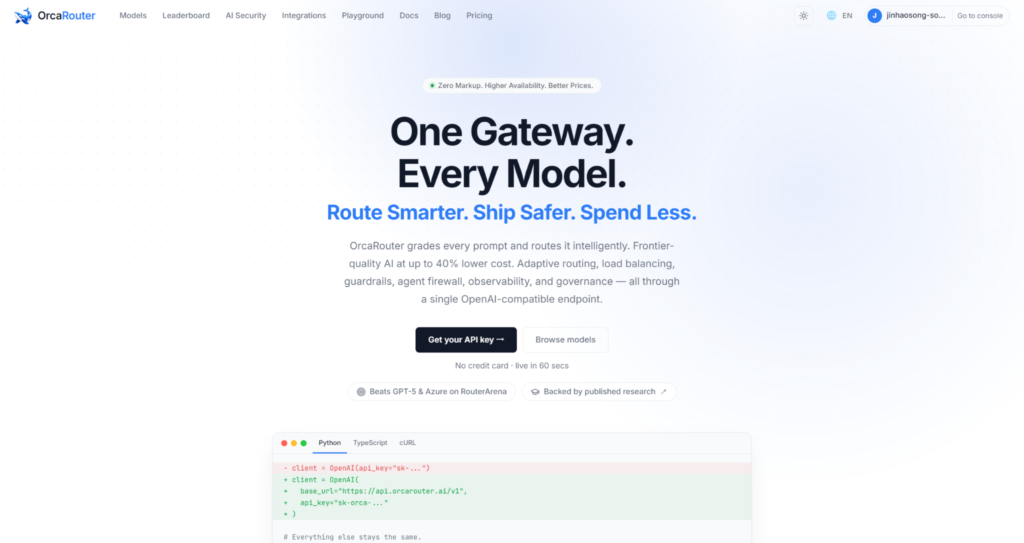
OrcaRouter is one example of an AI gateway: a single OpenAI-compatible endpoint that reaches 200+ models, routes each request to the right one, fails over automatically, and adds zero markup on tokens. This guide explains what an LLM gateway actually is, the problems it solves, the features to expect, and how to choose one — with OrcaRouter as a concrete reference point.
What is an LLM gateway?
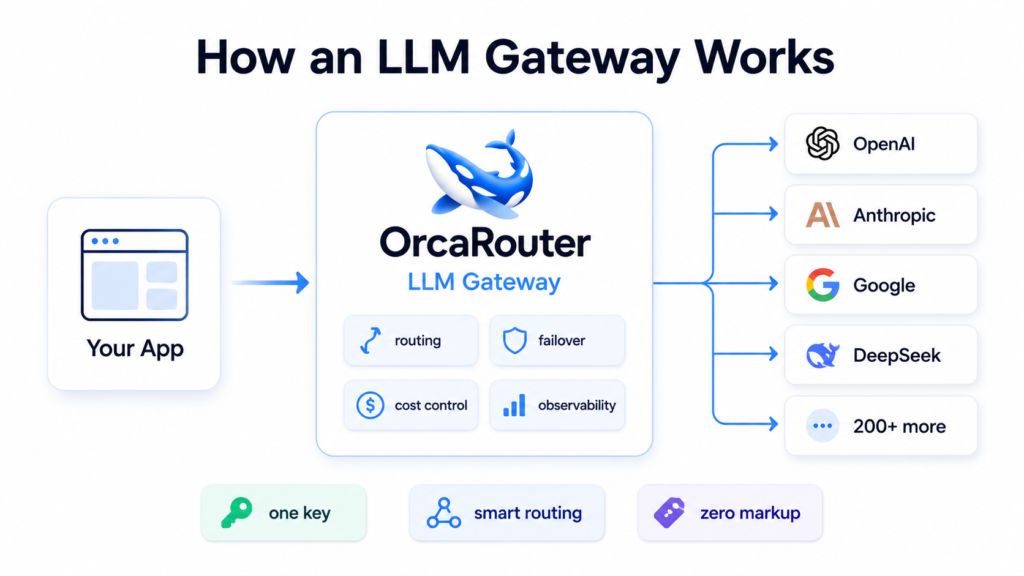
An LLM gateway is a layer that sits between your application and the many model providers you might use — OpenAI, Anthropic, Google, DeepSeek, and others. Instead of integrating with each provider separately, your code talks to the gateway through a single API, and the gateway forwards each request to the right model. Think of it as a reverse proxy or load balancer, but purpose-built for large language models: it understands models, tokens, prompts, and streaming, and it adds routing, reliability, cost control, and observability on top.
Most modern gateways are OpenAI-compatible, meaning they speak the same request format as the OpenAI API. That’s the detail that makes adoption painless: you keep your existing SDK and code, and simply point it at the
Why teams use an LLM gateway
A gateway earns its place by solving five problems that show up the moment you go multi-model:
- Provider sprawl — one API key and one integration instead of a different SDK and dashboard per provider
- Reliability — automatic failover reroutes to another model when a provider is down or rate-limiting you
- Cost control — route cheap, high-volume tasks to inexpensive models and reserve premium models for hard ones
- No lock-in — swap models by changing one string, so a price drop or better model elsewhere is easy to adopt
- Observability and governance — one place to see every call, track spend, and apply guardrails and access controls
Individually, each of these is solvable with glue code. Together, they’re a standing tax on every AI project — which is why teams increasingly treat the gateway as infrastructure rather than a nice-to-have.
Key features to expect
Not every gateway offers the same capabilities. A strong one should include:
- Smart routing — send each request to the best model by quality, cost, or latency
- Automatic failover — reroute mid-stream when a provider fails, so users never notice
- Prompt caching — reuse repeated context to cut cost and latency
- Observability — logs, usage, and spend across every model in one dashboard
- Security and governance — guardrails, PII handling, and access controls for team use
- Zero markup and OpenAI compatibility — pay providers’ real rates, and keep your existing code
LLM gateway vs building it yourself
You can build a thin version of a gateway in-house — a wrapper that picks a model and retries on failure. It works until it doesn’t: real routing quality, mid-stream failover, caching, per-model observability, and governance are each meaningful projects, and keeping adapters current as providers change their APIs is ongoing work. For most teams, a dedicated gateway delivers all of it out of the box, so engineering time goes to the product instead of to plumbing.
How to choose an LLM gateway
When you compare options, weigh five things:
- Zero markup — you should pay the provider’s real token price, not a marked-up rate
- Model breadth — access to many providers so you’re never boxed in
- OpenAI compatibility — so your code and SDKs work with no rewrite
- Reliability — measurable routing quality and fast automatic failover
- Observability and governance — the controls a team needs to run AI safely and see its spend
OrcaRouter is built around exactly these: one OpenAI-compatible endpoint to 200+ models, smart routing with automatic failover, full observability, built-in guardrails, and zero token markup — plus a free plan to start.
How to get started
Adopting a gateway is a one-line change, not a migration:
- Create a free account and generate an API key
- Point your existing OpenAI SDK at the gateway’s base URL
- Pick a model — and route different tasks to different models as you grow
- Watch cost and usage in one dashboard, and add failover and guardrails as needed
Common LLM gateway use cases
Teams reach for a gateway in a few recurring situations, and recognizing yours makes the value concrete:
- Cost optimization — route high-volume, simple work (classification, extraction, summaries) to cheap models, and escalate only the hard tasks to premium ones
- Multi-model products — apps that deliberately use different models for different features, all behind a single integration instead of several
- Reliability-critical apps — products where an outage at one provider must never take the whole app down, so automatic mid-stream failover is non-negotiable
- Team governance — organizations that need one place to enforce guardrails, track spend per project, and control who can call which model
If any of these describe your setup, a gateway stops being optional and starts paying for itself in saved engineering time and avoided downtime.
The bottom line
An LLM gateway is what turns a pile of provider integrations into infrastructure: one API, any model, with failover, cost control, and governance where you can actually manage them. If AI is load-bearing in your product — or about to be — the gateway isn’t an optimization, it’s the foundation you’ll wish you’d laid on day one.
Ready to put one API in front of every model? Start free with OrcaRouter — one OpenAI-compatible endpoint, 200+ models, smart routing and automatic failover, zero markup.
FAQ
Is an LLM gateway a single point of failure?
It’s a fair concern: you’re consolidating traffic through one layer. In practice a good gateway is built as redundant infrastructure and fails over across providers beneath it, so it usually removes more downtime than it adds — but uptime track record and SLA are exactly what to scrutinize when choosing one.
Can I self-host an LLM gateway?
Yes — open-source gateway projects exist that you run inside your own network, which suits strict data-residency needs. The trade-off is that routing quality, failover, and provider adapters become your team’s maintenance burden instead of a managed service’s.
How does a gateway handle streaming responses?
Requests pass through the gateway as a stream, so tokens still arrive incrementally with negligible added latency. The detail worth checking is failover mid-stream: the strongest gateways can switch providers partway through a response, weaker ones can only retry from the start.