
How to Address an Envelope
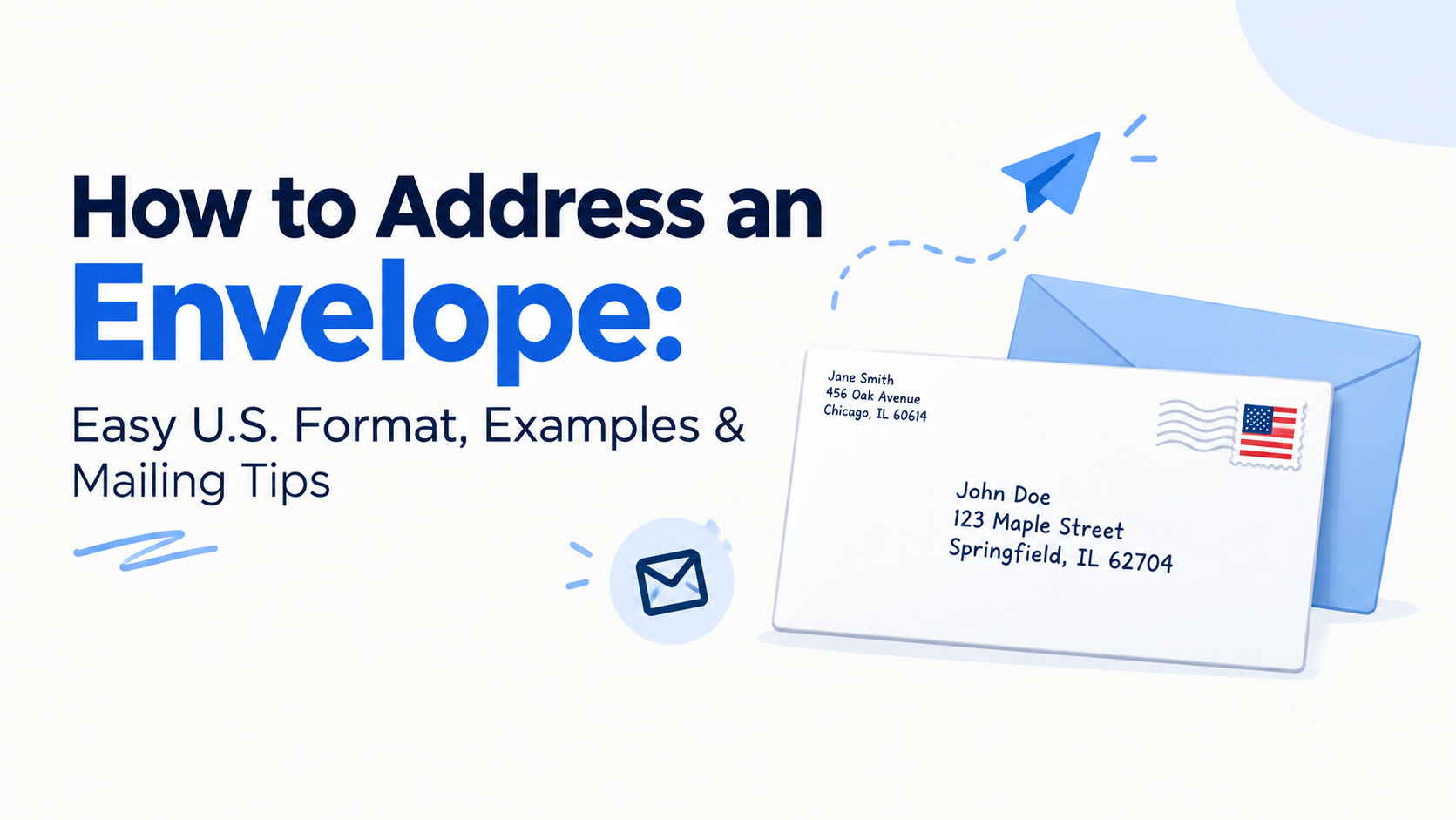
Learning how to address an envelope is simple once you know where each part of the address belongs. For a standard U.S. envelope, the recipient’s name and mailing address go in the center of the front, your return address goes in the upper-left corner, and the postage stamp goes in the upper-right corner. The address should be written clearly and positioned so postal processing information and the stamp have enough room.
Although addressing an envelope sounds straightforward, small details can matter when you’re mailing a letter, invitation, business document, greeting card, or important paperwork.
The good news is that the basic U.S. format is easy to follow.
What Goes on the Front of an Envelope?
A standard mailing envelope has three main areas to consider.
The recipient’s address belongs in the center of the front.
The return address belongs in the upper-left corner.
The postage stamp goes in the upper-right corner.
The address should generally run parallel to the longest edge of the envelope. This makes the information easier for postal systems to process. U.S. addressing guidance from the provided search results also emphasizes keeping the mailing address properly positioned on the front of the envelope.
A basic U.S. envelope can look like this:
Upper-left:
Your Name
123 Main Street
Chicago, IL 60601
Center:
Recipient Name
456 Oak Avenue
Dallas, TX 75201
Upper-right:
Postage Stamp
The exact placement is less complicated than it may initially seem. The key is to keep the recipient information prominent and easy to read.
How to Address an Envelope Step by Step
If you’re wondering how to address an envelope for regular U.S. mail, follow these basic steps.
1. Write the Return Address
Place your return address in the upper-left corner of the envelope.
Include your name, street address, city, state abbreviation, and ZIP code.
For example:
John Smith
123 Main Street
Austin, TX 78701
The return address tells the postal service where the mail should go back if it cannot be delivered.
2. Write the Recipient’s Name
Place the recipient’s name near the center of the envelope.
Use the person’s full name when appropriate.
For example:
Maria Johnson
If you’re mailing something to a company, use the company’s official name instead.
3. Add the Street Address
Write the recipient’s street address on the next line.
For example:
456 Oak Avenue
If the recipient lives in an apartment, condominium, office suite, or other unit, include that information as part of the mailing address.
4. Add City, State, and ZIP Code
The final address line should normally contain the city, two-letter state abbreviation, and ZIP code.
For example:
Denver, CO 80202
The complete recipient address would look like this:
Maria Johnson
456 Oak Avenue
Denver, CO 80202
5. Add the Postage
Place the appropriate postage in the upper-right corner.
A valid postage stamp or other accepted postage method should be used before putting the envelope into the mail.
How Should a U.S. Address Be Written on an Envelope?
A typical U.S. mailing address follows a simple three-line structure.
Recipient’s full name
Street address or PO Box
City, state abbreviation, ZIP code
For example:
Robert Davis
742 Pine Street
Boston, MA 02108
This format is one of the easiest ways to make an envelope readable.
The name identifies the person or organization receiving the mail.
The second line identifies the delivery location.
The final line provides the city, state, and ZIP code used for sorting and delivery.
Where Does the Return Address Go?
The return address goes in the upper-left corner of the front of the envelope.
It uses the same basic information structure as the recipient’s address.
For example:
Emily Carter
89 Lake Road
Portland, OR 97205
The return address is useful when the postal service cannot deliver the envelope to the intended recipient.
It can also help identify the sender.
For ordinary U.S. letters, placing the return address in the upper-left corner keeps it separate from the main delivery address in the center.
Where Does the Recipient’s Address Go?
The recipient’s address belongs in the center area of the front of the envelope.
This is the most important address on the envelope because it tells the postal service where the letter needs to go.
For example:
Michael Brown
1250 West Avenue
Phoenix, AZ 85001
Keep the address easy to read.
Avoid placing it too close to the edges, decorative areas, or postage location.
The recipient’s address should also be written parallel to the envelope’s longest edge, a formatting point highlighted by envelope-addressing guidance in the supplied search results.
Where Does the Stamp Go on an Envelope?
The postage stamp goes in the upper-right corner of the envelope.
This placement leaves the center area available for the recipient’s address and the upper-left area for the return address.
Before mailing, make sure the postage is appropriate for the size, weight, and type of mail being sent.
For important or unusual mail pieces, checking current postage requirements is useful because postage rates and mailing requirements can change.
How to Address an Envelope to a PO Box
A PO Box address is different from a normal street address.
Instead of writing a house or building street address, use the recipient’s PO Box number.
For example:
Sarah Williams
PO Box 245
Miami, FL 33101
The PO Box information generally takes the place of the street address line.
Make sure the PO Box number is accurate.
A missing or incorrect number can prevent the mail from reaching the intended recipient.
When addressing a PO Box, the city, state abbreviation, and ZIP code still need to be included.
How to Address an Envelope to a Business
When mailing a letter to a company, start with the business or organization name.
For example:
ABC Consulting LLC
500 Market Street
San Francisco, CA 94105
If you need the letter to reach a particular person or department, you can add the person’s name or an attention line.
A business envelope might look like:
ABC Consulting LLC
Attn: Maria Johnson
500 Market Street
San Francisco, CA 94105
The exact order can vary depending on the mailing situation, but the goal is always the same: make the intended recipient and delivery address clear.
How to Address an Envelope With an Attention Line
An attention line helps direct mail to a specific person or department within an organization.
For example:
ABC Publishing
Attn: James Wilson
200 Madison Avenue
New York, NY 10016
“Attn:” is commonly used when the letter is being sent to a business or organization but is intended for a particular person.
This can be especially useful for invoices, applications, business correspondence, legal documents, and other professional mail.
Use the person’s correct name and spelling whenever possible.
How to Address an Envelope to a Couple
Addressing an envelope to a couple depends partly on the type of correspondence and the names the recipients use.
For a simple informal letter, you might write:
John and Mary Smith
123 Oak Street
Nashville, TN 37201
For formal correspondence, names and titles may be handled differently depending on the occasion.
For example, a formal invitation may require more traditional etiquette than a casual personal letter.
The supplied first-page results include guidance on addressing correspondence to couples, showing that the formatting can depend on the type of mail and relationship between the recipients.
The safest approach is to use the recipients’ preferred names and titles when you know them.
How to Address an Envelope to a Family
If the mail is intended for everyone in a household, you can identify the family by name.
For example:
The Johnson Family
125 Oak Lane
Columbus, OH 43215
Another option is to address the envelope to specific household members.
For example:
John and Lisa Johnson
125 Oak Lane
Columbus, OH 43215
For formal correspondence, invitations, or situations where specific people are expected to receive the mail, naming the intended recipients can be clearer.
How to Address an Envelope to Multiple People
When sending one envelope to multiple people, make sure the names clearly identify everyone intended to receive the correspondence.
For example:
John Smith and Maria Smith
456 Pine Street
Seattle, WA 98101
If the recipients live at different addresses, they generally need separate envelopes.
For professional correspondence, listing each person’s name may be more appropriate than using a general group description.
How to Address an Envelope for Business Mail
Business mail should look clear, professional, and easy to process.
A typical format is:
Recipient Name
Company Name
Street Address
City, State ZIP Code
For example:
Daniel Lee
Bright Solutions Inc.
800 Market Street
San Diego, CA 92101
If the company has a department or specific office, that information can also be included.
An attention line can be useful when the envelope is addressed to an organization but needs to reach a particular employee.
How to Address an Envelope Internationally
International mail should not simply be formatted exactly like domestic U.S. mail.
The destination country’s addressing conventions can be different.
For example, the United Kingdom uses its own postal formatting conventions, including the town and full postcode. The U.K. Post Office guidance in the provided search results shows a format based on the addressee’s name, house number and street, locality when needed, town, and full postcode.
The destination country should generally appear as the final line of an international address.
Before mailing internationally, check the destination country’s current postal requirements.
This is especially important because postal formats, customs requirements, and restrictions can differ between countries.
How to Write an Apartment or Suite Number
If the recipient lives in an apartment or works in an office suite, include the unit information with the delivery address.
For example:
Maria Lopez
1250 Main Street, Apt 4B
Los Angeles, CA 90012
For a business:
David Miller
500 Market Street, Suite 200
San Francisco, CA 94105
The important thing is that the apartment or suite identifier is clearly connected to the street address.
Do not leave out a unit number when it is required for delivery.
How to Address an Envelope for a Formal Event
Formal events such as weddings, graduations, ceremonies, and other invitations can involve additional etiquette considerations.
The basic placement remains the same.
The recipient’s address goes in the center.
The return address goes in the upper-left corner.
The postage goes in the upper-right corner.
What changes is often the way names and titles are written.
Formal correspondence may call for complete names and appropriate titles instead of casual names or nicknames.
The Emily Post Institute’s addressing guidance, included in the provided first-page results, also shows that traditional correspondence etiquette can affect how names are presented on envelopes.
Should You Write the Address in All Capital Letters?
Clear, legible writing is more important than trying to make every line look decorative.
For ordinary U.S. mail, use an easy-to-read format and make sure the city, state abbreviation, and ZIP code are obvious.
If you’re addressing international mail, some postal services recommend specific capitalization practices, so follow the destination country’s current instructions.
The primary goal is accurate and readable addressing.
Should the Address Be Written Horizontally?
Yes.
The address should normally be written parallel to the longest edge of the envelope.
This is a standard point in envelope-addressing guidance and helps keep the address oriented correctly for postal processing.
Avoid writing the recipient’s address diagonally or vertically unless a particular mailing format specifically calls for it.
A simple horizontal layout is usually the clearest option.
What Information Should You Double-Check Before Mailing?
Before putting an envelope in the mailbox, check several details.
First, confirm the recipient’s name.
Then verify the street address or PO Box number.
Check the city spelling.
Confirm the correct state abbreviation.
Double-check the ZIP code.
Make sure the return address is complete.
Finally, check that the postage is appropriate.
A single incorrect digit in a ZIP code or PO Box number can cause delivery problems, so taking a few seconds to review the envelope is worthwhile.
Common Mistakes When Addressing an Envelope
Even though the basic format is simple, several mistakes can make mail harder to deliver.
Putting the Recipient Address in the Wrong Location
The recipient address should be placed in the central area of the envelope.
Do not put it in the upper-left corner where the return address normally belongs.
Forgetting the ZIP Code
A U.S. mailing address should normally include the ZIP code.
Make sure the ZIP code matches the intended delivery address.
Leaving Out an Apartment Number
If the recipient lives in a building with multiple units, the apartment or unit number may be essential.
Leaving it out can make delivery difficult.
Using an Incorrect State Abbreviation
Use the appropriate two-letter U.S. postal abbreviation.
For example:
California = CA
Texas = TX
New York = NY
Florida = FL
Forgetting the Return Address
A return address is useful if the envelope cannot be delivered.
Place it in the upper-left corner.
Putting the Stamp in the Wrong Place
The stamp belongs in the upper-right corner.
Keeping the standard layout makes the envelope easier to process.
How to Address an Envelope Neatly
Good envelope addressing is not only about having the correct information.
Presentation also matters.
Use clear handwriting if you are writing the envelope by hand.
If you are printing the address, choose a readable font and make sure the text fits comfortably on the envelope.
Keep lines aligned.
Avoid unnecessary decorative elements around the mailing address.
Do not place stickers or artwork over important address information.
For professional or formal mail, a clean and simple appearance is usually the safest approach.
Can You Handwrite an Envelope?
Yes.
Handwritten envelopes are common for personal letters, greeting cards, invitations, and other correspondence.
The main requirement is legibility.
If your handwriting is difficult to read, printing the address or using a computer-generated label may be a better choice.
When handwriting an envelope, use a pen or writing instrument that produces clear, durable text.
Avoid writing so close to the edges that part of the address could be missed or damaged.
How to Address an Envelope for a Letter
If you’re mailing a standard personal letter within the United States, the basic structure is straightforward.
Put your return address in the upper-left corner.
Write the recipient’s address in the center.
Place postage in the upper-right corner.
For example:
Return Address
Emma Wilson
321 Oak Street
Charlotte, NC 28202
Recipient
James Carter
800 Pine Avenue
Atlanta, GA 30303
Postage
Upper-right corner
This basic arrangement works for many ordinary domestic letters.
How to Address an Envelope for Official Documents
Official documents may require extra care because an incorrect address could delay an application, notice, form, or other important paperwork.
Before mailing, confirm the recipient’s exact mailing address.
If the instructions from an organization provide a department name, attention line, PO Box, suite number, or other specific information, follow those instructions exactly.
Do not replace a provided PO Box with a street address simply because it looks more familiar.
Use the mailing address supplied by the organization.
How to Address an Envelope Without Making Mistakes
The easiest way to avoid mistakes is to build the address one line at a time.
Start with the recipient.
Add the street address or PO Box.
Add the city, state, and ZIP code.
Then add your return address.
Finally, add postage.
Before mailing, compare the information against the address you were given.
This simple review can catch spelling errors, missing unit numbers, and incorrect ZIP codes.
How to Address an Envelope for U.S. Mail: Quick Example
Here is a simple example of a correctly organized U.S. envelope:
Return Address
Sarah Miller
100 Green Street
Boston, MA 02110
Recipient Address
Robert Anderson
450 Maple Avenue
Chicago, IL 60601
Postage
Place the stamp in the upper-right corner.
The recipient information remains the main focus of the envelope, while the return address provides a way for undeliverable mail to come back to the sender.
People Also Search For
How to Write Address on Envelope for Post
For U.S. mail, place the recipient’s name and address in the center, the return address in the upper-left corner, and postage in the upper-right corner.
Use the recipient’s full delivery address, including the street address or PO Box, city, state abbreviation, and ZIP code.
How to Address an Envelope to a PO Box
Write the recipient’s name first, followed by the PO Box number, city, state abbreviation, and ZIP code.
For example:
Jennifer Brown
PO Box 500
Orlando, FL 32801
How to Address an Envelope Business
For business mail, include the recipient’s name, company name, street address or PO Box, city, state, and ZIP code.
If necessary, include an attention line such as “Attn: Marketing Department” or a specific employee’s name.
How to Address an Envelope Internationally
International addresses vary by destination country.
Use the recipient’s complete address according to the destination country’s postal format and include the country name as required.
Always check the current postal instructions before sending international mail.
How to Address an Envelope to a Couple
For a casual letter, you can generally list both recipients’ names followed by their shared address.
For formal correspondence, use the recipients’ preferred names and appropriate titles according to the occasion.
How to Address an Envelope With Attention
For business correspondence, an attention line can identify the person or department that should receive the mail.
For example:
ABC Company
Attn: Sarah Williams
500 Main Street
Dallas, TX 75201
How to Address an Envelope to a Family
You can address informal household mail to the family name, such as:
The Wilson Family
200 Oak Street
Denver, CO 80206
For formal correspondence, naming the specific intended recipients may be more appropriate.
How to Address an Envelope to Multiple People
List the names of the people who should receive the correspondence and then provide their shared mailing address.
If the people have different addresses, send separate envelopes.
Final Checklist for Addressing an Envelope
Before mailing your envelope, check the following:
The recipient’s full name is correct.
Street address or PO Box is correct.
Apartment, suite, or unit number is included when necessary.
City is spelled correctly.
State abbreviation is correct.
ZIP code is accurate.
Return address is complete.
The recipient address is centered and readable.
The return address is in the upper-left corner.
Postage is in the upper-right corner.
International mail follows the destination country’s addressing requirements.
Taking a moment to review these details can prevent many common mailing problems.
Final Thoughts
Knowing how to address an envelope correctly does not require complicated rules. For standard U.S. mail, remember the basic layout: the recipient’s address goes in the center, the return address belongs in the upper-left corner, and the postage goes in the upper-right corner.
From there, the format depends on the type of mail you’re sending.
A normal residential letter may need only a name, street address, city, state, and ZIP code. A business letter may need a company name or attention line. A PO Box requires the correct box number, while international mail needs to follow the destination country’s postal conventions. Also read this blog Crucial Conversations PDF: Complete Summary, Chapters & Key Lessons.
The most important things are accuracy, clarity, and proper placement.
If you double-check the recipient’s information, include the complete delivery address, use the correct postage, and keep the envelope easy to read, you can handle most everyday U.S. mailing situations with confidence.