
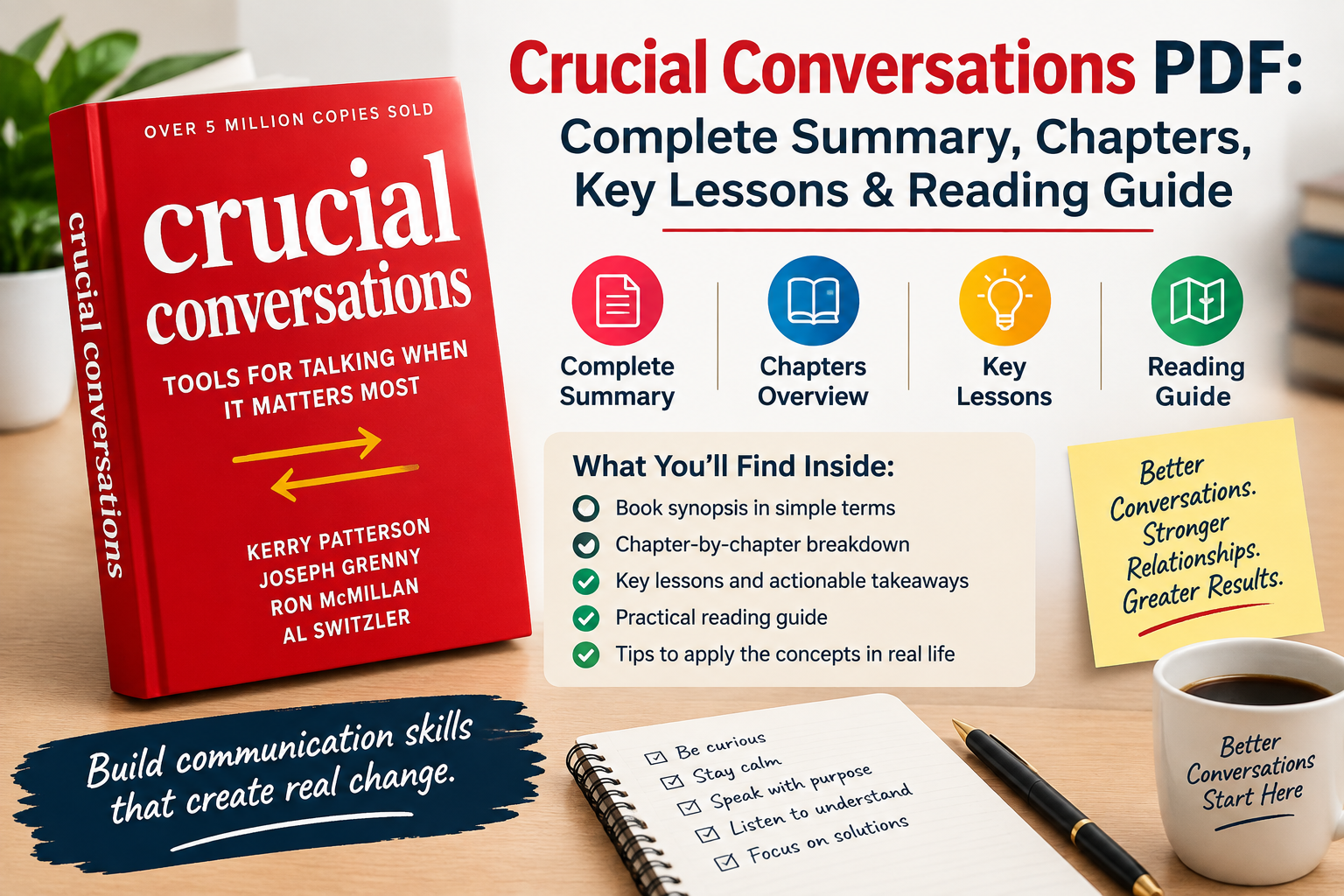
Crucial Conversations PDF: Complete Summary, Chapters, Key Lessons & Reading Guide
If you are searching for the crucial conversations pdf, you are probably looking for more than the name of the book. You may want to understand what the book teaches, find a quick summary, review its chapters, or locate a legitimate way to read the full book.
Crucial Conversations: Tools for Talking When Stakes Are High focuses on conversations where the stakes matter, opinions differ, and emotions can become intense. The book presents practical communication tools designed to help people stay in dialogue instead of reacting through silence, aggression, or avoidance.
This guide explains the main ideas of Crucial Conversations, its major chapters and communication techniques, and what readers should know before looking for a PDF version of the book.
What Are Crucial Conversations About?
Crucial Conversations is a communication and personal-development book associated with Kerry Patterson, Joseph Grenny, Ron McMillan, and Al Switzler. The book addresses situations in which people need to discuss important issues even though emotions are strong and opinions are different.
These situations can happen at work, in relationships, in families, or during important decisions.
The central idea is that difficult conversations do not have to become arguments. Instead, people can learn how to create an environment where everyone can contribute information and work toward a useful outcome.
The official Crucial Learning resources describe the book as a practical guide for conversations involving high stakes, opposing opinions, and strong emotions.
Why Are People Searching for a Crucial Conversations PDF?
The phrase crucial conversations pdf has a strong resource-seeking intent.
Some readers want the complete book in digital form. Others are looking for a PDF summary that explains the important concepts without requiring them to read the entire book first.
There is also a third group of readers who already own or have read the book but want a quick reference for its main techniques.
That makes a useful online guide different from simply uploading a book file. A good resource can explain the book’s concepts, chapter structure, practical methods, and reading options without reproducing copyrighted text.
If you want the official learning materials, Crucial Learning provides reader resources including videos, discussion questions, a communication assessment, and a model designed to reinforce the book’s concepts.
Is There a Free Crucial Conversations PDF?
Readers searching for a free Crucial Conversations PDF should pay attention to the source of the document.
Search results can contain unofficial copies, summaries, scanned books, and user-uploaded documents. Availability of a file online does not automatically mean that the file is authorized for free distribution.
For that reason, readers who want the full book should look for an authorized edition or legitimate digital reading option.
If your goal is simply to understand the ideas in the book, a detailed summary can be a useful alternative. Official Crucial Learning resources also provide free educational materials designed to help readers continue learning after reading the book.
Crucial Conversations Chapter-by-Chapter Summary
One reason the book continues to attract readers is its structured approach to difficult conversations.
The chapters move from recognizing crucial conversations to preparing your mindset, creating safety, managing your own interpretations, communicating clearly, listening to others, and turning dialogue into action.
Chapter 1: What’s a Crucial Conversation?
The book begins by explaining what makes a conversation crucial.
A crucial conversation generally involves three conditions: the stakes are high, opinions differ, and emotions are strong.
These conversations are important because the outcome can affect relationships, decisions, work performance, or personal goals.
The problem is that people often behave poorly at exactly the moment when communication matters most.
Instead of talking openly, someone may become silent, defensive, aggressive, sarcastic, or emotionally reactive.
Recognizing that you are entering a crucial conversation is therefore an important first step.
Chapter 2: Mastering Crucial Conversations
The next step is learning why dialogue matters.
A productive conversation allows people to contribute their information, observations, concerns, and perspectives.
When people feel safe enough to share what they know, the group has more information available for making decisions.
This idea is often described through the concept of a shared pool of meaning.
When important information is withheld, the group has less information to work with. When people can contribute honestly, the conversation has a stronger foundation for reaching a useful conclusion.
Chapter 3: Start With Heart
One of the central ideas in Crucial Conversations is to begin by asking what you genuinely want.
Before entering a difficult conversation, consider what you want for yourself, what you want for the other person, and what you want for the relationship.
This helps prevent a conversation from becoming a competition.
A person may begin a discussion wanting to solve a problem but change their goal once they feel challenged.
They may start trying to win, punish the other person, or simply avoid conflict.
Starting with the heart means returning to the real purpose of the conversation.
Chapter 4: Learn to Look
Difficult conversations can change quickly.
A normal discussion can suddenly become tense because of a comment, disagreement, misunderstanding, or emotional reaction.
The ability to notice these changes is important.
People may move toward silence by withholding information, avoiding questions, or becoming unusually quiet.
Others may move toward aggressive behavior by attacking, controlling, labeling, or trying to dominate the discussion.
Recognizing these signs gives you an opportunity to slow down before the conversation gets worse.
Chapter 5: Make It Safe
Safety is another major concept in the book.
People are more likely to communicate honestly when they believe they can speak without being attacked, humiliated, or unfairly judged.
The book connects safety with two important ideas: mutual purpose and mutual respect.
Mutual purpose means the people involved believe there is a reason to work toward a shared outcome.
Mutual respect means each person recognizes the other as a person whose perspective deserves consideration.
When either of these disappears, dialogue can quickly break down.
Chapter 6: Master My Stories
People do not respond only to what happens. They also respond to the meaning they give to what happens.
This is where the book’s idea of stories becomes important.
Imagine that someone does not respond to your message. You can observe that they did not respond.
But your interpretation might be that they are deliberately ignoring you, that they do not respect you, or that they are angry.
Those interpretations can create emotional reactions before you know what actually happened.
Learning to separate observable facts from personal interpretations can help you respond more thoughtfully.
Chapter 7: STATE My Path
The STATE method provides a framework for communicating when the topic is sensitive.
The acronym is built around five skills:
- Share your facts.
- Tell your story.
- Ask for others’ paths.
- Talk tentatively.
- Encourage testing.
The first step is to begin with facts rather than accusations.
Instead of immediately presenting your interpretation as truth, explain what you actually observed.
Then explain the conclusion or story you formed from those facts.
The other person should also have an opportunity to explain how they see the situation.
The goal is not to force your interpretation onto someone else. It is to create enough safety for both sides to examine the issue.
Chapter 8: Explore Others’ Paths
Good communication requires listening as well as speaking.
Crucial Conversations emphasise the importance of inviting other people to explain their perspective.
One approach is to ask questions that genuinely encourage the other person to talk.
Mirroring can also help. This involves noticing the person’s tone, expression, or behavior and gently reflecting what you observe.
Paraphrasing is another useful technique because it shows that you are trying to understand the person’s meaning rather than preparing your next argument.
The goal is to understand the other person’s path to their conclusion.
Chapter 9: Move to Action
A productive conversation should eventually lead somewhere.
People need to determine what happens next, who is responsible, and how decisions will be made.
The book discusses different approaches to decision-making, including command, consultation, voting, and consensus.
The appropriate method depends on the situation.
Not every decision requires everyone to have equal authority, but unclear expectations can create problems later.
Turning conversation into action helps prevent a discussion from ending with good intentions but no follow-through.
Chapter 10: Putting It All Together
Once the individual techniques are understood, they can be combined into a broader process.
First, recognize that the conversation has become crucial.
Then focus on what you really want.
Watch for signs that safety is disappearing.
Create mutual purpose and mutual respect when necessary.
Manage your own interpretation of events.
Share facts carefully, explain your conclusions, invite the other person’s perspective, and listen.
Finally, agree on what should happen next.
The strength of the method comes from using these skills together rather than treating them as isolated communication tricks.
Chapter 11: Yeah, But
Real conversations rarely follow a perfect script.
People may respond with objections, defensiveness, silence, anger, or confusion.
The book addresses difficult situations through examples and practical responses.
The important lesson is that communication skills have to be adapted to the situation.
If a conversation becomes unsafe, continuing to push the same argument may not solve the problem.
Sometimes the better approach is to step back, restore safety, clarify your purpose, and then return to the issue.
Chapter 12: Change Your Life
The final section focuses on applying the principles beyond a single conversation.
The value of Crucial Conversations is not simply knowing terminology such as dialogue, mutual purpose, or STATE.
The real value comes from practicing these skills when the conversation actually matters.
The techniques can be applied to workplace discussions, family disagreements, relationship problems, feedback, leadership situations, and other high-stakes conversations.
What Are the Main Lessons From Crucial Conversations?
Several themes run throughout the book.
1. Start With What You Really Want
Before trying to convince someone, identify the outcome you actually want.
This can prevent a difficult discussion from turning into a contest.
2. Separate Facts From Stories
A fact is something you can observe.
A story is the explanation you create about what that fact means.
Recognizing the difference can reduce unnecessary assumptions.
3. Make Conversations Safe
People are more likely to contribute honestly when they feel respected and understand the purpose of the conversation.
4. Listen Before Trying to Win
Understanding another person’s perspective does not require agreeing with everything they say.
It means creating space for their information to enter the conversation.
5. Turn Dialogue Into Action
A useful conversation should clarify what happens next.
Without clear decisions and responsibilities, even a productive discussion can fail to create change.
What Is the STATE Method in Crucial Conversations?
The STATE method is one of the most recognizable communication frameworks associated with the book.
It can be summarized as:
S — Share your facts
Start with observable information.
T — Tell your story
Explain the conclusion you have drawn from those facts.
A — Ask for others’ paths
Invite the other person to explain their perspective.
T — Talk tentatively
Avoid presenting your interpretation as unquestionable fact.
E — Encourage testing
Allow the other person to challenge, correct, or add to your interpretation.
This framework is especially useful when the subject is sensitive and the risk of defensiveness is high.
What Does “Make It Safe” Mean?
“Make It Safe” refers to creating conditions where people can continue talking even when they disagree.
Two concepts are particularly important: mutual purpose and mutual respect.
If someone believes you are only trying to win, embarrass them, or force them into an outcome, they may stop participating honestly.
Creating safety does not mean avoiding disagreement.
Instead, it means making disagreement possible without turning the conversation into a personal attack.
How Can Crucial Conversations Help at Work?
Workplaces frequently contain situations that require difficult conversations.
Employees may need to discuss missed deadlines, performance concerns, disagreements, responsibilities, leadership decisions, or team conflicts.
Avoiding these discussions can allow problems to continue.
The communication principles in Crucial Conversations provide a framework for addressing important issues while keeping the conversation focused on information, purpose, respect, and action.
Crucial Learning also presents the framework as relevant to communication, leadership, performance, and organizational relationships.
How Can Crucial Conversations Help in Relationships?
The same communication principles can apply outside professional settings.
Partners, friends, parents, and family members regularly face conversations involving expectations, money, responsibilities, trust, boundaries, and disagreements.
The basic challenge remains similar: people need to communicate important information while emotions are strong.
Starting with a clear purpose, separating facts from assumptions, and listening to another person’s perspective can create a more constructive conversation.
Who Should Read Crucial Conversations?
The book can be relevant to anyone who regularly has difficult or high-stakes conversations.
It may be particularly useful for:
- Managers and team leaders
- Business owners
- Employees
- Couples
- Parents
- Teachers
- Students
- People working in customer-facing roles
- Anyone trying to improve difficult conversations
The official publisher’s resources are also aimed at people who want to continue practicing the skills after reading the book.
Crucial Conversations PDF vs. PDF Summary
A full book and a PDF summary serve different purposes.
A full edition gives you the complete explanations, examples, context, and development of the author’s framework.
A summary is useful when you want to review the central ideas quickly.
If you are studying communication techniques, a summary can help you understand the framework before deciding whether you want to read the complete book.
For readers who already own the book, a summary can also work as a quick-reference guide.
Where Can You Find Official Crucial Conversations Resources?
The official Crucial Learning website provides free reader resources related to Crucial Conversations.
These include videos, discussion questions, a communication assessment, and a model designed to reinforce the book’s concepts.
The official resources are useful for readers who want to move beyond simply finding a crucial conversation pdf and actually practice the communication techniques. Also read this Target Company URL Research: Discover & Verify the Right Company Website.
Frequently Asked Questions
What is the Crucial Conversations PDF?
The phrase “Crucial Conversations PDF” can refer to a digital copy of the book or to a PDF summary of its main ideas. Readers should verify that a full-book copy is legally authorized before downloading or sharing it.
What are Crucial Conversations about?
Crucial Conversations: Tools for Talking When Stakes Are High teaches communication strategies for situations involving high stakes, different opinions, and strong emotions.
What is the STATE method?
STATE stands for Share your facts, Tell your story, Ask for others’ paths, Talk tentatively, and Encourage testing.
What does “Start With Heart” mean?
It means identifying what you genuinely want from the conversation before becoming focused on winning, punishing, or avoiding the issue.
What does “Make It Safe” mean?
It means creating enough mutual purpose and mutual respect for people to continue communicating honestly, even when they disagree.
Is there an official Crucial Conversations resource?
Yes. Crucial Learning provides official reader resources, including videos, discussion questions, assessments, and a model for practicing the book’s concepts.
Final Thoughts on the Crucial Conversations PDF
Searching for a crucial conversation pdf can lead to many different types of results, from full digital documents to summaries and study guides.
The important thing is to understand what you actually need.
If you want to learn the framework quickly, a detailed summary can introduce the major concepts, including Start With Heart, Learn to Look, Make It Safe, Master My Stories, STATE My Path, Explore Others’ Paths, and Move to Action.
If you want the complete book, use an authorized edition or legitimate reading source.
Either way, the central lesson of Crucial Conversations is practical: important conversations become more productive when people can speak honestly, listen carefully, maintain safety and respect, and work toward a clear outcome.