
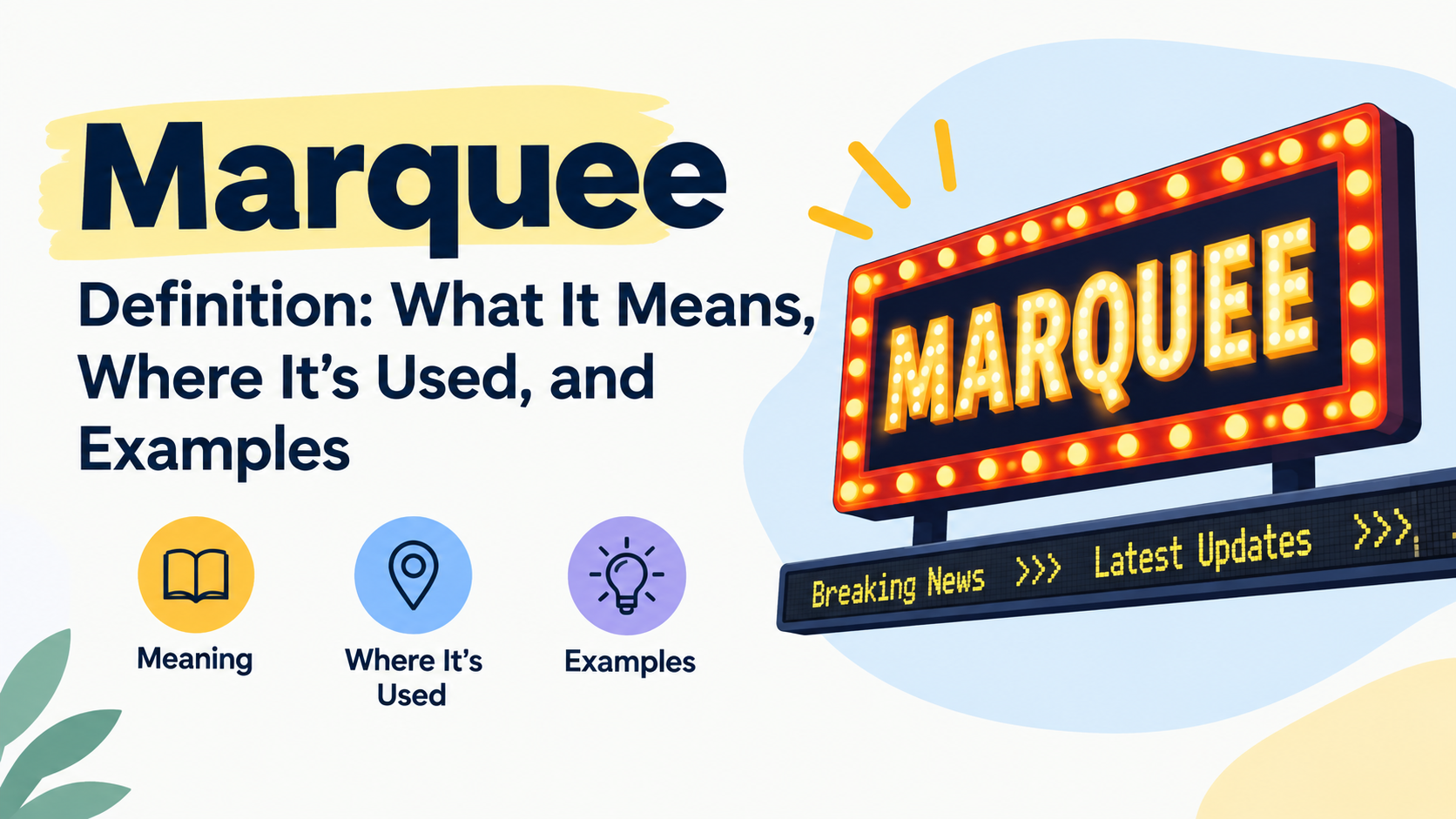
The word marquee can have several meanings depending on where you encounter it. Someone talking about a wedding may use a marquee to describe a large temporary tent. A person discussing a cinema may mean the covered structure or illuminated sign above a theater entrance. In sports, entertainment, or business writing, a “marquee” player, name, or event usually refers to someone or something especially prominent and likely to attract attention.
There is also a completely different technical use of the word. In web development, <marquee> refers to an old HTML element that was used to make text or other content move across a webpage. That element is now deprecated, and modern websites generally use CSS animations instead.
Because the word appears in several contexts, understanding the marquee definition requires looking at how it is being used rather than assuming that it always refers to one particular object.
What Is the Definition of Marquee?
The basic definition of marquee changes slightly between British and American English.
In British English, a marquee commonly means a large tent used for an outdoor event. These structures are often associated with weddings, parties, exhibitions, fairs, and other gatherings where many people need temporary covered space. Cambridge defines it as a large tent used for eating and drinking at events, while Oxford describes it as a large tent used at social events.
In American English, marquee is frequently associated with a roof like structure extending over the entrance of a theater or other public building. Such a structure may carry a sign displaying the name of a movie, play, performers, or another attraction.
The word can also function as an adjective. When something is described as “marquee,” it generally means that it is highly important, famous, prominent, or capable of attracting a large audience. A sports team might sign a marquee player, while an event can be described as a marquee event.
What Does Marquee Mean as a Tent?
One of the most common meanings of marquee is a large temporary tent.
These tents are usually designed for events where people need shelter while remaining in an outdoor setting. A marquee may be used for a wedding reception, garden party, exhibition, festival, celebration, or similar gathering.
Unlike a small camping tent, a traditional event marquee is designed to accommodate groups of people. It can contain tables, chairs, lighting, decorations, food service areas, and other equipment needed for an event.
The exact design can vary. Some marquees have enclosed sides, while others have open or partially open sides. Some are designed for formal events and decorated with flooring, lighting, curtains, and furniture.
This meaning is particularly common in British English. Oxford specifically identifies the large social event tent as a major meaning of the noun, while Cambridge also associates the word with outdoor events involving many people.
Where Are Marquee Tents Used?
Marquee tents can be used in many situations where a temporary covered space is needed.
- Common examples include:
- Wedding receptions
- Garden parties
- Outdoor celebrations
- Corporate events
- Food and drink events
- Exhibitions
- Fairs
- Festivals
- Community gatherings
- Private parties
The main advantage is flexibility. A marquee can create a usable event space without requiring a permanent building.
For example, a wedding may take place in a garden while the reception is held inside a decorated marquee. This allows guests to remain outdoors while still having protection from changing weather conditions.
What Does Marquee Mean at a Theater?
Another important meaning of marquee is connected with theaters and entertainment venues.
In this context, a marquee is a structure that extends over or around the entrance of a theater, cinema, hotel, or similar building. It often includes a sign that identifies the venue or promotes the current attraction.
A theater marquee may display the title of a movie, play, musical, concert, or other performance. Historically, illuminated letters and bulbs made these signs especially noticeable after dark.
Cambridge describes the American meaning as a sign on a roof-like structure extending over a public building entrance. Dictionary.com similarly describes a marquee as a rooflike projection above a theater entrance that can display the name of the featured production and its stars.
This is why phrases such as “under the theater marquee” or “the name appeared on the marquee” are often associated with entertainment venues.
Why Are Theater Marquees Important?
A theater marquee serves both a practical and promotional purpose.
The structure can provide some protection at the entrance, while the sign communicates information to people passing by. A prominent marquee can also become part of a theater’s visual identity.
Before digital displays became widespread, theater marquees were particularly important for advertising films and live performances. Large illuminated lettering could attract attention from people walking or driving nearby.
Today, some theaters still maintain traditional marquee designs, while others use electronic displays or digital signage.
What Does Marquee Mean as an Adjective?
Marquee can also be used as an adjective, particularly in American English.
When something is called a marquee attraction, marquee player, marquee event, or marquee name, the word suggests that it is especially important, famous, successful, or capable of attracting attention.
For example, a sports journalist might describe a championship match as a marquee event because it is one of the most anticipated events on the schedule.
A famous athlete might be called a marquee player because the person’s reputation can attract fans and attention.
Similarly, an actor may be described as a marquee name when their involvement is expected to make a movie or production more attractive to audiences.
Oxford defines the adjective as referring to something that is especially important or popular, particularly in sports. Collins also describes a marquee player or performer as someone likely to attract many people because of their fame and success.
What Is a Marquee Event?
A marquee event is an event considered particularly important, prominent, or highly anticipated.
The expression is often used in sports, entertainment, business, and marketing.
For example, a major championship game could be described as a marquee sporting event. A major film premiere could be called a marquee entertainment event. A large industry conference might also be described this way if it attracts influential speakers and substantial attention.
The word does not simply mean that an event exists. It adds the idea that the event stands out from others.
In everyday language, “marquee” in this context can be understood as something that is designed to draw attention or represents one of the biggest attractions in a particular setting.
What Is a Marquee Player?
A marquee player is a highly prominent or famous athlete whose presence can attract attention, fans, media coverage, or commercial interest.
The phrase is especially common in sports.
For example, a club might describe a newly signed star as a marquee player because the athlete has a strong reputation and is expected to become one of the team’s most recognizable figures.
The term can refer to talent, popularity, reputation, or a combination of these qualities. It does not necessarily mean that the player is the best athlete in the entire sport.
Instead, the emphasis is usually on prominence and audience appeal.
This meaning comes from the broader adjective sense of marquee, where the word describes someone or something that serves as a major attraction.
What Is the Difference Between a Marquee and a Canopy?
Marquee and canopy can sometimes describe structures that provide overhead protection, but they are not always interchangeable.
A canopy is generally a covering or roof like structure that provides shade or protection. It can be attached to a building, supported independently, or used in a variety of settings.
A marquee, when used in the event sense, generally refers to a larger temporary tent intended to accommodate people. When used in the American theater sense, it refers to a projecting structure over an entrance and often the sign associated with it.
Therefore, the meaning depends strongly on context.
A temporary structure covering an entire outdoor reception area may be called a marquee. A smaller fabric covering over a doorway would more naturally be called a canopy or awning.
How Do You Pronounce Marquee?
The pronunciation of marquee is generally close to mar-KEE.
Cambridge gives both British and American pronunciations with the primary stress on the second syllable.
The word is commonly pronounced with two syllables:
marquee = mar-KEE
The plural form is marquees.
Because the spelling can look unfamiliar to English learners, pronunciation is sometimes a source of confusion. The final “ee” sound is pronounced clearly rather than silently.
What Is the Origin of the Word Marquee?
The history of marquee is interesting because the modern English word developed from an earlier French word.
Major dictionaries trace the word to marquise. The English form developed partly through a misunderstanding of the French plural form, which was interpreted as though it were a singular noun. The word dates back to the late seventeenth century.
The word originally had associations with a large tent or canopy and later developed the meanings connected with theater entrances and prominent attractions.
This history helps explain why the modern word can refer both to a physical structure and to something that is considered highly prominent.
Although these meanings may seem unrelated today, they developed from the same linguistic history.
What Does Marquee Mean in HTML?
In technology, marquee has a completely different meaning.
The HTML <marquee> element was used to create a scrolling area for text or other content on a webpage. For example, older websites sometimes displayed headlines or announcements that continuously moved from one side of the screen to another.
The element allowed developers to control aspects of the movement, including direction, behavior, scrolling speed, delay, size, and looping.
However, <marquee> is now deprecated and should not be used for new web projects.
The modern approach is to create scrolling or moving effects with CSS animations and other current web technologies. MDN specifically recommends avoiding the deprecated element and suggests using CSS transforms and animations when an equivalent visual effect is actually necessary.
Why Was the HTML Marquee Element Popular?
The HTML marquee element became popular during the earlier era of the web because it made it relatively simple to create movement without advanced animation techniques.
A website owner could use it to make a line of text travel horizontally or vertically across a page.
News headlines, announcements, promotional messages, and decorative text were common examples.
However, continuously moving text can make information difficult to read. Users cannot always control the speed or direction of the content, and people who need more time to read may find the animation distracting.
Modern accessibility practices therefore favor motion that can be controlled or disabled.
Is the HTML Marquee Element Still Used?
The <marquee> element may still appear on older websites or work in some browser environments, but it is not recommended for new development.
MDN categorizes it as deprecated and strongly discourages its use. The recommended alternative is to create the desired movement with modern CSS animation techniques.
This distinction is important because someone searching for a marquee definition may be asking about the word in a general English context or about the HTML element.
The surrounding words usually make the intended meaning clear.
If someone says, “The wedding was held in a marquee,” they are talking about a tent.
If they say, “The theater marquee displayed the movie title,” they are referring to an entrance structure or sign.
If they say, “The website uses a marquee effect,” they may be referring to moving content.
What Is a Marquee Effect?
A marquee effect is a visual effect in which content moves continuously across a display area.
On modern websites, the effect can be created using CSS animation rather than the obsolete <marquee> element.
A common example is a horizontal row of logos or short pieces of decorative content that move continuously from one side of a screen to another.
However, moving content should be used carefully. If users need to read the information, continuous motion can make the experience less comfortable.
For accessibility, developers should consider giving users control over motion and respecting the preferred-reduced-motion setting. MDN specifically recommends considering reduced motion when implementing animated alternatives to the old marquee element.
Marquee vs. Marquee Effect: Are They the Same?
No.
The traditional noun marquee refers to a physical structure, such as a large event tent or theater entrance sign.
The adjective marquee describes something prominent or highly attractive to an audience.
The HTML term refers to a scrolling or moving visual effect.
These meanings share the same word but belong to different contexts.
Understanding the context is therefore the easiest way to determine which meaning is intended.
How Is Marquee Used in Everyday Sentences?
The word can appear naturally in several types of sentences.
For the tent meaning:
“The wedding reception was held inside a large marquee.”
For the theater meaning:
“The movie title was displayed above the theater entrance on the marquee.”
For the prominent or famous meaning:
“The team signed a marquee player during the summer.”
For the event meaning:
“The championship final is expected to be one of the season’s marquee events.”
For the web development meaning:
“The developer replaced the old marquee effect with a CSS animation.”
These examples demonstrate why the surrounding context matters when interpreting the word.
What Is the Difference Between Marquee and Marquise?
Marquee and marquise look and sound somewhat similar, but they are different words.
Marquee is the word discussed in this article and can refer to a tent, theater structure, prominent attraction, or historical HTML element.
Marquise has separate meanings and can refer to a title or, in other contexts, a particular gemstone shape.
The words have a historical connection in the development of the English word marquee, but they should not be treated as interchangeable in modern English. Dictionary sources trace marquee’s origin to French marquise.
Why Does Context Matter When Understanding Marquee?
Context is especially important with words that have developed several meanings.
If the conversation involves weddings, outdoor parties, or exhibitions, marquee most likely refers to a large temporary tent.
If the subject is movies, theaters, or performances, it may refer to the sign or covered structure above a venue entrance.
If the discussion involves sports, entertainment, or business, it may be an adjective meaning prominent or highly attractive.
If the subject is programming or website design, the reference may be to the old HTML element or a modern scrolling effect.
Looking at the words surrounding the marquee usually makes the intended meaning obvious.
Frequently Asked Questions About Marquee Definition
What is the simplest marquee definition?
Marquee can mean a large temporary tent, a theater entrance sign or structure, or something especially prominent or famous. Its exact meaning depends on context.
What does marquee mean in British English?
In British English, marquee commonly means a large tent used for events such as parties, weddings, and social gatherings.
What does marquee mean in American English?
In American English, marquee commonly refers to the projecting sign or roof like structure above a theater or entertainment venue entrance. It can also be an adjective meaning prominent or highly popular.
What is a marquee player?
A marquee player is a prominent or highly recognized athlete whose reputation and presence can attract substantial attention or audiences.
What does marquee mean in HTML?
In HTML, <marquee> was an element used to create scrolling content. It is deprecated, and modern websites should use CSS animation and other current techniques instead.
How do you pronounce marquee?
Marquee is generally pronounced mar-KEE, with the stress on the second syllable.
What is a marquee event?
A marquee event is a particularly important, prominent, or highly anticipated event that is expected to attract significant attention.
What is a theater marquee?
A theater marquee is the projecting structure and associated sign at a theater or cinema entrance, often used to display the name of a movie, play, or performance.
Final Thoughts
The marquee definition depends on the context in which the word appears. It can describe a large temporary tent used for an event, a theater or cinema entrance structure and sign, or a person, event, or attraction that is especially prominent.
The word also has a technical history in web development. The old HTML <marquee> element created scrolling content, but it has been deprecated and is no longer recommended for modern websites.
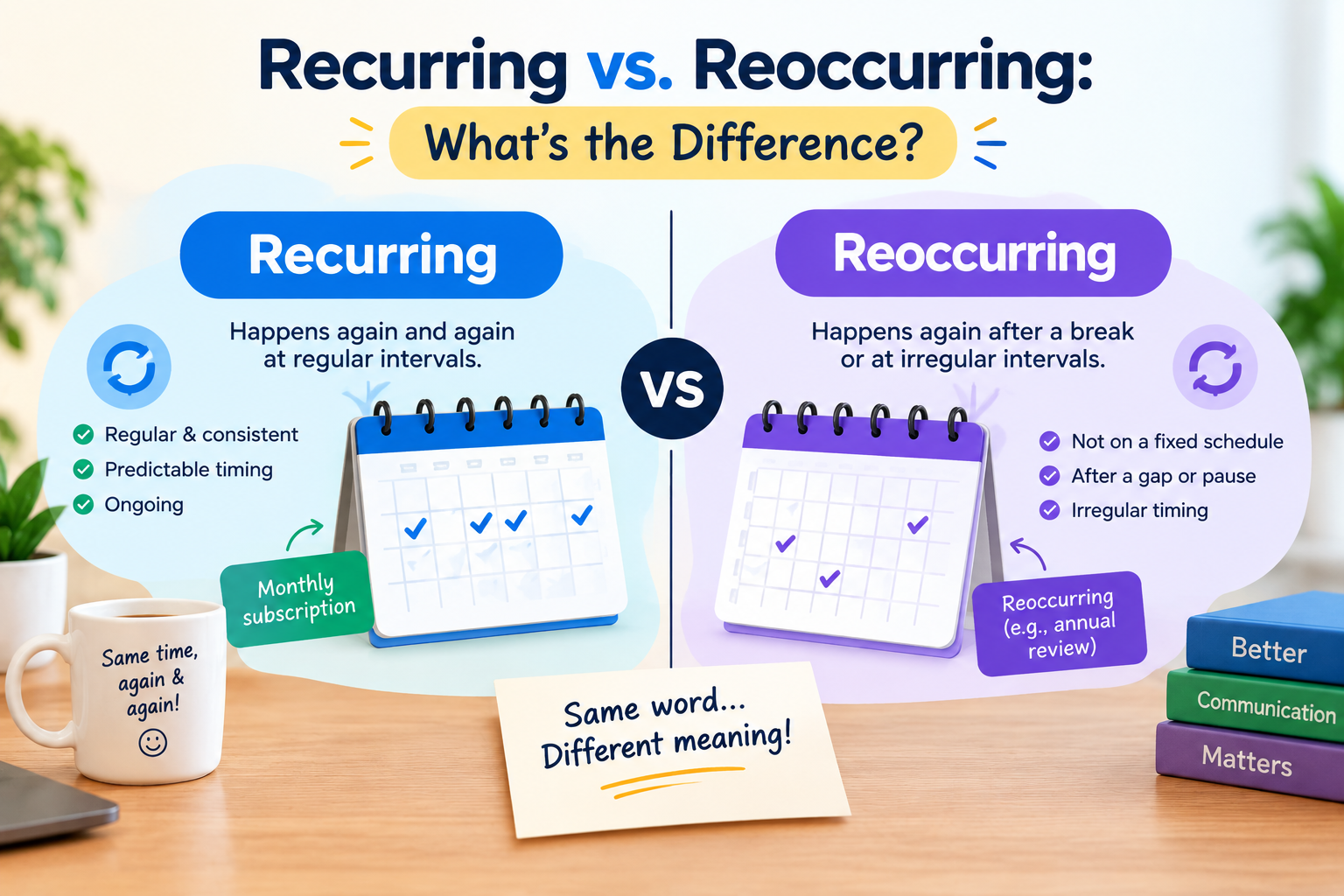
Understanding these different meanings makes the word much easier to recognize in articles, conversations, sports coverage, entertainment news, event planning, and technology discussions.Also read this blog Recurring vs. Reoccurring: What’s the Difference?
Whether you encounter a marquee at a wedding, see one outside a theater, hear about a marquee athlete, or come across the term while reading about HTML, the surrounding context provides the key to understanding exactly what marquee means.