
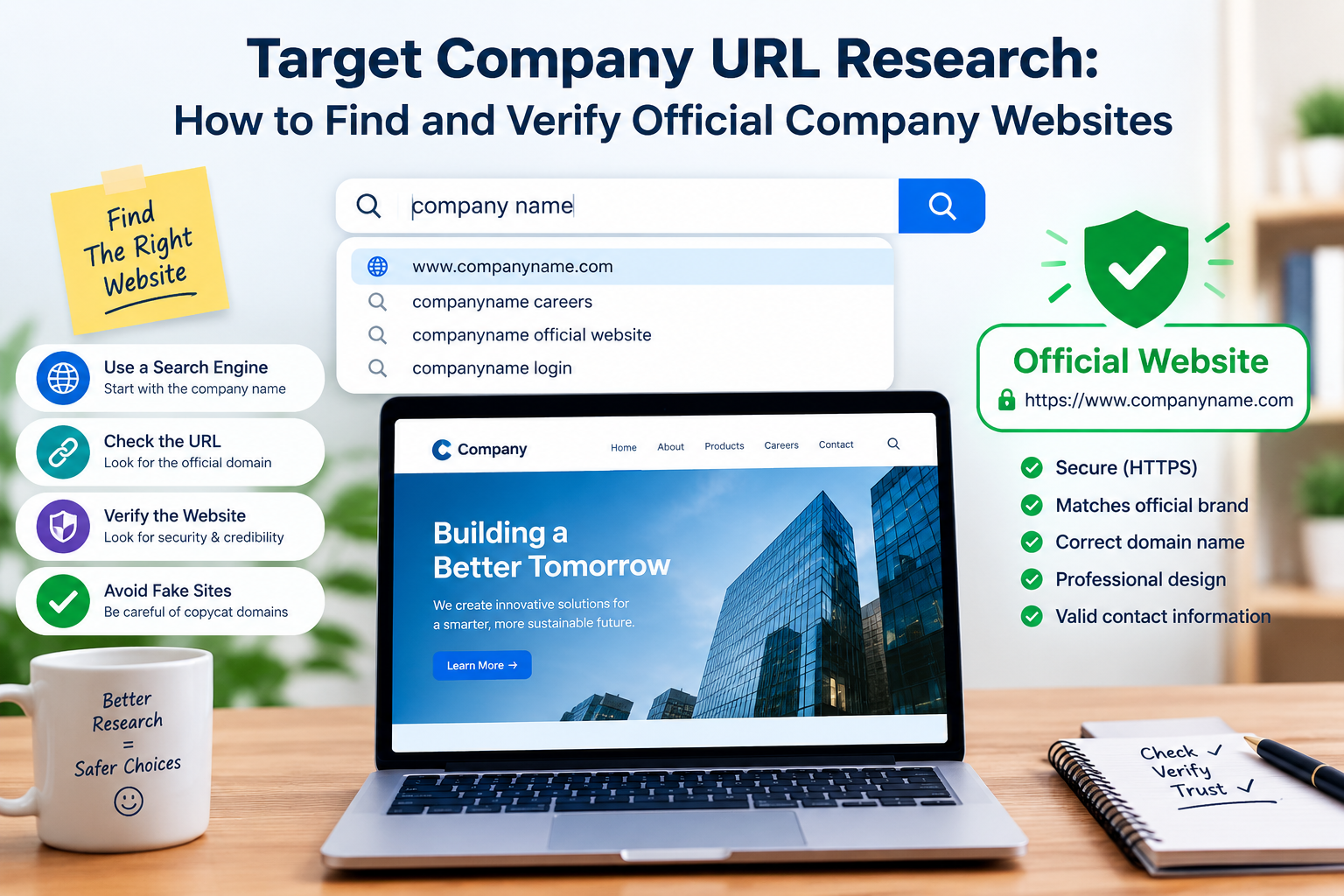
Finding a company website sounds easy when you are dealing with a well-known brand. Type the company name into Google, open the first result, and you are usually done.
The situation changes quickly when you have a spreadsheet containing hundreds of companies.
A company name may be abbreviated, several businesses may use similar names, a brand may operate under a parent company, or the website shown in search results may actually be a directory, social media profile, review page, or an unrelated business. That is where target company URL research becomes important.
Target company URL research is the process of finding the correct official website or primary domain associated with a company and then verifying that the domain actually belongs to the business you intended to research.
This simple step can make a major difference in sales prospecting, recruiting, marketing, competitive research, SEO, database cleanup, and account-based marketing.
What Is Target Company URL Research?
Target company URL research means identifying the official website address of a company you want to research, contact, analyze, or add to a business database.
For example, imagine that your spreadsheet contains these names:
Company Name → Official Domain
Salesforce → salesforce.com
HubSpot → hubspot.com
Notion → notion.com
Figma → figma.com
For famous companies, finding the domain is usually straightforward. But business research rarely consists entirely of famous brands.
You may have a list containing local companies, startups, manufacturers, agencies, software companies, retailers, distributors, or businesses operating in different countries.
In those situations, the company name is only the starting point.
The real objective is:
Company name → Possible website → Verification → Correct domain
That last step is important because the first website appearing in a search result is not automatically the official website.
A search can return LinkedIn pages, business directories, review websites, news articles, marketplaces, social profiles, franchise pages, or another company with almost the same name.
For reliable research, you need to establish which website actually belongs to the target organization.
Why Is Target Company URL Research Important?
A wrong URL may look like a small data-entry mistake, but it can create problems throughout an entire research workflow.
Suppose a sales team has a list of 1,000 target companies. If some company names are matched with the wrong websites, the team may research the wrong products, industries, locations, employees, or business models.
The problem becomes even larger when that information is imported into a CRM.
Once incorrect data enters a database, it can be copied into other systems, sales sequences, reports, spreadsheets, and marketing platforms.
That is why company URL research should not be treated as simply finding a website. It should be treated as a verification step.
Accurate URLs Help Sales Teams
Sales researchers often begin with a list of companies and then need to understand what each organization does.
Once the official website is confirmed, a salesperson can review:
Company products and services
Target industries
Locations
Business model
Pricing information
Customer segments
Careers information
Company announcements
This makes it easier to understand the prospect before starting outreach.
It Helps Recruiters Verify Employers
Recruiters and job researchers may receive company names without website addresses.
Finding the official domain can help them locate the company’s careers section, company information, locations, and other first-party information.
LinkedIn can also be useful for finding a company’s organization page and confirming that the company name and location match the business being researched. LinkedIn’s own documentation explains that company pages can be located by searching the organization name and filtering by factors such as location, industry, and company size.
It Improves Marketing Research
Marketing teams frequently build competitor lists from company names.
Before comparing websites, content, products, or positioning, marketers first need the correct domains.
A wrong domain can make competitor research almost meaningless because the analysis is being performed on the wrong business.
It Matters for SEO Research
SEO professionals regularly work with lists of competing businesses.
Once the correct domains are identified, those websites can be examined for:
Organic content
Keyword opportunities
Website structure
Content gaps
Competitor pages
Backlink opportunities
Search visibility
The domain identification stage should happen before the deeper SEO analysis.
The Biggest Problem: Company Names Are Not Unique
One of the hardest parts of target company URL research is that company names are not reliable identifiers by themselves.
Consider a name such as “Atlas Solutions.”
There could be several unrelated businesses using that name in different cities or countries.
The same problem can happen with names such as:
Mercury
Summit
Pioneer
Bolt
Bluebird
Apex
If you simply select the first search result, you may attach the wrong domain to your database.
This is why company URL research should include additional signals.
Useful verification signals include:
Company name: Does the website clearly identify the expected company?
Location: Does the business operate in the city or country associated with your record?
Industry: Does the website describe the same products or services?
Branding: Does the logo, brand name, and visual identity match?
Contact information: Does the address, phone number, or email domain make sense?
Company description: Does the website describe the organization you intended to find?
Social presence: Do verified company profiles point to the same domain?
A strong match is usually based on several signals rather than a company name alone.
How to Perform Target Company URL Research
A reliable process does not need to be complicated.
The following workflow works particularly well when researching individual companies or cleaning a large spreadsheet.
Step 1: Start With the Exact Company Name
Begin with the company name exactly as it appears in your source.
If you have:
ABC Technologies Inc.
also consider searching:
ABC Technologies
The legal company name and the trading name are not always identical.
A business might legally operate under one name while customers know it by a shorter brand name.
Removing unnecessary legal suffixes can sometimes make a search easier, but do not permanently delete that information from your original dataset.
Keep the original company name available for reference.
Step 2: Search for the Company
Enter the company name into a search engine.
Do not immediately choose the first result.
Instead, examine the results and look for evidence that connects the website to the company you actually want.
Pay particular attention to:
Company descriptions
Locations
Industry information
Contact pages
About pages
Brand name
Products and services
The goal is not simply to find a website that contains the same word.
The goal is to find the website belonging to the correct business.
Step 3: Check the Website Itself
Open the potential website.
Look at the homepage first.
Then check the About, Contact, or Company pages.
If available, compare the information with your original company record.
For example, if your spreadsheet says the company is a software company based in Chicago but the website belongs to a construction company in London, you have an obvious mismatch.
Do not record the URL simply because the company names look similar.
Step 4: Check the Domain Carefully
A company may operate several domains.
For example, it might own:
example.com
example.net
example.co.uk
Or it may have separate domains for different countries.
Some domains may redirect to another website.
The objective is normally to identify the primary domain currently representing the company, rather than recording every URL variation as a separate business.
The domain itself is also an important technical identifier. ICANN’s registration-data lookup can be used to investigate current public registration information for domains, while IANA maintains the authoritative root-zone database for top-level domains.
ICANN Registration Data Lookup
Step 5: Verify With Another Source
When a company name is ambiguous, use another source to confirm the match.
Possible sources include:
LinkedIn
Official business directories
Industry associations
Government business records
Company social profiles
Press releases
Regulatory filings
The purpose is not to collect dozens of sources for every company.
The purpose is to increase confidence when the match is uncertain.
Step 6: Record the Confidence Level
For larger datasets, it is useful to classify URL matches.
A simple system could be:
High Confidence: Company name, industry, location, and website clearly match.
Medium Confidence: Website appears relevant, but one or more details require additional checking.
Low Confidence: The domain is only a possible match and should not yet be treated as verified.
This small step can prevent questionable URLs from silently entering your main database.
Manual Search vs. Automated Company URL Research
If you only need to find five company websites, manual searching is perfectly reasonable.
The problem begins when your list contains hundreds or thousands of companies.
Searching manually means opening a search engine repeatedly, checking results, opening websites, comparing information, and entering the domain into a spreadsheet.
Automation can reduce that repetitive work.
A company URL lookup system can take a company name and return one or more potential domains. Some systems also provide a match or confidence score.
But automation has an important limitation.
A suggested match is not necessarily a verified match.
This distinction matters.
An automated system may be excellent at narrowing down possibilities, but ambiguous company names still require human review.
The strongest workflow is therefore:
Automation for discovery + human verification for uncertain matches
That gives you the speed of automation without blindly trusting every result.
What Is a Company URL Lookup Tool?
A company URL lookup tool is designed to turn company names into likely website domains.
For example, you may provide:
Company: Salesforce
The system may return:
Domain: salesforce.com
For a straightforward company name, this can save time.
For a name with multiple possible matches, however, the tool may return several candidates.
That is where match scoring and manual verification become useful.
One current company URL research tool describes a workflow where users can paste company names in bulk, review matched domains and alternative candidates, and export results to CSV.
The important point is that the tool should be viewed as a research accelerator, not as a replacement for judgment.
How Match Scores Can Help
Some company URL lookup systems assign a score or label to a potential match.
For example:
High: Strong name match
Medium: Partial or less certain match
Low: Significant difference between the supplied name and returned company
This is useful for prioritizing your review.
High-confidence matches can move through the workflow quickly.
Medium-confidence matches deserve a quick manual check.
Low-confidence matches should generally be investigated before being added to an important CRM or research database.
However, a score based on name similarity should never be treated as absolute proof.
A company named “Mercury” could have a high name similarity with several completely different businesses.
That is why context still matters.
Common Mistakes in Target Company URL Research
Mistake 1: Selecting the First Google Result
The first result may be relevant, but ranking position is not proof of company identity.
A directory with strong SEO can outrank a small company’s official website.
Always verify the business behind the domain.
Mistake 2: Using a Directory as the Official Website
Business directories are useful research sources.
However, a directory listing and the company’s own domain are not the same thing.
If your database needs the official company website, record the company’s domain separately from third-party profiles.
Mistake 3: Confusing Similar Businesses
This is probably the most dangerous mistake.
Two companies can share almost identical names while operating in completely different industries.
Always check at least one additional identifying factor.
Mistake 4: Ignoring Country or Location
Location can be extremely useful when researching generic company names.
For example:
ABC Consulting New York
may produce a completely different result from:
ABC Consulting Toronto
Adding a country, city, or industry to your research query can dramatically reduce ambiguity.
Mistake 5: Treating Every Domain as a Separate Company
A business can have multiple domains.
Some may redirect to the main website.
Others may be country-specific.
Do not automatically create multiple company records simply because several URLs exist.
Mistake 6: Never Updating Old URLs
Websites change.
Companies rebrand.
Businesses merge.
Domains are changed.
A URL that was correct three years ago may no longer represent the company’s primary online presence today.
For important datasets, URL verification should therefore be repeated periodically.
Target Company URL Research for Sales Prospecting
Sales teams can use verified company domains as the foundation for account research.
Once a prospect’s website has been confirmed, a researcher can review its:
Products
Services
Industries
Locations
Customer types
Leadership information
Careers
Recent announcements
This makes prospect research more relevant.
Instead of approaching a company with a generic message, the salesperson can understand what the organization actually does before starting the conversation.
For large prospect lists, the process can also be divided into stages:
Stage 1: Collect company names
Stage 2: Clean company names
Stage 3: Find candidate domains
Stage 4: Verify uncertain matches
Stage 5: Import approved domains into the CRM
Stage 6: Recheck important records periodically
That creates a much cleaner workflow than searching for a website only when someone needs it.
Target Company URL Research for Recruiting
Recruiters can also benefit from accurate company domains.
Once the official website has been identified, look for pages such as:
Careers
Jobs
Join Us
Work With Us
Opportunities
About
A company’s official website may also link to an external applicant-tracking system.
That does not automatically mean the external domain is wrong.
The important distinction is whether the job link was reached through the company’s verified website.
LinkedIn can provide another verification layer when the company has an organization page. LinkedIn recommends searching the company name and using filters such as location, industry, or company size when identifying the correct organization page.
Target Company URL Research for SEO
SEO teams can use company URL research before beginning competitor analysis.
Suppose you have a list of 50 competitors but only 35 website URLs.
Before performing keyword or backlink research, identify the missing domains.
After the URLs are verified, you can analyze:
Competitor content
Keyword coverage
Website architecture
Product pages
Resource sections
Content gaps
Internal linking
Backlink opportunities
This is especially useful when several brands belong to the same parent organization.
A competitor list based only on company names can easily contain duplicates or incorrect businesses.
Verified domains provide a much cleaner starting point.
How to Build a Clean Company URL Database
If you regularly perform target company URL research, do not keep the information in a single “Company” and “Website” column.
A more useful structure could include:
| Field | Purpose |
| Company Name | Original company name |
| Standardized Name | Cleaned business name |
| Official Domain | Verified primary website |
| Country | Geographic identifier |
| City | Location verification |
| Industry | Business category |
| Source | Where the company was identified |
| Verification Date | When the URL was checked |
| Confidence | High, Medium, or Low |
| Notes | Additional verification details |
You do not need every field for every project.
The important idea is to preserve enough information that someone else can understand why a particular domain was considered the correct match.
Keep Original Data Separate
Never overwrite the original company name simply because you want to standardize it.
Keep the original value and create a separate standardized field.
This makes auditing much easier.
Record the Verification Date
A verification date is particularly useful for large databases.
For example:
Verified: September 2026
Later, you can prioritize older records for another review.
Separate Verified and Unverified URLs
Do not mix uncertain matches with confirmed domains.
A simple field such as:
Verified: Yes / No / Needs Review
can prevent a lot of confusion.
How to Verify a Difficult Company Name
Some company names need more investigation than others.
If the first search produces several possible businesses, use a layered approach.
First, add the country.
If that does not solve the problem, add the city.
Then add the industry.
For example:
Summit Solutions
can become:
Summit Solutions software company New York
or:
Summit Solutions manufacturing Canada
The additional context can help separate businesses that otherwise appear identical.
You can also compare:
Company address
Phone number
Products
Leadership names
LinkedIn organization
Industry classification
Official social accounts
The more important the company, the more verification you should perform.
When Should You Use Automation?
Automation makes the most sense when the volume is high.
For example:
1–10 companies: Manual search may be fastest.
10–100 companies: A lookup tool can save considerable time.
100–1,000+ companies: A structured bulk workflow becomes much more valuable.
At higher volumes, consistency becomes just as important as speed.
A researcher should ideally use the same matching rules for every company rather than making a different judgment on every row.
A Simple Target Company URL Research Workflow
If you want a repeatable process, use this checklist:
- Collect the company name.
- Preserve the original spelling.
- Remove obvious duplicate records.
- Standardize unnecessary legal suffixes for searching.
- Search for the company.
- Identify potential official domains.
- Compare company name and branding.
- Check location and industry.
- Open the website and verify first-party information.
- Check another trusted source when the match is unclear.
- Record the primary domain.
- Add a verification date and confidence level.
- Keep uncertain matches separate.
- Recheck important records over time.
This approach is simple enough for a small spreadsheet but can also become part of a larger data-enrichment workflow.
Is Target Company URL Research the Same as Finding a Company on Google?
Not exactly.
A normal Google search answers:
“What websites are related to this company name?”
Target company URL research asks:
“Which website actually belongs to the specific company I am trying to identify?”
That distinction is what makes verification important.
Search engines are excellent discovery tools, but the final decision should be based on evidence connecting the domain to the intended business.
Google’s own guidance emphasizes creating useful, original and people-first content rather than producing pages primarily to manipulate rankings. It also recommends descriptive titles and clear organization so users and search engines can understand the page.
Frequently Asked Questions About Target Company URL Research
What is the target company URL research?
Target company URL research is the process of finding and verifying the official website or primary domain associated with a specific company.
It is commonly used for sales prospecting, recruiting, marketing, SEO, competitive research, and business database management.
Why can’t I simply use the first search result?
Because search results can include unrelated companies, directories, social profiles, news websites, review platforms, and businesses with similar names.
The first result is a possible lead, not automatic proof of identity.
What information helps verify a company website?
Company name, location, industry, products, branding, contact information, company descriptions, and trusted business profiles can all help establish whether a domain belongs to the intended company.
Can a company have more than one domain?
Yes.
A business may operate country-specific domains, legacy domains, campaign domains, or multiple domains that redirect to its main website.
The goal is usually to identify the primary domain currently representing the company.
Are company URL lookup tools always accurate?
No automated lookup system should be treated as perfect.
They are useful for discovering likely domains and reducing repetitive manual work, but ambiguous or high-value matches should still be verified manually.
What should I do if I cannot find a company’s website?
Try the company’s trading name rather than only its full legal name.
You can also add its country, city, industry, parent company, or other identifying information.
If the business has very little online presence, manual research may still be necessary.
Can target company URL research help SEO?
Yes.
Verified domains provide a cleaner starting point for competitor analysis, content research, keyword research, backlink analysis, and identifying potential content opportunities.
How often should company URLs be verified?
There is no universal schedule.
High-value or frequently used databases should be reviewed more regularly, while less important datasets may only need periodic checks.
A verification date makes it easier to decide which records need another review.
Final Thoughts
Target company URL research is more than simply finding a website from a company name.
The real goal is to connect the right company with the right domain.
That distinction becomes increasingly important as your research list grows.
For a handful of companies, manual searching may be enough. For hundreds or thousands of records, a structured URL research process can save substantial time and improve the quality of your business data.
The most reliable approach combines both speed and judgment:
Find the domain → Check the company → Verify the match → Record the result → Review uncertain URLs
That process can support cleaner CRM data, better sales prospecting, more accurate recruiting research, stronger competitor analysis, and more reliable SEO research. Also read Condoleezza Rice: Who Is She and Why Is She Trending?
And most importantly, it prevents one of the easiest mistakes in business research: starting with the wrong company website.