


TikTok has become more than a short-video platform. For creators, it can be a way to build an audience, attract brands, promote products, and explore different sources of online income. But one question comes up again and again: how much money can a TikTok account actually make?
A TikTok Money Calculator can help answer that question with an estimated earning range. Instead of looking only at follower count, a useful calculator can consider factors such as audience size, likes, views, engagement, location, and potential monetization opportunities. The result is an estimate rather than a guaranteed TikTok payment.
What Is a TikTok Money Calculator?
A TikTok Money Calculator is an online tool designed to estimate the potential earning value of a TikTok account.
It can help creators understand how different account metrics may relate to potential income. These metrics can include TikTok followers, total likes, audience location, estimated views, engagement, and other factors that may influence creator earnings.
The [TikTok Money Calculator] can make this process easier by turning basic account information into an estimated monthly and yearly earning range.
The main purpose is not to predict an exact paycheck.
Instead, it provides a useful starting point for creators who want to understand their potential TikTok income.
How to Use TikTok Money Calculator in 2026
Using a TikTok earnings calculator is generally simple. You do not need advanced financial knowledge or complicated formulas.
Step 1: Enter Your Follower Count
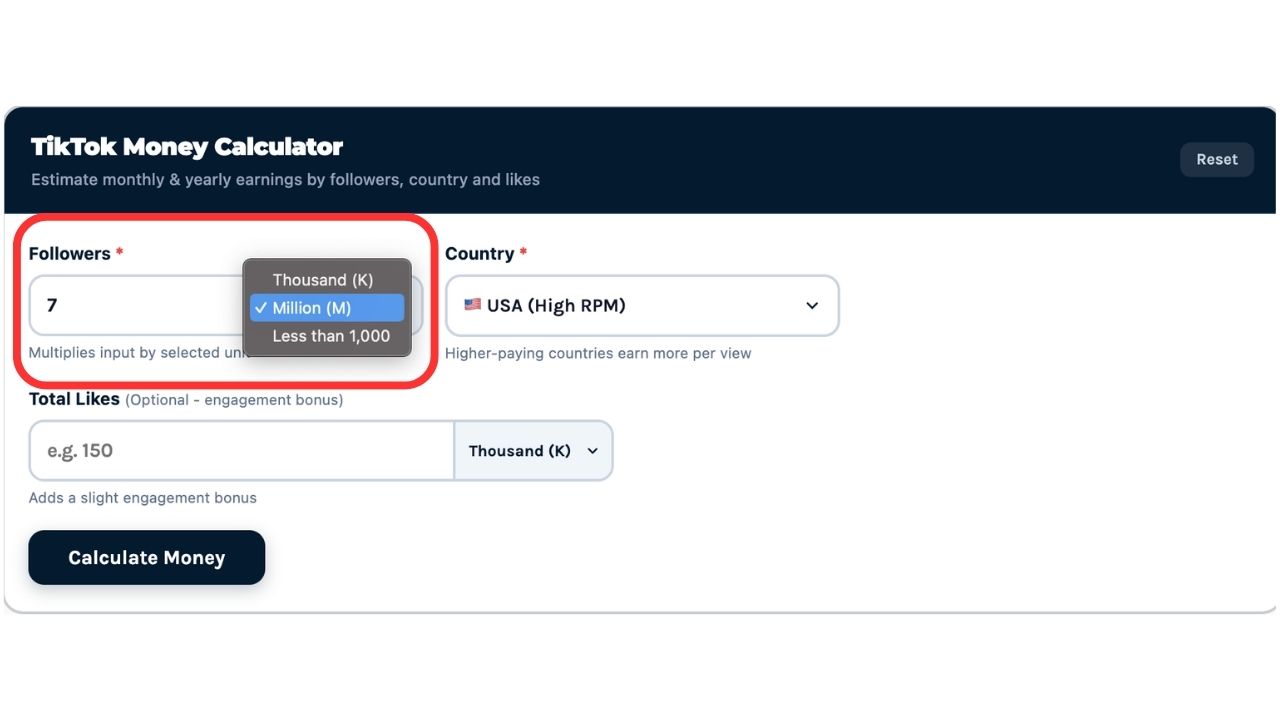
Start by entering the number of followers associated with the TikTok account you want to evaluate.
The calculator uses follower count as one of the indicators of audience size.
However, followers are only one part of the calculation.
Having more followers does not automatically mean earning more money. An account with a smaller but highly engaged audience can sometimes have stronger commercial value than a much larger account with weak engagement.
Step 2: Select Your Country
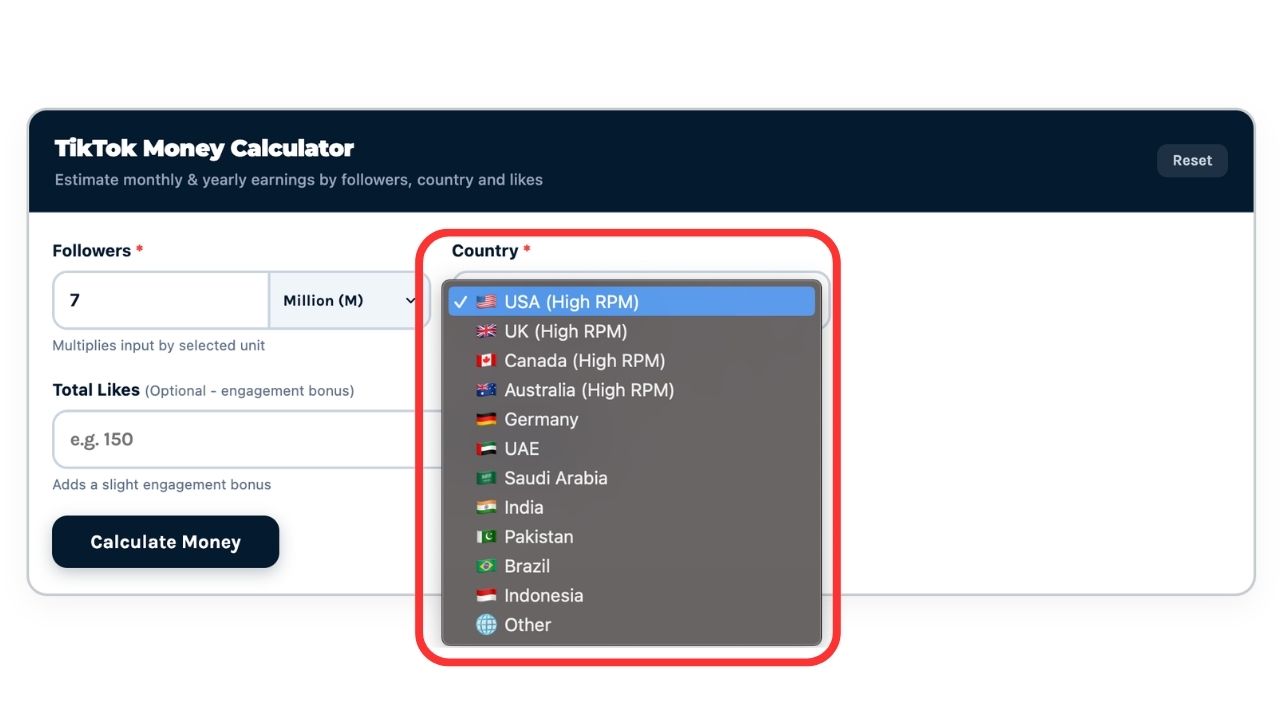
The next important factor is audience or account location.
TikTok monetization and advertising value can vary between markets. Audience location can influence the commercial value of an account because advertisers in different countries may have different budgets and target different audiences.
This is why two TikTok accounts with similar follower counts can potentially have very different earning estimates.
Select the most relevant country available in the calculator to make your estimate more useful.
Step 3: Add Total Likes
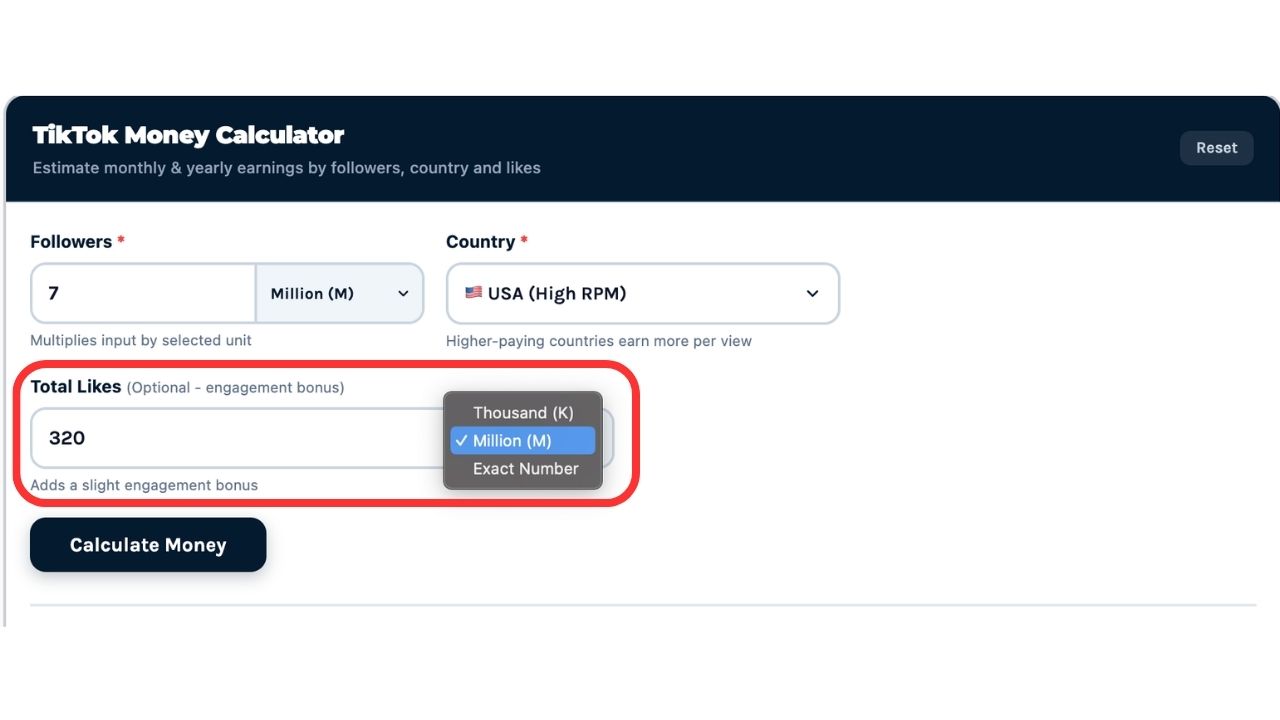
The calculator can also use total likes as an optional engagement signal.
Likes provide some indication of how audiences interact with content.
They should not be treated as a complete measurement of engagement, though.
Comments, shares, views, watch time, audience quality, and other performance signals can also matter when evaluating a creator’s commercial potential.
Step 4: Click Calculate Money
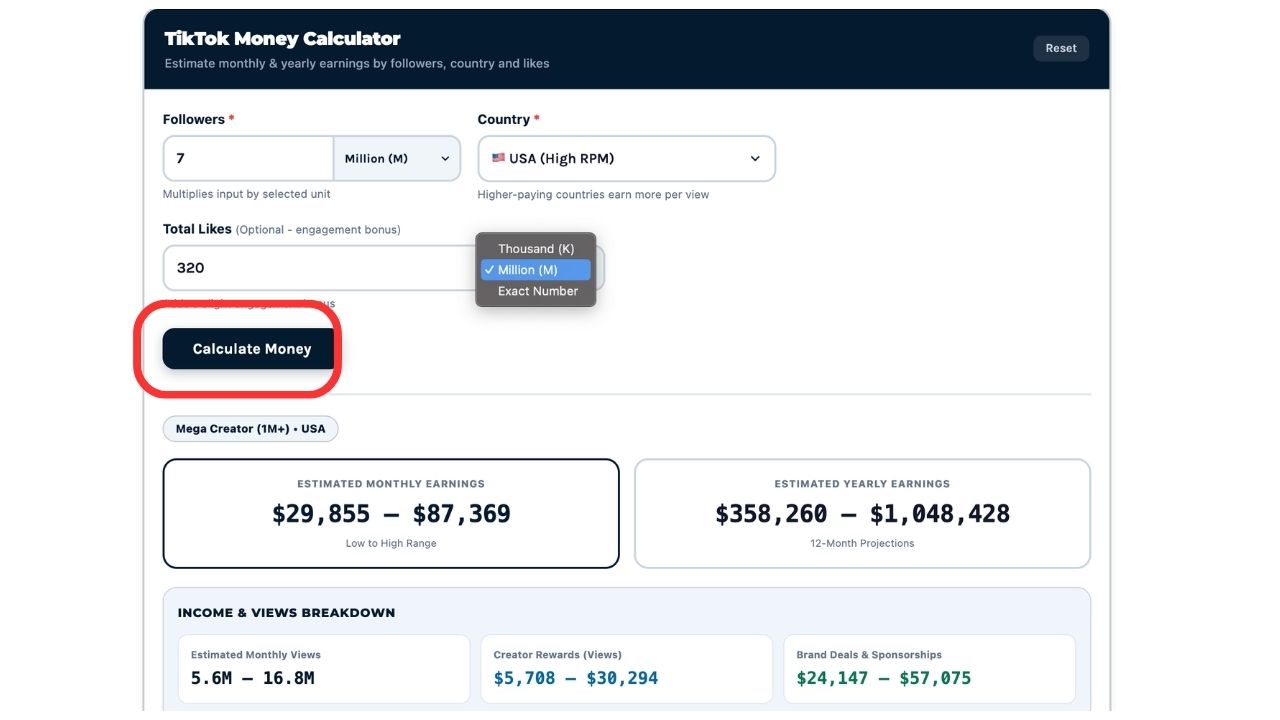
After entering the available information, use the calculator’s calculation option to generate the estimate.
The tool can then provide an estimated monthly earning range and a projected yearly amount.
This makes it easier to understand the potential value of the account without manually working through different calculations.
Step 5: Review the Earnings Estimate
The result should be treated as an estimated range rather than a guaranteed income figure.
Your actual earnings can be higher or lower depending on factors that are difficult to measure from public account information.
These can include content performance, niche, audience quality, sponsorship rates, monetization eligibility, brand demand, and the specific income sources available to the creator.
How Does the TikTok Money Calculator Work?
A TikTok Money Calculator does not rely on one universal TikTok pay rate.
Instead, an earnings estimate can consider multiple signals.
The most important factors include:
Followers: Shows the approximate size of the creator’s audience.
Likes: Provides an additional engagement signal.
Views: Indicates how much attention the creator’s content receives.
Audience location: Different markets can have different advertising and monetization values.
Content niche: Finance, technology, beauty, fitness, gaming, education, fashion, and other niches can attract different commercial opportunities.
Engagement: Active audiences can be more valuable to brands than large audiences with limited interaction.
This combination provides a more realistic picture than simply multiplying followers by a fixed dollar amount.
Does TikTok Pay Based on Followers?
Not directly.
A large follower count can help a creator attract attention from brands and build a larger audience, but followers alone do not determine income.
For example, a creator with 50,000 highly engaged followers may have valuable sponsorship opportunities, while an account with 200,000 followers may have weaker commercial performance if its audience rarely interacts with the content.
This is why creators should think about audience quality and engagement rate, not just follower numbers.
Does TikTok Pay for Views?
Views can contribute to creator earnings, but there is no single universal amount that TikTok pays for every view.
The actual amount can depend on the monetization program, eligibility, location, content, qualified views, and other conditions.
TikTok’s current Creator Rewards Program is based on eligible original content and qualified performance factors. TikTok explains that its rewards system considers areas such as originality, play duration, search value, and audience engagement.
That is why a simple “X dollars per 1,000 views” formula can be misleading.
What Factors Affect TikTok Earnings?
There are several factors that can change how much a creator can potentially earn.
Average Video Views
Views show how much exposure content is receiving.
A creator with consistent high-performing videos may have greater monetization potential than an account with a similar follower count but very low views.
Engagement Rate
Engagement can include likes, comments, shares, and other interactions.
Brands often care about whether an audience actually responds to a creator’s content.
A high follower count with little interaction may not be as commercially valuable as a smaller audience that actively watches, comments, shares, and purchases.
Audience Location
The location of your audience can affect commercial opportunities.
Advertiser demand and purchasing power can vary between countries and regions.
This is one reason a TikTok income estimate should consider location rather than relying on followers alone.
Content Niche
The niche of an account can influence earning potential.
A creator in technology, finance, beauty, fitness, gaming, education, fashion, or another specialized category may attract different advertisers.
The value of an audience depends partly on how relevant that audience is to potential brands.
How Much Money Can You Make on TikTok in 2026?
There is no single answer.
A creator’s total TikTok income can come from several different sources.
Some creators earn through platform monetization.
Others make money through sponsorships, affiliate marketing, LIVE features, gifts, product sales, services, or brand partnerships.
This means two creators with similar follower counts can have completely different monthly incomes.
A TikTok Money Calculator is therefore better used as a planning tool than as a paycheck calculator.
How Do TikTokers Make Money?
TikTok creators can potentially use multiple monetization methods.
Brand Sponsorships
Brands may pay creators to feature products or services in sponsored content.
The price of a sponsored post can depend on followers, views, engagement, niche, audience location, content requirements, and usage rights.
Affiliate Marketing
Creators can recommend products and receive commissions from qualifying purchases.
This can be particularly useful for creators working in product-focused niches.
Creator Rewards
Eligible creators may earn through TikTok’s Creator Rewards Program when their content and views meet the program’s requirements.
TikTok’s previous Creator Fund has been replaced by the Creator Rewards Program, so older articles based entirely on Creator Fund calculations may not accurately represent the current system.
TikTok LIVE and Gifts
LIVE content provides another potential monetization opportunity.
Eligible creators can interact with viewers in real time, while viewers may use TikTok’s available gifting features during eligible LIVE experiences.
The availability and rules for these features can depend on region and account eligibility.
Selling Products or Services
TikTok can also work as a traffic source for a creator’s own business.
Creators may promote physical products, digital products, courses, memberships, services, or other offers.
In this situation, TikTok may help generate customers even when the platform itself is not directly paying the creator for every view.
Why Is Engagement Important for TikTok Money?
Engagement is important because it shows how actively an audience responds to content.
A simple engagement calculation can be expressed as:
Engagement Rate = Engagements ÷ Followers × 100
Different analytics platforms may use different formulas.
Still, the basic idea remains useful.
If people regularly like, comment, share, watch, and interact with your content, your audience may have stronger commercial value than a much larger audience that rarely responds.
Can a Small TikTok Account Make Money?
Yes.
You do not necessarily need millions of followers to explore monetization.
A smaller creator can potentially earn through affiliate marketing, niche sponsorships, product sales, services, or other opportunities.
In some cases, a highly focused audience can be more attractive to a brand than a huge but general audience.
For example, a creator with a smaller audience focused entirely on fitness products may be highly relevant to a fitness brand.
This is another reason follower count should not be used as the only measure of TikTok earning potential.
TikTok Money Calculator vs TikTok Earnings Calculator
The terms TikTok Money Calculator and TikTok Earnings Calculator are often used interchangeably.
Both generally refer to tools designed to estimate potential creator income.
A money calculator may provide a broader estimate covering different potential revenue sources.
An earnings calculator may focus more specifically on estimated income from views, engagement, or account metrics.
Neither should be considered an official TikTok payment statement.
The actual amount a creator receives depends on real monetization activity and applicable TikTok programs.
Is a TikTok Money Calculator Accurate?
It can be useful, but it cannot be perfectly accurate.
A calculator can estimate earning potential using available information.
It cannot know every private factor affecting a creator’s income.
For example, public data usually cannot reveal:
Private sponsorship contracts
Affiliate commissions
Taxes
Private business revenue
Brand negotiation rates
Creator expenses
Exact qualified views
Private monetization arrangements
Therefore, calculator results should be viewed as estimates.
The more complete and accurate the input data is, the more useful the estimate can become.
How Can You Increase Your TikTok Earnings?
If your goal is to increase your potential TikTok income, focus on improving the quality and commercial value of your audience.
Create Better Content
Strong hooks, clear audio, good visuals, useful information, and entertaining ideas can improve the overall quality of your videos.
Improve Engagement
Encourage genuine interaction.
Reply to comments, study what your audience enjoys, and create content that gives viewers a reason to watch and respond.
Build a Clear Niche
A clear niche can make your account easier for audiences and potential advertisers to understand.
Instead of trying to appeal to everyone, develop a recognizable content direction.
Track Your Performance
Monitor views, engagement, follower growth, and the types of videos that perform best.
Your analytics can reveal which topics and formats are creating the strongest results.
Diversify Your Income
Do not depend on only one source of TikTok money.
Depending on eligibility, creators can explore sponsorships, affiliate marketing, platform monetization, LIVE opportunities, products, services, and other legitimate revenue channels.
Why You Should Not Treat Calculator Results as Guaranteed Income
A calculator can estimate potential earnings, but it cannot guarantee that you will actually receive the displayed amount.
TikTok monetization rules can change.
Eligibility can vary by country.
Brand rates can change.
Audience behavior can change.
Views can rise or fall.
Even a creator with strong performance may have different income from month to month.
For that reason, use your result as a benchmark for planning rather than a promise of future income.
What Is the Best Way to Use a TikTok Money Calculator?
The best approach is to use the calculator regularly instead of checking it only once.
For example, you could record your estimated earning potential at different stages of account growth.
Compare your results after gaining more followers.
Then compare them again after improving engagement or average views.
This can help you understand whether your account’s commercial potential is moving in the right direction.
The calculator becomes more useful when it is treated as an analytical tool rather than a simple curiosity.
Final Thoughts
A TikTok Money Calculator can give creators a simple way to estimate their potential TikTok earnings using important account and audience signals.
Followers, likes, views, engagement, location, niche, and monetization opportunities can all influence the value of a TikTok account.
The most important point is that there is no universal TikTok income formula.
Creator earnings can come from multiple sources, and platform rules and eligibility requirements can change over time.
Use the calculator to understand potential income, compare account growth, and plan your monetization strategy.
For official information about current TikTok monetization programs, eligibility, and rewards, always check TikTok’s latest creator resources rather than relying only on third-party estimates.