

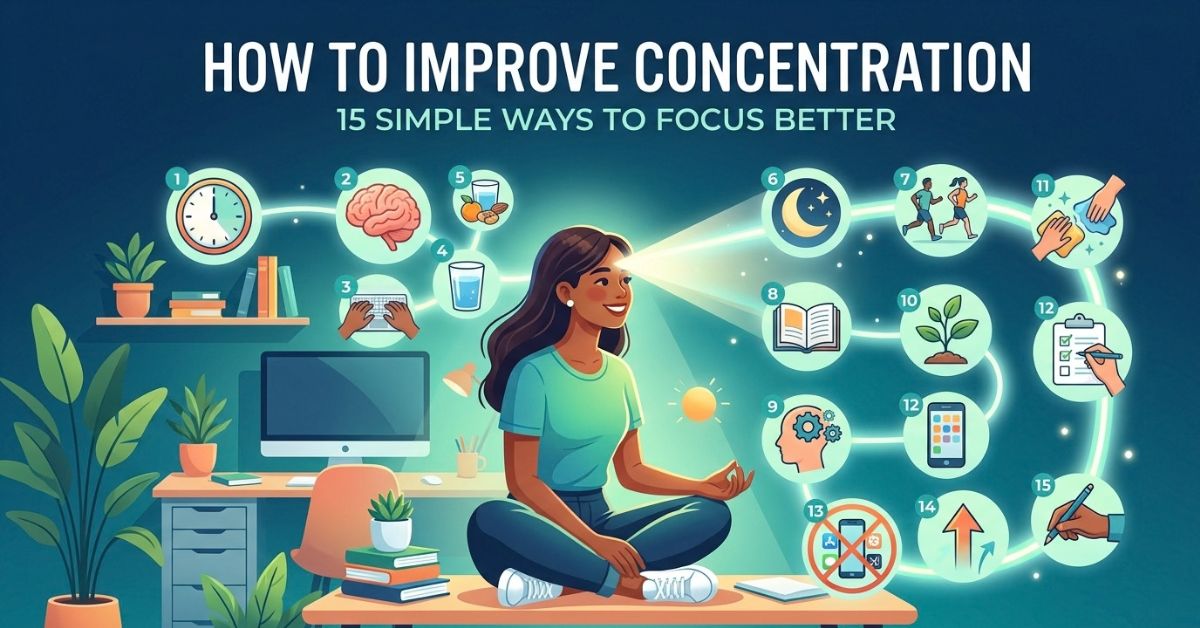
Knowing how to improve concentration can make everyday work, studying, reading and other tasks much easier. When your mind keeps moving from one thought to another, even a simple task can take much longer.
Poor concentration can happen for many reasons. Lack of sleep, stress, distractions, information overload, certain health conditions and some medicines can affect your ability to focus.
The good news is that small daily changes can support better concentration. You do not need to change everything at once.
What Is Concentration?
Concentration is the mental effort you use to keep your attention on a particular task.
It is closely related to attention, but the two terms are not exactly the same. Concentration involves staying engaged with something instead of repeatedly moving your attention to other things.
For example, reading a book for 30 minutes without checking your phone requires concentration.
How to Improve Concentration Naturally
There is no single method that works for everyone. A combination of healthy habits and practical focus strategies can be more useful. Harvard Health recommends approaches such as regular exercise, enough sleep, mindfulness, healthier eating and reducing distractions.
Here are practical ways to improve your concentration.
1. Get Enough Sleep
Sleep is one of the most important parts of good mental performance.
When you do not sleep well, it can become harder to stay alert and complete tasks that require attention.
Harvard Health recommends around seven to nine hours of sleep each night for adults. A consistent sleep and wake schedule may also help.
Try going to bed and waking up at similar times each day.
2. Exercise Regularly
Regular physical activity can support concentration and overall brain health.
Harvard Health recommends aiming for about 150 minutes of moderate aerobic exercise each week, such as brisk walking, running or swimming.
You do not have to start with long workouts.
A daily walk can be a simple way to add more movement to your routine.
3. Practice Mindfulness
Mindfulness means bringing your attention back to the present moment.
A simple exercise is to sit quietly and focus on your breathing. When your thoughts move somewhere else, gently bring your attention back to your breath.
Harvard Health notes that regular mindfulness practice may help attention and reduce the impact of stress on focus.
Even a few minutes can be a useful starting point.
4. Stop Multitasking
Multitasking may feel productive, but constantly switching between tasks can make it harder to give full attention to any one activity.
Instead, choose one important task and work on it until you reach a natural stopping point.
This simple change can make your work session more organized and focused.
5. Put Your Phone Away
Your phone can become one of the biggest sources of distraction.
Messages, social media alerts and other notifications can pull your attention away from work or study.
Put your phone in another room when possible. You can also use Do Not Disturb or silence unnecessary notifications.
Reducing digital distractions is a commonly recommended concentration strategy.
6. Use the Pomodoro Technique
The Pomodoro Technique divides work into short periods of focused work followed by short breaks.
A common version is:
- 25 minutes of focused work
- 5 minutes of rest
- Repeat the cycle
- After several cycles, take a longer break.
You can also change the work period based on your own attention span. The goal is to create a clear period when you focus only on one task.
7. Try Time Blocking
Time blocking means giving a specific period of your day to a specific task.
For example, you could reserve 9:00 to 9:30 for reading and 10:00 to 11:00 for important work.
During that time, avoid unrelated tasks.
This approach can make it easier to protect your attention from unnecessary interruptions.
8. Keep Your Workspace Clean
Your environment can affect how easily you concentrate.
A desk covered with unnecessary items can create visual distractions.
Before starting an important task, remove things you do not need.
Keep only the items required for your current activity.
A quiet room can also help if background noise regularly breaks your concentration.
9. Take Short Breaks
Working continuously for a long time is not always the best way to maintain attention.
When you notice that your mind is wandering, take a short break.
Stand up, drink some water, walk for a few minutes or step outside.
Short breaks can help you return to your task with a fresher mind.
10. Eat a Balanced Diet
Your eating habits can also support overall brain health.
Harvard Health highlights healthier eating patterns, including a Mediterranean style diet with fruits, vegetables and high fiber foods, as part of a healthy approach to supporting brain function.
Try to build regular meals around nutritious foods instead of relying heavily on highly processed foods.
Staying hydrated is also a useful daily habit.
11. Try Simple Brain Training
Activities that require attention can give your brain a chance to practice concentration.
You can try:
- Sudoku
- Crossword puzzles
- Chess
- Jigsaw puzzles
- Memory games
- Learning a new skill
Healthline reports that some research has found benefits from brain training activities, although the evidence is not the same for every type of training.
The goal should be regular mental engagement rather than spending hours on a single game.
12. Use Background Sound Carefully
Some people concentrate better with a quiet background sound.
White noise, nature sounds or instrumental music may help mask sudden sounds and make the environment more comfortable.
However, music does not work equally well for everyone.
If lyrics distract you, try instrumental music or simple background sounds instead.
13. Spend Time in Nature
A change of environment can sometimes help when your mind feels tired.
Take a short walk outside or spend some quiet time in a natural setting.
Healthline includes spending time in nature among approaches that may support concentration.
You can combine this with light physical activity for a simple break from screens.
14. Train Yourself to Notice Wandering Thoughts
One useful concentration exercise is to notice when your attention moves away from the task.
For example, read for 20 or 30 minutes.
When you realize that you are thinking about something else, notice it without becoming frustrated.
Then return your attention to the page.
Harvard Health describes this type of single task practice as a way to become more aware of attention wandering and practice bringing your focus back.
15. Set One Clear Goal
A long list of tasks can make it difficult to know where to start.
Instead of saying, “I need to study today,” create a smaller goal.
For example:
“Read 10 pages.”
“Finish one section.”
“Write 500 words.”
“Study one chapter.”
A clear goal gives your attention something specific to work toward.
How to Improve Concentration for Students
Students often need concentration for reading, writing, memorizing and solving problems.
Start by creating a quiet study area.
Keep your phone away and choose one subject for each study session.
Use short focused work periods followed by breaks.
Mindfulness and regular exercise may also support attention. Harvard Health recommends mindfulness, exercise and healthy sleep as part of a broader approach to better concentration.
How to Improve Concentration While Working
For work, start by identifying the task that needs your highest level of attention.
Do that task during the time of day when you normally have the most energy.
Close unnecessary browser tabs.
Turn off notifications.
Avoid checking email or social media during your focused work period.
Time blocking and working in focused blocks can help reduce interruptions.
How to Increase Concentration Immediately
You cannot always create major improvements instantly, but you can make your environment more focus friendly within a few minutes.
Try this simple reset:
- Put your phone away.
- Clear your desk.
- Choose one task.
- Set a short timer.
- Take a few slow breaths.
- Start the task without switching to anything else.
- This gives your brain fewer competing signals.
What Is the Main Cause of Lack of Concentration?
There is no single cause of poor concentration.
Common factors can include poor sleep, stress, distractions, information overload, aging, some medicines and certain health conditions.
If concentration problems are new, severe or affecting daily life, the underlying cause may need professional attention.
How to Improve Focus and Memory
Focus and memory are connected, but they are not the same thing.
When you pay better attention to information, you give your brain a better opportunity to process and remember it.
Good sleep, exercise, mindfulness and active learning can support both attention and cognitive health.
Instead of only rereading information, try explaining what you learned in your own words.
Natural Ways to Increase Focus and Concentration
Natural approaches can include:
- Getting enough sleep
- Regular physical activity
- Mindfulness practice
- Reducing distractions
- Taking short breaks
- Eating a balanced diet
- Drinking enough water
- Spending time outdoors
- Working on one task at a time
These habits are generally more useful as a consistent routine rather than a one day solution.
Should You Use Supplements for Concentration?
Supplements are often marketed for focus and memory, but they should not automatically be treated as a solution for poor concentration.
Healthline notes that research on several supplements is still developing.
If you are considering supplements because of ongoing concentration problems, especially if you take medicines or have a health condition, discuss the option with a qualified healthcare professional.
When Should You Talk to a Doctor?
Occasional distraction is normal.
However, you should consider speaking with a healthcare professional if concentration problems are persistent, suddenly become worse or interfere with everyday activities.
Harvard Health notes that sudden changes in concentration can sometimes be connected with medical conditions, mood problems, sleep disorders or medication effects.
Do not assume that every concentration problem is simply a lack of discipline.
A Simple Daily Concentration Routine
You can start with a simple routine.
Morning: Get enough sleep, drink water and do some physical activity.
Before work or study: Clear your workspace and put your phone away.
During work: Choose one task and use a focused time block.
During breaks: Stand up, walk or get some fresh air.
Evening: Reduce unnecessary screen distractions and keep a consistent sleep schedule.
The goal is not perfect concentration.
The goal is to create conditions that make concentration easier.
Also read this How to Become a Product Tester: Free Products and Paid Tests.
People Also Ask
How do I increase my concentration level?
You can support concentration by getting enough sleep, exercising regularly, practicing mindfulness, reducing distractions and working on one task at a time. Short focused work sessions with planned breaks can also help.
What is the main cause of lack of concentration?
There is no single main cause. Poor sleep, stress, information overload, distractions, certain medicines, aging and some health conditions can all affect concentration.
How can I fix my lack of concentration?
Start with basic changes such as improving your sleep routine, reducing phone notifications, removing distractions, exercising regularly and practicing mindfulness. If the problem continues or suddenly becomes worse, speak with a healthcare professional.
Why is my focus so poor?
Poor focus can have many possible causes, including lack of sleep, stress, distractions, information overload, medication effects and certain health conditions. Finding the cause is important when concentration problems continue.
FAQs About How to Improve Concentration
How can I naturally improve my concentration?
Focus on sleep, exercise, mindfulness, healthy eating, hydration, fewer distractions and regular breaks. These habits can support better concentration over time.
How can I improve concentration while studying?
Keep your phone away, choose one subject, study in focused blocks and take short breaks. A quiet workspace can also reduce distractions.
How can I improve concentration and focus while working?
Set one clear goal, remove unnecessary notifications, avoid multitasking and use time blocks for important work.
How can I increase concentration immediately?
Clear your workspace, silence your phone, take a few slow breaths and start one specific task for a short focused period.
Does exercise improve concentration?
Regular exercise is associated with better cognitive function and attention. Harvard Health recommends about 150 minutes of moderate aerobic exercise per week for adults.
Does mindfulness improve concentration?
Mindfulness involves bringing attention back to the present moment. Research discussed by Harvard Health suggests regular mindfulness practice can support attention and help manage stress.
How much sleep do I need for better concentration?
Harvard Health recommends around seven to nine hours of sleep each night for adults. Individual sleep needs can vary.
Can food improve concentration?
A balanced diet can support overall brain health. Harvard Health highlights healthy eating patterns that include fruits, vegetables and high fiber foods.
Is multitasking bad for concentration?
Multitasking often involves switching between tasks rather than giving full attention to several tasks at the same time. Working on one task at a time may make it easier to maintain concentration.
Final Thoughts
Learning how to improve concentration is mostly about building better conditions for your brain.
Start with the basics. Get enough sleep, move your body, reduce distractions and work on one task at a time.
Then add strategies such as mindfulness, time blocking and short focused work sessions.
You do not need to change everything in one day. Small habits practiced consistently can make concentration easier to manage over time.
For additional authoritative guidance on concentration and focus, Harvard Health’s concentration and focus resources provide medically reviewed information and practical strategies.