
Knowing how to dose fertilizer for plants is mainly about matching the amount of nutrients your plants need with the concentration of nutrients in the fertilizer you are using. A simple way to calculate the product amount is to determine the desired weight of a nutrient, such as nitrogen, and divide it by the nutrient percentage in the fertilizer after converting that percentage into a decimal.
The right fertilizer dose is not the same for every plant. It can depend on the plant type, growing conditions, soil nutrient levels, fertilizer formulation, application method, and the amount of growing area or water involved.
The fertilizer label is therefore an important starting point. The NPK numbers tell you the percentage of nitrogen, phosphate, and potassium in the product, which helps you understand how concentrated the fertilizer is.
A correct dose can help provide plants with nutrients without unnecessarily applying large amounts of fertilizer. The goal is not simply to use more fertilizer. It is to apply an amount that fits the plant’s needs and the instructions for the specific product.
What Does Fertilizer Dosing Mean?
Fertilizer dosing means determining how much fertilizer should be applied to a plant, container, garden bed, lawn, crop, or volume of water.
The dose can be expressed in several ways. Depending on the fertilizer and application method, you may see instructions given in grams, teaspoons, tablespoons, pounds, milliliters, gallons of water, liters of water, or area such as square feet.
This is why there is no single universal fertilizer dose for every plant.
For example, a liquid fertilizer may tell you how many milliliters to mix into a certain amount of water. A granular fertilizer may instead provide an application rate based on the size of the garden or lawn.
Understanding the difference between these instructions is an important part of learning how to dose fertilizer for plants correctly.
Why Is the NPK Ratio Important?
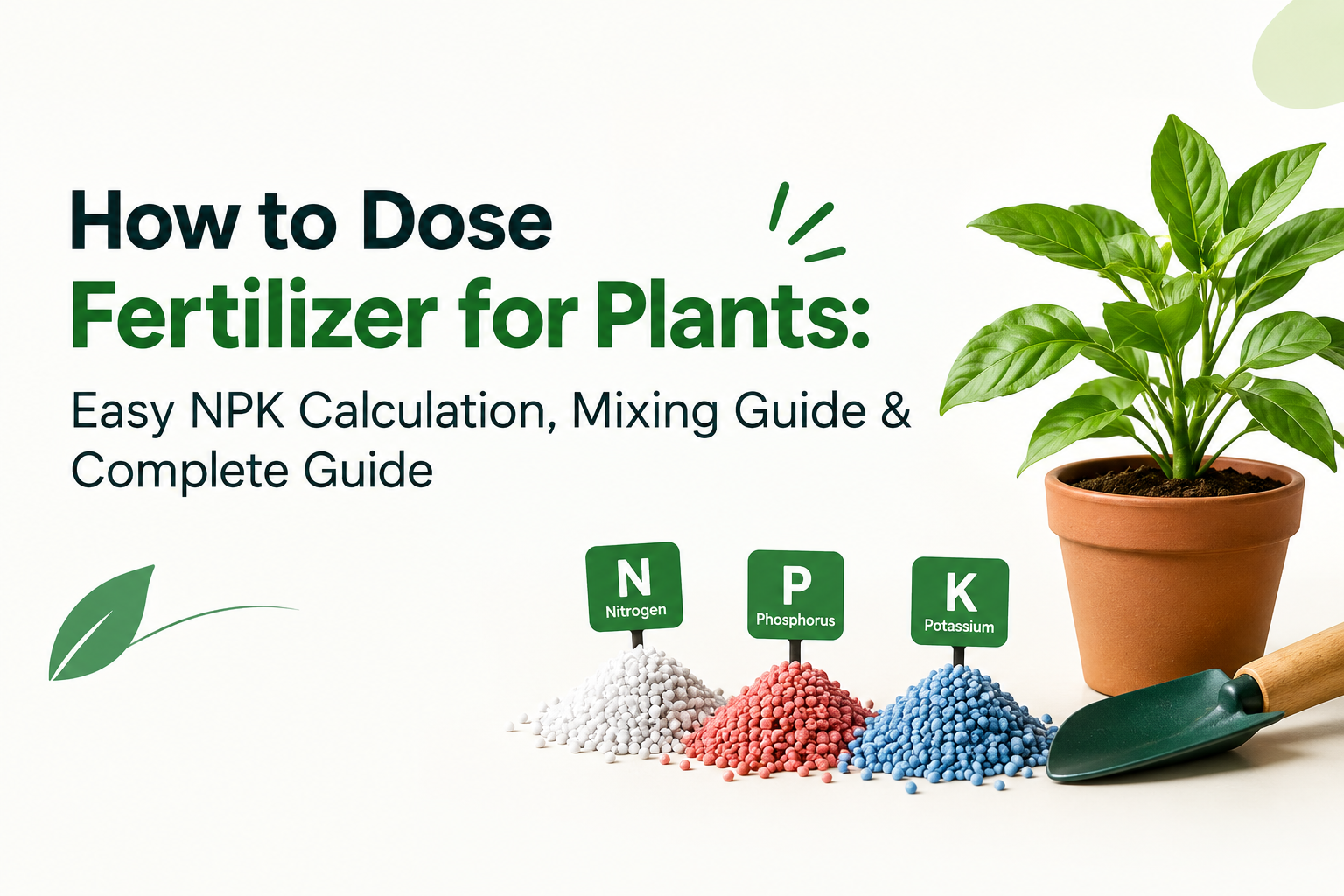
Most complete fertilizers display three numbers on the package.
These numbers represent the fertilizer’s NPK grade.
N stands for nitrogen. P refers to phosphate. K represents potassium.
For example, a fertilizer labeled 10-5-8 contains 10 percent nitrogen, 5 percent phosphate, and 8 percent potassium by weight.
The numbers do not simply represent the total amount of fertilizer. They tell you the percentage of the listed nutrients or nutrient forms contained in the product.
This allows you to compare fertilizer concentrations and calculate how much product is needed when a particular nutrient requirement is known.
For example, a 26-5-10 fertilizer contains a much higher percentage of nitrogen than a 5-10-5 fertilizer.
The correct choice still depends on the plant and soil requirements rather than simply choosing the fertilizer with the largest number.
How Do You Know How Much Fertilizer Your Plants Need?
The first step is to understand the nutritional needs of the plant.
Different plants can have different nutrient requirements. A vegetable garden, lawn, flowering plant, houseplant, and ornamental plant may not all need the same fertilizer program.
Soil conditions also matter.
A soil test can provide useful information about existing nutrient levels. Instead of automatically adding fertilizer, you can use soil analysis and plant requirements to determine what nutrients may actually be needed.
This approach can help prevent unnecessary applications.
The fertilizer label should then be checked carefully. Product instructions are designed around the concentration and formulation of that particular fertilizer.
How to Dose Fertilizer for Plants Using NPK
A basic nutrient calculation can be used when you know how much of a specific nutrient is required.
The formula is:
Required fertilizer product = Required nutrient amount ÷ Nutrient percentage expressed as a decimal
The percentage must first be converted into a decimal.
For example, 26 percent becomes 0.26.
If a particular application requires 1 pound of nitrogen and the fertilizer contains 26 percent nitrogen, the calculation is:
1 ÷ 0.26 = approximately 3.85 pounds
That means approximately 3.85 pounds of the 26 percent nitrogen fertilizer would supply 1 pound of nitrogen.
This calculation explains why the fertilizer’s concentration matters so much.
A fertilizer with a lower nutrient percentage requires a larger amount of product to provide the same quantity of that nutrient.
How Do You Convert Fertilizer Percentages?
Converting a percentage into a decimal is simple.
Divide the percentage by 100.
For example:
10 percent = 0.10
15 percent = 0.15
20 percent = 0.20
26 percent = 0.26
30 percent = 0.30
Once the percentage has been converted, it can be used in the fertilizer calculation.
This is particularly useful when calculating fertilizer weight based on a specific nutrient requirement.
For everyday home gardening, however, you should still follow the fertilizer manufacturer’s application instructions when they are provided for your particular plant and growing situation.
How to Dose Liquid Fertilizer in Water
Liquid fertilizer is commonly measured according to the amount of water being used.
A product might specify a certain number of milliliters, teaspoons, or other measurements per liter or gallon of water.
For example, if the product label says to mix a specific amount of fertilizer into one gallon of water, the same ratio can be scaled for a larger or smaller volume.
The important point is to preserve the recommended dilution ratio.
If you use half the amount of water, you generally need to scale the fertilizer amount accordingly when maintaining the same labeled concentration.
Likewise, if you prepare a larger quantity of fertilizer solution, the amount of fertilizer should be adjusted to match the total water volume.
Do not assume that a stronger mixture will automatically produce better growth.
How Do You Mix Fertilizer for Plants?
Start by checking whether the fertilizer is designed to be diluted in water.
Read the product label before mixing.
Measure the required amount rather than estimating with an unmarked container.
Add the fertilizer according to the manufacturer’s stated dilution instructions.
Mix the solution thoroughly so that the fertilizer is distributed through the water.
The final concentration should match the intended application rate.
For liquid concentrates, accurate measuring becomes especially important because small changes in concentrated products can change the final strength of the solution.
How to Dose Fertilizer for Potted Plants
Potted plants require a slightly different approach because their growing environment is limited to a container.
A garden bed has a larger soil volume, while a container may hold only a relatively small amount of growing medium.
This means fertilizer can become concentrated in the root zone if too much is applied.
For potted plants, check whether the fertilizer label gives instructions specifically for containers or houseplants.
If the label provides a dilution rate for water, use that rate rather than creating a stronger mixture based on plant size alone.
The size of the pot can also influence how much growing medium is present, but it should not be used as a reason to ignore the product’s directions.
Different plants can also have different feeding requirements.
How to Dose Fertilizer for Indoor Plants
Indoor plants generally grow under different conditions from outdoor garden plants.
Light levels, temperature, potting medium, watering patterns, and growth rates can all influence nutrient requirements.
Because indoor containers have limited growing space, fertilizer should be applied carefully.
A concentrated fertilizer solution can be particularly unsuitable if it is mixed incorrectly.
Some fertilizers designed for indoor plants provide specific instructions such as a certain number of drops or a measured amount per liter of water.
Always use the dilution information supplied for the fertilizer you have rather than assuming that all liquid fertilizers have the same concentration.
How Often Should You Apply Fertilizer?
Fertilizer frequency depends on the product, plant, growing medium, season, and growing conditions.
There is no single schedule that applies to every plant.
Some products are designed for regular feeding, while others may be slow release or intended for less frequent applications.
The label should therefore be treated as the primary guide for application frequency.
Plant growth also matters.
A plant actively producing new leaves, flowers, or fruit may have different nutritional demands from a plant experiencing slow growth or dormancy.
Applying fertilizer more frequently than recommended is not automatically beneficial.
How to Dose Granular Fertilizer
Granular fertilizers are usually measured by weight or volume and may be applied directly to soil.
Some products provide rates based on the area being fertilized.
For example, a fertilizer may specify a certain number of pounds per 1,000 square feet.
In this situation, you first determine the total area that needs treatment.
You can then scale the recommended fertilizer amount according to that area.
The calculation should always use the rate provided for the particular product.
Granular fertilizers can also differ significantly in nutrient concentration, so two bags with different NPK numbers should not automatically be applied at the same rate.
How Does Soil Testing Help With Fertilizer Dosing?
Soil testing can help identify the nutrients already present in the growing medium.
This information can be useful when deciding whether fertilizer is necessary and what type of nutrient application may be appropriate.
For garden soil, a soil analysis can provide a more informed starting point than guessing based only on plant appearance.
Soil testing is particularly useful when repeated fertilization is being considered.
If a nutrient is already present at an adequate level, adding more without a specific reason may not be necessary.
The fertilizer selection should therefore consider both soil conditions and plant needs.
How Do You Calculate Fertilizer for a Specific Area?
Area-based fertilizer calculations are useful for lawns, garden beds, vegetable plots, and larger planting areas.
First determine the recommended nutrient or fertilizer rate.
Then measure the area that will receive the fertilizer.
If the fertilizer rate is given for 1,000 square feet, for example, you can scale the amount according to the actual area.
A simple example is useful.
Suppose a fertilizer label recommends 5 pounds of product per 1,000 square feet.
If the area is 500 square feet, the proportional amount would be half of the 1,000-square-foot application.
The important part is to use the label’s rate and then adjust it to the actual area.
How Can a Fertilizer Calculator Help?
A fertilizer calculator can simplify the mathematics involved in dosing.
The basic calculation still depends on the same information.
You need to know the desired nutrient amount, the nutrient concentration in the fertilizer, and the size or volume of the area being treated.
For liquid fertilizer, you may instead need the product’s dilution ratio and the total volume of water.
A calculator can reduce manual arithmetic, especially when working with larger areas or multiple measurements.
However, a calculator cannot determine the correct nutrient requirement by itself.
The calculation is only as useful as the information entered into it.
How to Dose Fertilizer for Plants in Water
When fertilizer is intended to be mixed with water, two measurements become important.
The first is the fertilizer amount.
The second is the water volume.
If the product instruction is given per gallon, convert your total water volume into gallons or use a proportional calculation.
If the instruction is given per liter, use the same approach with liters.
For example, if a label recommends a certain amount per liter, preparing five liters of solution requires five times the labeled amount.
Maintaining the same fertilizer-to-water ratio is the key principle.
What Happens If You Use Too Much Fertilizer?
Using more fertilizer than recommended can create problems.
Excess fertilizer can increase the concentration of dissolved salts around plant roots.
Plants can respond poorly to excessive nutrient concentrations.
Symptoms may vary depending on the plant, fertilizer, growing medium, and severity of the problem.
This is one reason fertilizer dosing should be based on measurements rather than guesswork.
More fertilizer does not necessarily mean faster or healthier growth.
Following the product label and considering soil and plant requirements provides a more controlled approach.
Can You Use the Same Fertilizer Dose for Every Plant?
No.
Plants differ in their nutritional needs and growing conditions.
A fertilizer suitable for a lawn may not be the right choice for a potted houseplant.
Similarly, a fertilizer selected for flowering plants may have a different nutrient profile from one used for other crops.
The NPK ratio is one factor to consider, but it is not the only factor.
Plant type, soil, growth stage, container size, application method, and product formulation can all influence how fertilizer should be used.
How Do You Read a Fertilizer Label?
Start with the NPK numbers.
These indicate the nutrient percentages shown on the product.
Then look for the recommended application rate.
Check whether the rate is provided for soil area, individual plants, containers, or water volume.
Also check the recommended frequency.
Some products are intended for regular feeding, while others have different application schedules.
The label may also include specific precautions and instructions for handling or applying the product.
Reading the entire label is therefore more useful than looking at the NPK numbers alone.
How to Dose Fertilizer for Plants Without Guessing
The safest way to avoid guesswork is to work through a simple sequence.
First, identify the plant or crop.
Second, determine whether soil testing or another reliable recommendation is available.
Third, check the fertilizer’s NPK numbers.
Fourth, read the product’s application instructions.
Fifth, identify whether the fertilizer is liquid, granular, slow release, or another formulation.
Sixth, measure the area, number of plants, or water volume involved.
Finally, calculate or measure the required amount according to the product instructions.
This process makes fertilizer application more consistent and easier to repeat.
Common Fertilizer Dosing Mistakes
One common mistake is assuming that all fertilizers have the same strength.
They do not.
A second mistake is ignoring the NPK numbers.
Two products may look similar but contain very different nutrient concentrations.
Another mistake is measuring fertilizer without measuring the water or application area.
For liquid products, this can result in an unintended concentration.
For granular products, failing to measure the area can lead to uneven application.
Applying fertilizer too frequently is another common problem.
Following the product’s instructions helps reduce these errors.
Fertilizer Dosing for Different Plant Types
The basic calculation principles remain similar, but the application method can differ.
For indoor plants, the focus is often on correct dilution and controlled feeding.
For potted plants, the limited growing medium makes accurate application particularly important.
For garden vegetables, soil nutrient levels and crop requirements can guide fertilizer selection.
For lawns, fertilizer rates are commonly connected to the area being treated.
For flowering plants, the fertilizer selection may differ from products used for other types of plants.
The important principle is to match the fertilizer program to the plant and growing environment rather than applying one universal dose.
How to Dose Fertilizer for Plants During Active Growth
Plants actively producing new growth may have different nutritional requirements from plants that are growing slowly.
This is why fertilizer schedules often take the growth cycle into account.
During active growth, follow the recommended feeding schedule for the fertilizer and plant.
Do not increase the dose simply because the plant is growing quickly.
Instead, use the recommended concentration and frequency.
If the plant is not growing as expected, consider other factors such as light, watering, temperature, soil condition, and root health rather than assuming that more fertilizer is the solution.
How to Dose Fertilizer for Plants Using a Simple Example
Imagine you have a fertilizer containing 10 percent nitrogen.
The decimal form of 10 percent is 0.10.
If an application requires 1 pound of nitrogen, the basic calculation would be:
1 ÷ 0.10 = 10 pounds of fertilizer
This means 10 pounds of a fertilizer containing 10 percent nitrogen would contain 1 pound of nitrogen.
Now compare that with a 20 percent nitrogen fertilizer.
The decimal is 0.20.
The calculation becomes:
1 ÷ 0.20 = 5 pounds
The second fertilizer requires less total product to provide the same amount of nitrogen because its nitrogen concentration is higher.
This simple comparison demonstrates why fertilizer concentration must be considered when calculating application amounts.
Why Fertilizer Concentration Matters
Fertilizer concentration affects how much product is required to supply a particular nutrient.
A highly concentrated fertilizer can provide a target nutrient using less total product.
A less concentrated fertilizer may require more product for the same nutrient amount.
This does not mean the more concentrated product is automatically better.
The fertilizer should still be appropriate for the plant and application.
Using a concentration that does not match the intended application can make dosing more difficult and may increase the risk of overapplication.
How to Apply Fertilizer More Evenly
Consistent measurement is important for even fertilizer application.
For granular fertilizer, measure the required amount before spreading it.
For liquid fertilizer, measure both fertilizer and water.
When treating a large area, divide the application into manageable sections if necessary.
For container plants, apply the recommended solution evenly rather than concentrating it in one small location.
Uniform application helps ensure that the fertilizer is distributed according to the intended rate.
Can Fertilizer Be Dosed by Teaspoon or Tablespoon?
Some household and indoor plant fertilizers provide instructions using teaspoons or tablespoons.
These measurements should only be used when they are appropriate for the product.
A teaspoon of one fertilizer is not necessarily equivalent in nutrient concentration to a teaspoon of another fertilizer.
This is because fertilizer products can have different formulations and concentrations.
For this reason, volume measurements should follow the manufacturer’s instructions.
When a precise weight is required, using an appropriate scale can provide more consistent measurement.
How to Dose Fertilizer for Plants More Accurately
Accuracy starts with knowing what you are measuring.
For soil applications, know the area.
For container plants, know the product instructions for that type of plant.
For liquid fertilizer, know the water volume.
For nutrient calculations, know the percentage of the target nutrient.
For all fertilizer types, read the label before application.
Small differences in measurement can become more significant when fertilizer is highly concentrated or when the same product is used repeatedly.
Final Checklist Before Fertilizing Plants
Before applying fertilizer, ask a few simple questions.
Do I know what type of plant I am feeding?
Do I know what nutrients the plant needs?
Have I checked the fertilizer’s NPK ratio?
Have I read the application instructions?
Do I know whether the product should be diluted?
Have I measured the amount of water or soil area involved?
Am I following the recommended frequency?
If the answer to these questions is yes, you have a much stronger foundation for accurate fertilizer dosing.
People Also Search For
How to Dose Fertilizer for Plants Calculator
A fertilizer calculator can help with the arithmetic involved in converting nutrient requirements into fertilizer amounts.
The calculation usually depends on the desired nutrient quantity, fertilizer nutrient percentage, application area, or water volume.
The calculator should be used together with reliable fertilizer instructions and plant requirements.
How to Dose Fertilizer for Plants in Water
For fertilizer that is designed to be mixed with water, follow the product’s stated fertilizer-to-water ratio.
Measure the water volume first and then add the appropriate amount of fertilizer.
Do not create a stronger mixture simply because you want faster plant growth.
How to Dose Fertilizer for Plants for Aquarium
Aquarium plant fertilization is a specialized application because the fertilizer is being added to an aquatic environment rather than ordinary garden soil.
The fertilizer product should specifically be intended for aquarium plants.
Its instructions should be followed according to aquarium volume and the nutrient requirements of the plants being grown.
How to Apply Fertilizer to Potted Plants
For potted plants, begin by checking the fertilizer instructions for containers.
Measure the recommended amount carefully.
If it is a liquid concentrate, dilute it according to the stated water volume.
Because pots have limited growing medium, avoid treating them as though they were large garden beds.
How to Fertilize Indoor Plants
Indoor plants should be fertilized according to their specific fertilizer instructions and growing conditions.
Pay particular attention to dilution when using liquid fertilizer.
Indoor plants generally grow in containers with limited soil volume, so accurate measurement is important.Read this tech section.
Final Thoughts
Learning how to dose fertilizer for plants becomes much easier once you understand three basic things: the plant’s nutrient requirements, the fertilizer’s concentration, and the application area or water volume.
The NPK numbers help explain what is contained in the fertilizer.
The percentage can be converted into a decimal when calculating the amount of product needed to supply a specific nutrient.
For liquid fertilizers, the fertilizer-to-water ratio is especially important.
For granular fertilizers, application area and product concentration are key considerations.
Soil testing can also provide useful information about existing nutrients and help guide fertilizer decisions.
Most importantly, fertilizer should be measured rather than guessed.
A careful approach can make applications more consistent and help you provide nutrients according to the needs of your plants and the instructions for the product you are using.