
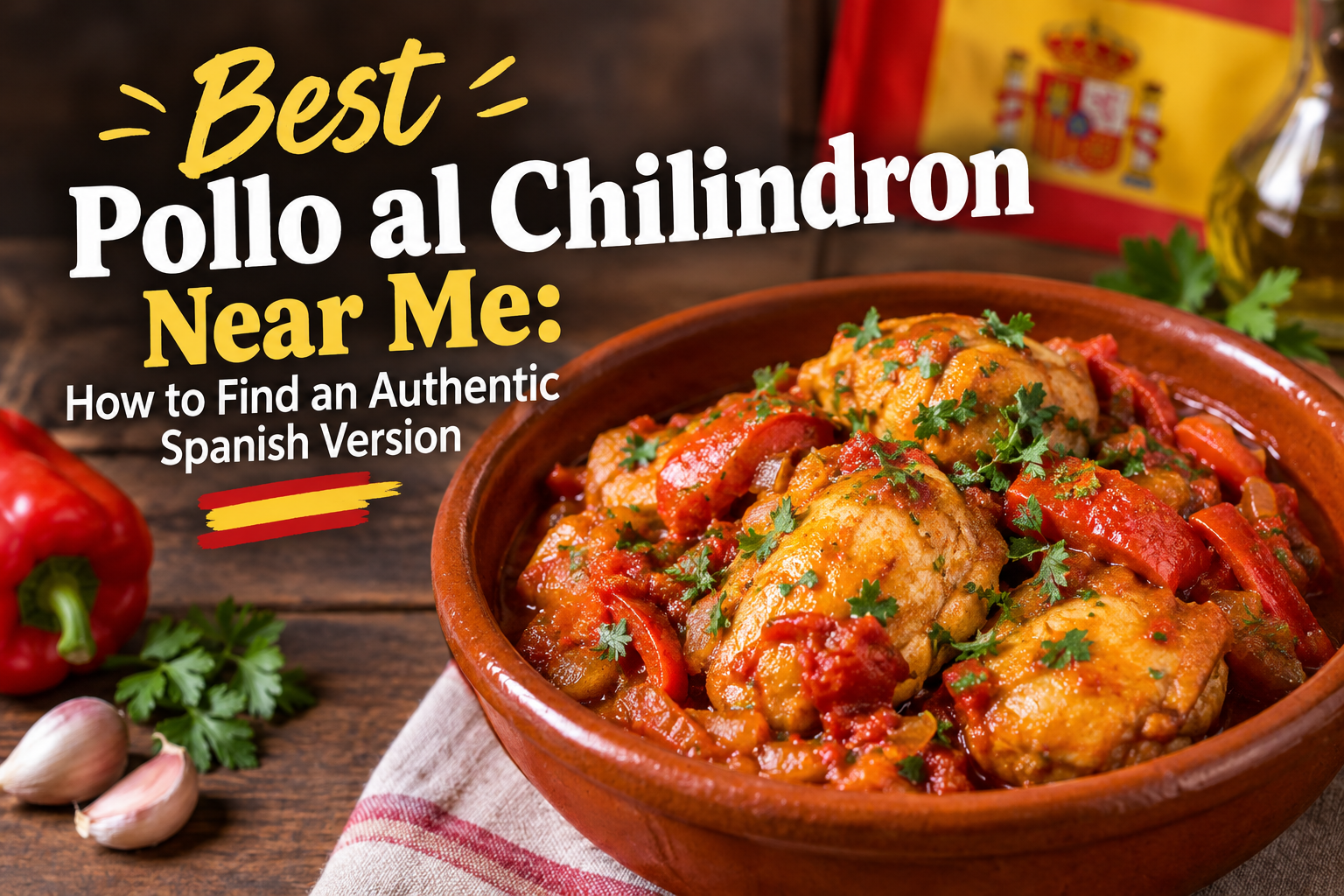
Searching for the best pollo al chilindron near me usually means you are looking for more than an ordinary chicken dish. You want the rich Spanish preparation made with tender chicken, peppers, tomatoes, onion, garlic, olive oil, and the savory depth associated with cured ham.
The challenge is that pollo al chilindrón is not a standard menu item everywhere. It is closely associated with Aragón in Spain, and authentic versions can be easier to find at Spanish restaurants, regional restaurants, tapas establishments, or specialist kitchens than at general international restaurants. Spain’s official tourism site lists pollo al chilindrón as an Aragón dish and gives a traditional preparation based on chicken, tomatoes, onion, green peppers, garlic, olive oil, ham, and wine.
So, if a quick restaurant search does not produce a nearby result, knowing what the dish should actually contain can help you find a worthwhile alternative or prepare it at home.
What Is Pollo al Chilindrón?
Pollo al chilindrón is a traditional Spanish chicken stew associated particularly with Aragón.
The dish is built around a flavorful vegetable base rather than a heavily spiced curry or a simple tomato sauce. Chicken is browned and then cooked slowly with peppers, tomato, onion, garlic, olive oil, and other ingredients that vary slightly by recipe.
Cured Spanish ham is another important ingredient in many traditional versions. Spain’s official recipe uses Jamón de Teruel along with ripe tomatoes, onion, green peppers, garlic, olive oil, and white wine.
The finished dish should have a rich, rustic sauce with tender chicken and clearly recognizable pieces of vegetables.
That texture is important.
Pollo al chilindrón is generally not meant to taste like chicken covered in a smooth commercial tomato sauce. The vegetables contribute both flavor and texture to the finished stew.
Why Is Pollo al Chilindron Hard to Find Near Me?
The biggest issue with the best pollo al chilindron near me is that the dish is regional rather than a universal Spanish restaurant staple.
Many restaurants may serve Spanish chicken, tapas, paella, or Mediterranean dishes without offering chilindrón.
A restaurant can therefore have an extensive Spanish menu and still not have pollo al chilindrón available on the day you visit.
Availability can also depend on whether the restaurant follows a regional menu, changes its specials regularly, or prepares traditional dishes only on certain days.
For that reason, searching only for the exact dish name may not always produce the most useful local results.
Where Should You Look for Pollo al Chilindrón?
If you want to find the dish at a restaurant, start with establishments that have a genuine connection to Spanish cuisine.
Spanish Restaurants
A Spanish restaurant is the most obvious place to start.
Look for menus that include traditional regional dishes rather than only popular Spanish-inspired items.
Restaurants that regularly feature dishes from Aragón, northern Spain, or traditional Spanish home cooking are particularly worth checking.
Tapas Restaurants
Tapas restaurants can also be useful because many serve rotating regional dishes and seasonal specials.
However, do not assume that every tapas restaurant serves pollo al chilindrón.
Check the current menu or contact the restaurant before travelling.
Basque or Northern Spanish Restaurants
Some restaurants specializing in northern Spanish cooking may feature chicken and pepper preparations related to the broader culinary traditions of the region.
This does not mean every Basque dish is pollo al chilindrón.
Instead, the point is that regional Spanish restaurants are generally more promising than restaurants using the word “Spanish” only as a broad cuisine label.
Mediterranean Restaurants
Mediterranean restaurants may sometimes offer similar combinations of chicken, peppers, tomatoes, garlic, and olive oil.
But a similar ingredient list does not automatically make a dish pollo al chilindrón.
If authenticity matters, ask specifically whether the kitchen prepares the Aragón-style dish.
How Can You Tell If Restaurant Pollo al Chilindrón Is Authentic?
When looking for the best pollo al chilindron near me, the word “authentic” should be treated carefully.
There is not one single recipe followed identically by every cook.
Still, several characteristics can help you evaluate the dish.
A traditional-style preparation should have chicken as the central ingredient and a substantial vegetable base featuring peppers, tomatoes, and onion.
Garlic and olive oil are also important.
Cured ham is commonly included, particularly in versions following the Aragón tradition. Spain’s official recipe uses Jamón de Teruel, while other established recipes use Jamón Serrano.
White wine may also be used.
The sauce should taste developed and savory rather than simply tasting like canned tomato sauce.
What Does Traditional Pollo al Chilindrón Taste Like?
The flavor is rich, savory, slightly sweet from the cooked vegetables, and deeply aromatic.
Peppers provide sweetness and vegetal character.
Tomatoes add acidity and body.
Onion develops sweetness as it cooks.
Garlic adds another layer of aroma.
Cured ham contributes saltiness and umami.
Olive oil brings the ingredients together.
Some recipes also use pimentón, or Spanish paprika, while others emphasize the natural flavor of the peppers and tomatoes. Jose Andrés’ PBS recipe, for example, includes sweet pimentón, Spanish cured ham, peppers, onions, garlic, tomato sauce, white wine, rosemary, and bay leaf.
This combination creates a comforting stew rather than a fiery dish.
What Ingredients Are Used in Pollo al Chilindrón?
Although recipes differ, the classic ingredient family is fairly recognizable.
You will usually find:
- Chicken
- Tomatoes
- Green or red peppers
- Onion
- Garlic
- Extra-virgin olive oil
- Cured ham
- White wine
- Salt and pepper
Some versions add paprika, bay leaf, rosemary, or other herbs.
Spain’s official recipe for four people uses a whole chicken, 200 grams of Jamón de Teruel, one kilogram of ripe tomatoes, one large onion, green peppers, garlic, olive oil, and white wine.
The exact proportions are not universal.
That is why two genuinely traditional versions can look or taste slightly different.
Should Pollo al Chilindrón Use Red or Green Peppers?
Both can appear in modern versions.
The official Spain Tourism recipe uses green peppers, while other established recipes combine red and green bell peppers. PBS’s Jose Andrés recipe uses both colors.
Red peppers generally bring more sweetness.
Green peppers can provide a more pronounced vegetal flavor.
Using both creates additional color and flavor complexity.
The important point is that peppers should remain an identifiable part of the dish rather than disappearing into a completely smooth sauce.
What Chicken Is Best for Pollo al Chilindrón?
Bone-in chicken pieces are an excellent choice for a slow-cooked version.
Thighs and drumsticks remain juicy during longer cooking and contribute flavor to the sauce.
Some recipes use a whole chicken cut into portions.
Spain’s official recipe calls for one large chicken cut into pieces, while Jose Andrés’ version uses chicken legs separated into thighs and drumsticks.
Boneless chicken can work when convenience is the priority, but it can become dry if overcooked.
For a restaurant-style result at home, bone-in thighs are a practical choice.
How Is Authentic Pollo al Chilindrón Cooked?
The cooking process is relatively straightforward, but patience makes a difference.
Step 1: Prepare the Chicken
Season the chicken with salt and pepper.
Pat it dry so it browns properly.
Step 2: Brown the Chicken
Heat olive oil in a heavy pot or casserole.
Brown the chicken pieces on several sides until they develop a golden surface.
Do not worry about cooking them completely at this stage.
The purpose is to develop flavor before the slow cooking begins.
Remove the chicken and set it aside.
Step 3: Build the Vegetable Base
Add the onion and peppers to the same cooking vessel.
Allow them to soften slowly.
Add garlic after the vegetables have started cooking so it does not burn.
The goal is to create a deep, sweet base rather than simply frying everything quickly.
Step 4: Add Tomato
Add chopped, peeled, grated, or crushed tomatoes depending on the recipe.
Cook until the excess moisture reduces and the sauce becomes concentrated.
Step 5: Add Ham and Wine
Cured ham can be added to provide a savory element.
Add white wine and allow it to cook down.
This helps integrate the wine’s flavor into the sauce.
Step 6: Return the Chicken
Put the browned chicken back into the pot.
Lower the heat and allow everything to simmer gently.
The chicken should become tender while the sauce thickens.
Spain’s official recipe cooks the dish for approximately 30 minutes after combining the chicken with the vegetable preparation, while other recipes use a longer, slower simmer.
Step 7: Rest Before Serving
Once the chicken is tender, let the dish rest briefly.
This allows the sauce to settle and makes serving easier.
How Long Does Pollo al Chilindrón Take to Cook?
Cooking time depends on the size of the chicken pieces and the recipe.
A traditional stovetop version can take around 30 minutes after the main ingredients are combined.
Longer cooking can produce a softer, more developed stew.
Jose Andrés’ recipe takes the slower approach, simmering the chicken and sauce for about an hour after the main ingredients are added.
The better indicator is not the clock alone.
The chicken should be tender, cooked through, and easy to separate from the bone.
The sauce should also have enough time to become rich without burning.
What Should You Serve With Pollo al Chilindrón?
Pollo al chilindrón is substantial enough to serve as a complete main course.
Crusty bread is an excellent choice because the sauce is one of the highlights of the dish.
Spanish-style potatoes also work well.
Spain’s official tourism recipe specifically suggests serving the dish with diced fried potatoes or white rice.
White rice is useful when you want the sauce to remain the main flavor.
Potatoes make the meal heavier and more comforting.
A simple green salad can provide freshness alongside the rich stew.
Can You Make Pollo al Chilindrón Without Jamón?
Yes, although the flavor will be different.
Cured ham adds saltiness and savory depth, and it is included in many traditional recipes.
If you cannot find Jamón de Teruel or Jamón Serrano, another good-quality cured ham can provide a similar function.
For a vegetarian adaptation, the chicken and ham would need to be replaced entirely, so the result would no longer be traditional pollo al chilindrón.
For an authentic experience, keeping the cured ham when available is worthwhile.
Can You Make It Without Wine?
Yes.
White wine is part of many traditional recipes, including the official Spain Tourism preparation.
If you do not want to use wine, you can prepare the dish without it, although the acidity and aroma will change.
A small amount of suitable stock can help maintain moisture during cooking.
However, avoid adding too much liquid.
The finished dish should have a concentrated sauce rather than a thin soup.
Is Pollo al Chilindrón Spicy?
Usually, no.
The dish is flavorful but does not depend on hot chili peppers for its identity.
Its character comes from peppers, tomatoes, onion, garlic, olive oil, cured ham, and slow cooking.
Paprika may appear in some recipes, but the result does not have to be hot.
If you see a restaurant describing its chilindrón as extremely spicy, ask what peppers or chili ingredients it uses.
That can help you understand whether you are getting a traditional-style preparation or a modern variation.
What Is the Difference Between Pollo al Chilindrón and Other Spanish Chicken Dishes?
Spanish cuisine has many chicken preparations, and they are not interchangeable.
Pollo al ajillo, for example, is strongly associated with garlic.
Chicken with a chilindrón-style sauce is defined by the combination of vegetables, especially peppers, tomato, and onion.
Pepitoria is another traditional Spanish chicken preparation, generally associated with a different sauce and ingredient profile.
So if you search for best pollo al chilindron near me, do not accept any Spanish chicken dish as an equivalent.
The sauce and cooking method matter.
Is Pollo al Chilindrón the Same as Basque Chicken?
Not exactly.
Some modern English-language recipes describe pollo al chilindrón as “Basque chicken and peppers,” but the dish is particularly associated with Aragón. Spain’s official tourism site places its featured recipe under Aragón, and Zaragoza’s tourism information likewise identifies the chilindrón with the region’s culinary tradition.
Regional Spanish cuisines naturally overlap in ingredients and techniques.
That does not mean every chicken-and-pepper dish belongs to the same culinary tradition.
For search purposes, this distinction is useful because a restaurant might list a similar preparation under another regional name.
What If You Cannot Find Pollo al Chilindrón Near You?
This is where understanding the dish becomes especially useful.
If no nearby restaurant lists it, search for Spanish restaurants with regional menus rather than limiting your search to the exact phrase.
You can also ask restaurants whether they have a daily special based on chilindrón.
Another option is to make it at home.
The ingredient list is relatively accessible, and the dish does not require specialized cooking equipment.
The official Spanish recipe uses familiar ingredients that can be adapted to what is available locally.
How to Search for the Best Pollo al Chilindron Near Me
A more targeted search can save time.
Instead of searching only for the exact dish, try combinations such as:
Spanish restaurant + your city
Aragonese restaurant + your city
Spanish tapas + your city
pollo al chilindrón + your city
Spanish chicken stew + your city
Then check the restaurant’s current menu.
If the menu does not mention the dish, call before visiting.
Ask whether the kitchen currently serves pollo al chilindrón and whether it is a traditional preparation.
This is particularly useful because restaurant menus can change.
How to Judge a Restaurant Serving Pollo al Chilindrón
A good restaurant version should have a sauce with depth.
The chicken should be tender rather than dry.
The peppers and onions should be properly cooked rather than crunchy.
Tomato should support the sauce without overwhelming it.
The dish should taste balanced rather than excessively salty.
If cured ham is included, it should contribute flavor rather than dominate every bite.
A rushed preparation can taste like chicken cooked in tomato sauce.
A carefully cooked chilindrón should taste more integrated, with the chicken, vegetables, ham, and sauce working together.
Can Pollo al Chilindrón Be Prepared Ahead of Time?
Yes.
Like many slow-cooked stews, it can benefit from resting after cooking.
As the dish sits, the sauce and chicken continue to develop a more integrated flavor.
If preparing it ahead, cool and refrigerate it safely, then reheat thoroughly before serving.
When reheating, use gentle heat so the sauce does not scorch.
If the sauce becomes too thick, a small amount of water or stock can help loosen it.
Frequently Asked Questions About Best Pollo al Chilindron Near Me
Where can I find the best pollo al chilindron near me?
Look first at Spanish restaurants, tapas restaurants, and establishments specializing in regional Spanish cuisine. Because pollo al chilindrón is associated with Aragón, restaurants with a strong traditional or regional Spanish focus may be more likely to offer it.
What is the traditional Spanish chicken dish called pollo al chilindrón?
It is a chicken stew associated with Aragón and built around ingredients such as peppers, tomatoes, onion, garlic, olive oil, and cured ham.
What are the main ingredients in pollo al chilindrón?
The traditional ingredient profile includes chicken, tomatoes, peppers, onion, garlic, olive oil, cured ham, and often white wine. Exact recipes vary.
Is pollo al chilindrón spicy?
Traditional pollo al chilindrón is generally savory rather than extremely hot. Its main flavor comes from cooked peppers, tomatoes, onion, garlic, olive oil, and cured ham.
What region of Spain is pollo al chilindrón from?
Pollo al chilindrón is particularly associated with Aragón in northeastern Spain. Zaragoza’s tourism information also identifies the dish with the region.
What does pollo al chilindrón taste like?
It has a rich, savory, slightly sweet and tomato-forward flavor with cooked peppers, onion, garlic, olive oil, and often cured ham. The sauce should be hearty and concentrated rather than watery.
What chicken is best for pollo al chilindrón?
Bone-in thighs, drumsticks, or a whole chicken cut into portions work particularly well because they remain moist during slow cooking.
Can I make pollo al chilindrón at home?
Yes. It is a relatively straightforward one-pot-style stew. Brown the chicken, cook the vegetables, add tomato and other ingredients, return the chicken, and simmer until tender.
What should I serve with pollo al chilindrón?
Crusty bread, white rice, or fried diced potatoes are suitable accompaniments. Spain’s official recipe specifically recommends fried potatoes or white rice.
Is pollo al chilindrón the same as chicken with peppers?
Not necessarily. Chicken with peppers is a broad description, while pollo al chilindrón refers to a particular Spanish preparation associated with Aragón and its characteristic sauce.
Final Thoughts
Finding the best pollo al chilindron near me can take more than a simple restaurant search because this is a regional Spanish dish that is not universally available.
The best starting point is to look for Spanish or regional restaurants and check whether the current menu specifically mentions pollo al chilindrón.
When evaluating the dish, look for the characteristics that make it distinctive: tender chicken, peppers, tomato, onion, garlic, olive oil, and the savory contribution of cured ham.
If the dish is unavailable locally, making it at home is a practical alternative. The traditional ingredients are straightforward, and the cooking method relies more on patient simmering than complicated technique.Also read this blog Best Tarta de Choclo Near Me: Top Chilean Spots in the US.
Ultimately, the most useful way to approach this search is not simply to find any restaurant selling Spanish chicken. It is to understand what pollo al chilindrón actually is, then use that knowledge to identify a restaurant version that respects the character of this classic Aragón preparation.