

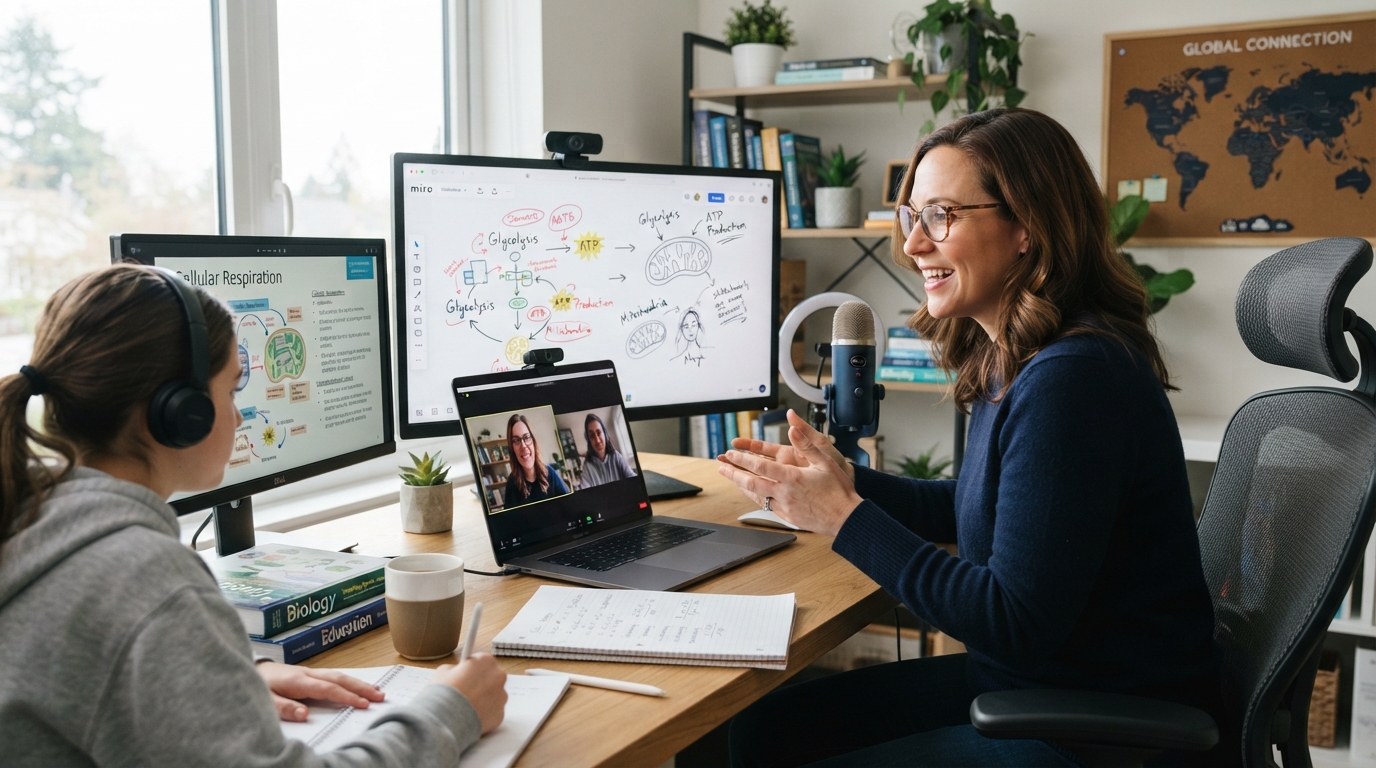
Online tutoring and teaching have changed the way students access education and the way educators share their knowledge. A learner no longer has to live near a particular school, coaching center, or private tutor to receive specialized academic support. With a reliable internet connection, a suitable device, and the right digital tools, students can attend lessons, communicate with teachers, complete assignments, and receive feedback from almost anywhere.
For educators, online teaching has opened another path for reaching students beyond the limits of a physical classroom. A teacher can work with individual learners, small groups, or larger virtual classes while using video conferencing, digital whiteboards, learning management systems, presentations, quizzes, and other educational resources.
This shift does not simply mean moving a traditional classroom onto a screen. Effective online tutoring and teaching require thoughtful lesson planning, clear communication, student interaction, appropriate technology, regular assessment, and an understanding of how learners behave in a virtual environment. Recent research and professional teaching resources also emphasize personalization, engagement, digital literacy, feedback, and the ability to adapt instruction to individual learners.
For students, the right online tutor can provide focused assistance with difficult subjects, exam preparation, languages, academic skills, or practical subjects. For teachers, digital education can create opportunities to develop new teaching skills, serve students in different locations, and build a flexible professional practice.
This guide explains what online tutoring and teaching involve, how they work, their benefits and limitations, the types of lessons available, essential tools, effective teaching strategies, and the steps educators can take to create better virtual learning experiences.
What Is Online Tutoring and Teaching?
Online tutoring and teaching refer to educational instruction delivered through internet-based technologies rather than exclusively through a physical classroom.
The terms are related, but they are not exactly identical.
Online teaching generally describes instruction delivered to a class, group, or broader audience. A teacher may conduct scheduled lessons, provide course materials, organize assignments, explain concepts, and assess student performance through a digital learning environment.
Online tutoring is usually more individualized. A tutor often works with one student or a small group and focuses on particular learning needs. The goal may be to explain a difficult topic, improve academic performance, prepare for an examination, strengthen a weak skill, or provide additional practice.
A useful distinction is that teaching often follows a broader curriculum, while tutoring can be more targeted and responsive to the learner’s immediate difficulties.
However, the two approaches frequently overlap. An online teacher may provide personalized support, while an online tutor may follow a structured curriculum.
The common element is the digital learning environment. Students and educators communicate using technologies such as video calls, virtual classrooms, digital whiteboards, shared documents, learning management systems, messaging tools, and online assessment platforms.
How Does Online Tutoring and Teaching Work?
A successful online lesson usually involves much more than opening a video call.
The process begins with understanding the learner. The tutor or teacher may identify the student’s current level, goals, previous knowledge, difficulties, preferred learning methods, and expected outcomes.
The educator then prepares a lesson around those needs.
During the session, the teacher explains concepts, asks questions, demonstrates examples, gives the learner opportunities to practice, and observes the student’s responses. Digital tools can make these activities more interactive.
After the lesson, the teacher may provide homework, additional resources, a short assessment, or specific feedback.
A typical online tutoring session can therefore follow this sequence:
- Identify the student’s learning objective.
- Review previous knowledge or difficulties.
- Introducing the new concept.
- Demonstrate the concept with examples.
- Ask the student to apply it.
- Correct misunderstandings.
- Provide practice or an assessment.
- Give feedback.
- Set the next learning goal.
This approach is particularly useful because tutoring should not become a one-way lecture. The teacher needs evidence of what the student understands before deciding what to explain next.
Why Has Online Tutoring Become So Popular?
Several factors have contributed to the growth of virtual education.
One is convenience. Students can attend lessons without spending time traveling to a tutoring center. This can make regular learning easier for families with demanding schedules.
Another factor is access. A student may be able to find a specialist who is not available locally. Similarly, an experienced teacher can work with learners outside their own city or country.
Technology has also improved. Video conferencing, interactive whiteboards, cloud-based documents, digital assignments, and educational platforms allow teachers to recreate many classroom activities online.
Research published in 2026 continues to examine online tutoring as an established educational model, including questions around learner engagement, accessibility, personalization, digital tools, and effectiveness.
At the same time, the growing availability of online tutor opportunities shows that digital teaching is not limited to large education companies. Current job listings include remote tutoring positions across different subjects and academic levels, with employers commonly expecting strong subject knowledge, communication ability, and familiarity with tools such as Zoom or Google Meet.
Benefits of Online Tutoring and Teaching
Greater Accessibility
One of the strongest advantages of online education is accessibility.
Students do not necessarily need to live close to a specialist tutor. A learner interested in mathematics, science, languages, programming, writing, or examination preparation can search for an educator based on subject expertise rather than physical location.
This is particularly valuable when specialized instruction is difficult to find locally.
Online learning can also benefit students who have scheduling, transportation, or location constraints.
Flexible Scheduling
Traditional tutoring often requires the student and tutor to be physically present at the same place at a fixed time.
Online tutoring can provide greater scheduling flexibility.
Teachers may offer lessons in the morning, afternoon, evening, or on weekends, depending on their availability and the needs of students.
This flexibility can be useful for school students, university learners, working professionals, and adults who want to develop new skills.
Personalized Learning
Personalization is another major strength of tutoring.
A classroom teacher may need to follow a common lesson plan for many students. An online tutor working individually with a learner can spend more time on specific weaknesses.
For example, if a student understands basic algebra but struggles with word problems, the tutor can devote more of the session to interpreting mathematical language rather than repeating concepts the student already understands.
Personalized instruction can also involve changing the pace, examples, exercises, explanations, and learning materials.
Wider Choice of Subjects
Online tutoring is not restricted to traditional academic subjects.
Students can find online instruction in:
- Mathematics
- Physics
- Chemistry
- Biology
- English
- Foreign languages
- History
- Geography
- Writing
- Coding
- Programming
- Graphic design
- Music
- Art
- Business skills
- Professional software
- Test preparation
The expansion of digital education means learners can look beyond the subjects available at nearby tutoring centers.
Convenient Access to Learning Resources
Digital lessons can incorporate videos, presentations, websites, interactive exercises, shared documents, electronic worksheets, quizzes, and recorded explanations.
Instead of relying entirely on a physical textbook, teachers can combine different resources to explain a concept from several angles.
Opportunities for Educators
Online teaching also benefits educators.
Teachers can develop digital teaching skills, reach students outside their local area, create specialized courses, offer one-to-one tutoring, or work through established education platforms.
Current tutoring services in Pakistan, for example, demonstrate models in which tutors create profiles, choose subjects, set rates, connect with students, and conduct lessons remotely.
Types of Online Tutoring
Online tutoring can be organized around different student needs.
Academic Tutoring
Academic tutoring provides additional support for school, college, or university subjects.
A tutor may help a learner understand difficult chapters, complete practice exercises, prepare for examinations, or strengthen foundational knowledge.
Test Preparation
Online tutors can specialize in examination preparation.
This can include school examinations, university entrance tests, English-language tests, and standardized assessments.
Effective test preparation should not consist only of solving questions. Students also need to understand examination structure, time management, question patterns, common mistakes, and strategies for reviewing answers.
Language Tutoring
Language learning is particularly suitable for online instruction.
Students can practice vocabulary, pronunciation, grammar, reading, writing, listening, and conversation with a teacher.
A virtual lesson can also provide opportunities for real-time speaking practice that students may not receive in their normal academic environment.
Skills-Based Tutoring
Digital education also supports practical and creative skills.
Students may learn programming, coding, photography, writing, design, music, business software, or other professional and personal-development skills.
One-to-One Tutoring
One-to-one tutoring provides the highest degree of individual attention.
The teacher can adjust the lesson according to the student’s pace and immediately respond to questions.
This format is useful when a learner has a specific academic difficulty or needs intensive preparation.
Small-Group Online Classes
Small-group classes combine some benefits of individual tutoring with peer interaction.
Students can discuss problems, compare approaches, participate in activities, and learn from one another.
For the teacher, small groups can also make instruction more scalable than individual sessions.
Online Tutoring vs. Online Teaching
Although the terms are often used interchangeably, understanding the difference can help students select the right service.
| Feature | Online Tutoring | Online Teaching |
| Typical audience | One student or small group | Class or larger group |
| Main focus | Individual learning needs | Curriculum or course |
| Pace | Highly flexible | Usually structured |
| Feedback | Often immediate and personalized | May follow scheduled assessments |
| Lesson design | Adapted to learner | Usually planned for a group |
| Main goal | Targeted improvement | Broader instruction |
Neither model is automatically better.
A student who needs help with one difficult topic may benefit from tutoring, while a learner taking a complete course may prefer structured online teaching.
Essential Tools for Online Tutoring and Teaching
Technology should support teaching rather than become the lesson itself.
Video Conferencing
Video conferencing allows teachers and students to communicate in real time.
Zoom is widely used for virtual meetings and online classes. Teachers can use video, audio, screen sharing, chat, and other meeting functions to conduct lessons.
Google Meet provides another option for live online instruction.
The best platform depends on class size, available features, internet quality, institutional requirements, and student familiarity.
Digital Classrooms
Google Classroom can help educators organize assignments, materials, communication, and student work in one digital environment.
Interactive Whiteboards
A digital whiteboard allows teachers to write equations, draw diagrams, annotate images, explain processes, and work through problems step by step.
This is especially useful for mathematics, science, language instruction, and subjects requiring visual explanation.
Learning Resources
Khan Academy provides educational videos, practice exercises, and learning resources that can supplement tutoring sessions.
The important principle is not to overwhelm students with resources. A tutor should select materials that directly support the learning objective.
Online Courses and Professional Development
Educators who want to improve their online teaching skills can also explore structured professional development.
For example, Coursera’s Learning to Teach Online course focuses on online teaching strategies, digital pedagogy, educational technology, and course planning.
Qualities of an Effective Online Tutor
Technology cannot compensate for weak teaching.
A successful online tutor needs a combination of subject expertise and interpersonal skills.
Strong Subject Knowledge
Students need accurate explanations.
A tutor should understand not only the correct answer but also the reasoning behind it. This allows the teacher to explain a concept in different ways when the first explanation does not work.
Clear Communication
Online teaching makes communication especially important.
Teachers should speak clearly, structure explanations logically, use understandable language, and check whether the learner is following the lesson.
Patience
Students do not all learn at the same speed.
A patient tutor does not treat repeated questions as a problem. Instead, repeated confusion becomes evidence that the explanation or learning activity may need to change.
Empathy
Students may feel nervous about asking questions online.
A supportive teacher creates an environment where mistakes are treated as part of learning rather than something embarrassing.
Adaptability
An effective lesson rarely goes exactly according to plan.
A student may understand one concept quickly but struggle with another. The tutor should be able to adjust examples, pace, activities, or explanations.
Digital Confidence
Teachers should know how to use the basic technology required for their lessons.
This includes video calls, screen sharing, digital files, whiteboards, presentations, online assignments, and communication tools.
How to Keep Students Engaged During Online Lessons
Student engagement is one of the biggest challenges of virtual education.
A teacher who talks continuously for an entire lesson may lose the student’s attention even if the information is correct.
Instead, online tutoring should include regular opportunities for participation.
Ask questions.
Let the student solve problems.
Use short exercises.
Ask the learner to explain a concept in their own words.
Use polls or quizzes when appropriate.
Show diagrams or examples.
Give students a task rather than simply telling them the answer.
This changes the lesson from passive listening into active learning.
Research on virtual tutoring has identified student motivation, connection, technical limitations, and engagement as continuing challenges, while practical strategies such as personalized tutoring, encouragement, communication, and timely feedback can help address them.
How to Plan an Effective Online Lesson
A strong virtual lesson should have a clear beginning, middle, and end.
Start With a Learning Objective
Tell the student what they should be able to understand or do by the end of the lesson.
For example:
“By the end of today’s session, you will be able to solve quadratic equations using the factorization method.”
A specific objective is more useful than a vague goal such as “learn algebra.”
Activate Previous Knowledge
Ask a few questions about what the student already knows.
This helps identify gaps before introducing new information.
Explain the Concept
Keep explanations focused.
Use examples that match the student’s level and connect new information to concepts they already understand.
Practice Together
After explaining, solve an example with the student.
Do not immediately move from explanation to independent homework.
Guided practice allows the tutor to identify misunderstandings while the student is still receiving support.
Let the Student Work Independently
Give the learner a problem or task to complete without continuous assistance.
This provides evidence of whether they can actually apply the concept.
Review and Give Feedback
End the session by reviewing the key idea, discussing mistakes, and identifying what the student should practice next.
Assessment and Feedback in Online Tutoring
Assessment does not always have to mean a formal examination.
A tutor can assess learning through questions, short quizzes, homework, practical tasks, discussions, and problem-solving exercises.
The purpose is to answer a simple question:
What can the student do independently now that they could not do before?
Good feedback should be specific.
Instead of saying “This is wrong,” explain what went wrong and how the student can improve.
For example:
“Your formula is correct, but you substituted the value incorrectly in the second step.”
That gives the learner a clear action for improvement.
Common Challenges of Online Tutoring and Teaching
Internet and Technical Problems
Poor connectivity can interrupt a lesson.
Teachers should have a backup communication method and should keep essential lesson materials available offline when possible.
Student Distraction
Students may be surrounded by distractions at home.
Short activities, direct questions, visual material, and clear lesson structure can help maintain attention.
Limited Physical Interaction
Teachers cannot always read body language as easily through a screen.
This makes verbal check-ins important.
Instead of assuming the student understands, ask questions and invite them to demonstrate their understanding.
Screen Fatigue
Long periods in front of a screen can become tiring.
Teachers can use short activity changes, discussions, writing tasks, demonstrations, and brief breaks where appropriate.
Assessment Difficulties
Remote assessment requires careful design.
If the goal is to measure understanding rather than memorization, teachers should use practical questions, explanations, applied tasks, and discussions rather than relying entirely on simple multiple-choice tests.
How to Make Online Tutoring More Effective
Effective online tutoring depends on consistency.
The teacher should establish a predictable lesson routine while still adapting instruction to individual needs.
A useful structure is:
Review → Explain → Demonstrate → Practice → Assess → Feedback → Next Step
This creates a clear learning cycle.
Teachers should also maintain records of student progress. Notes can include completed topics, recurring mistakes, assessment results, homework, and upcoming goals.
Progress tracking makes future lessons more focused.
How to Start Online Tutoring as a Teacher
For educators considering online tutoring as a professional activity, the first step should be defining what they can teach well.
Do not begin by trying to teach everything.
Choose a subject, level, or problem you understand thoroughly.
For example, a tutor might specialize in:
- GCSE or IGCSE Mathematics
- A-Level Biology
- Spoken English
- Primary-school Science
- Programming for beginners
- IELTS preparation
- Academic writing
A clear specialization helps students understand why they should choose that tutor.
Build a Professional Tutor Profile
A tutor profile should explain:
- Subjects taught
- Student levels
- Qualifications
- Teaching experience
- Teaching approach
- Available schedule
- Lesson format
- Languages spoken
- Relevant achievements
Avoid making unrealistic promises such as guaranteed grades.
Students and parents are more likely to trust specific, credible information.
Prepare a Sample Lesson
A short demonstration can show how the tutor explains concepts, communicates, uses digital tools, and engages learners.
Choose a Teaching Model
Educators can work through established tutoring platforms or find students independently.
A platform may provide access to potential students, while independent tutoring can provide greater control over pricing, scheduling, and the student relationship.
The right choice depends on the tutor’s goals and experience.
Can Online Tutoring Become a Source of Income?
Yes, online tutoring can become a paid professional service, but earnings vary considerably.
Factors can include:
- Subject
- Academic level
- Qualifications
- Teaching experience
- Location
- Student demand
- Lesson length
- Individual or group format
- Platform fees
- Reputation
- Number of students
Current online tutoring marketplaces show substantial variation in tutor rates, demonstrating why there is no universal “online tutor salary.”
For a new tutor, the priority should be building teaching quality and credibility rather than focusing exclusively on income.
A strong reputation, positive feedback, student retention, and clear specialization can become more valuable over time.
Online Tutoring and Teaching for Students
Students should also understand that not every online tutor will be a good match.
Before choosing a tutor, consider:
Subject Expertise
Does the tutor understand the subject and the relevant curriculum?
Teaching Experience
Can the tutor explain concepts rather than simply provide answers?
Communication
Does the tutor listen and respond clearly?
Lesson Structure
Does the tutor have a plan for each session?
Feedback
Will the student receive meaningful guidance about progress?
Technology
Does the tutor have a reliable setup for online lessons?
A short trial lesson can help a student determine whether the tutor’s teaching style is suitable.
Online Tutoring for Children
Online tutoring for younger learners requires additional consideration.
Children may need shorter activities, more visual material, frequent interaction, and greater parental involvement.
The tutor should use age-appropriate language and maintain a clear lesson structure.
Parents should also understand how the platform works, how communication occurs, and how student progress will be reported.
Online Tutoring for Adults
Adults often have different learning goals.
They may study a language for work, learn software for a career, prepare for an examination, or develop a new skill.
Adult learners usually benefit from practical examples and lessons connected to their real-world goals.
For example, an English learner preparing for a job interview may benefit more from interview simulations than from a generic grammar lecture.
The Future of Online Tutoring and Teaching
The future of digital education is likely to involve increasingly personalized learning environments.
Teachers will continue to use video, interactive content, digital assessments, learning management systems, and other technologies.
Artificial intelligence may also assist educators with areas such as practice generation, resource organization, feedback support, and personalized learning activities. However, technology should support rather than replace the human elements of teaching.
The most valuable role of a teacher remains understanding the learner, identifying misconceptions, motivating progress, explaining difficult ideas, and making professional judgments about what the student needs next.
The broader direction of research also suggests that online tutoring is being examined not merely as a temporary alternative to classroom education but as an established educational approach with ongoing questions around effectiveness, equity, learner engagement, tutor roles, and instructional design.
Frequently Asked Questions
What is online tutoring and teaching?
Online tutoring and teaching involve delivering educational instruction through internet-based tools such as video conferencing, virtual classrooms, digital whiteboards, online assignments, and learning platforms.
Is online tutoring the same as online teaching?
They are closely related but not identical. Online teaching often involves structured instruction for a class or course, while online tutoring is generally more personalized and may focus on a specific student’s needs.
What subjects can be taught online?
Almost any subject can be taught online, including mathematics, science, languages, English, history, coding, writing, music, art, business skills, and test preparation.
What are the benefits of online tutoring?
Major benefits include flexibility, accessibility, personalized instruction, a wider choice of tutors, convenient scheduling, and access to digital learning resources.
What equipment does an online tutor need?
A tutor generally needs a reliable computer or suitable device, stable internet, a microphone, a camera when video is required, and access to appropriate teaching software.
Which platforms are used for online tutoring?
Common options include video conferencing services, digital classrooms, learning management systems, interactive whiteboards, shared documents, and online assessment tools.
How can online tutors keep students engaged?
Tutors can use questions, discussions, demonstrations, quizzes, problem-solving activities, visual resources, and frequent opportunities for students to participate.
How does online tutoring support personalized learning?
A tutor can adjust lesson pace, examples, explanations, exercises, and feedback according to an individual student’s abilities and learning goals.
What are the disadvantages of online tutoring?
Potential challenges include technical problems, distractions, screen fatigue, reduced face-to-face interaction, engagement difficulties, and the additional work involved in remote assessment.
Can teachers earn money through online tutoring?
Yes. Teachers can offer paid tutoring independently or through online tutoring platforms. Income depends on subject demand, experience, qualifications, rates, student numbers, and the business model used.
How can a beginner start online tutoring?
A beginner should choose a subject or specialization, prepare a professional profile, develop a lesson structure, select suitable technology, create sample teaching material, and begin building a student base.
Is online tutoring effective for school students?
It can be effective when lessons are appropriately structured and personalized. The quality of instruction, student engagement, consistency, technology, and feedback all influence the learning experience.
Is one-to-one online tutoring better than group classes?
It depends on the learner. One-to-one tutoring offers more personalization, while small-group teaching can provide peer interaction and may be more economical.
Final Thoughts
Online tutoring and teaching have developed into an important part of modern education. Their value is not simply that lessons can happen through a screen. The real advantage comes from combining accessibility, personalization, effective communication, digital resources, structured instruction, and meaningful feedback.Read blog section education
For students, online tutoring can make specialized academic support easier to access and more convenient to schedule. For educators, online teaching can provide a flexible way to reach learners, develop digital teaching skills, and build a professional education practice.
The strongest virtual learning experiences still depend on good teaching fundamentals. Technology can connect the teacher and student, but clear explanations, thoughtful lesson planning, active participation, empathy, assessment, and consistent feedback are what turn an online session into meaningful learning.
As digital education continues to develop, successful online tutoring and teaching will belong not simply to those who know how to use technology, but to educators who know how to use technology to teach people better.